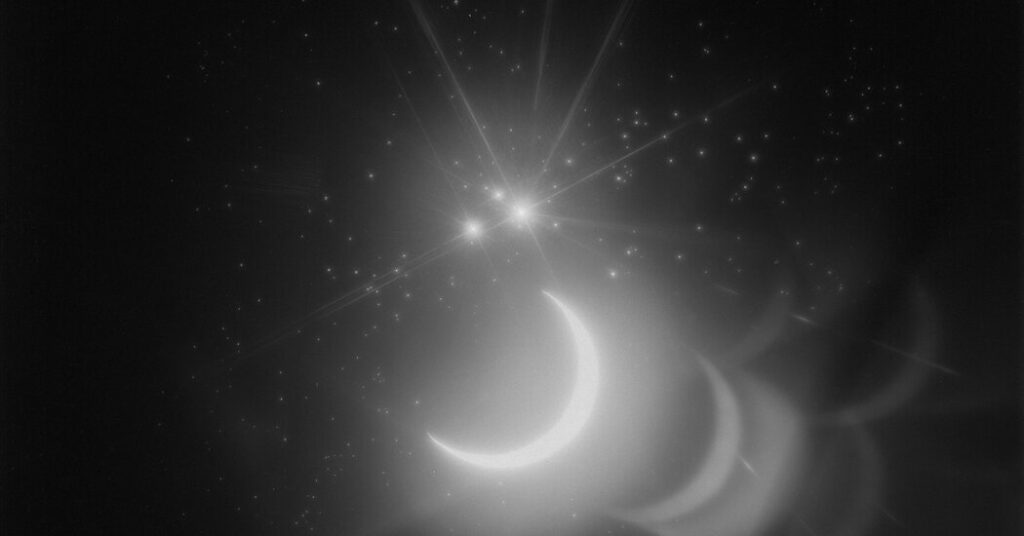
“Awe deficit disorder,” a term that’s bopped around the internet for at least a decade, does not have a formal medical diagnosis, but its symptoms are endemic. The desire for efficiency, for digital distraction, for staying inside has taken awe from our lives. It’s knocked us from time spent staring at the stars, from imagining, from confronting the grandness of the world.
Without awe we become stuck. The neuropsychologist Paul Pearsall got it right when he wrote that languishing and despair are symptomatic of being “awe deficient.”
Trying to describe awe is near impossible. Is it religious? Emotional? Neurological? Philosophical? Awe is not external so much as the dynamic experience of your mind rapidly apprehending something bigger than yourself and, say, whatever is flickering across your phone — the moment of having your understanding of the world transformed. Awe jolts us outside of our day-to-day perspective, permitting us to process new information, to adjust our mind-set, to see so much anew.
Spending just two minutes looking up from your phone screen to absorb the grandeur of a tree or the sky is enough to hit the reset button on your mind, says the psychologist Dacher Keltner. At such times, “I’m aware of things that are vaster than my little identity in time and space,” he said on a recent podcast. “I feel a little bit of vanishing of my ego.”
How many of us are constantly deceiving ourselves about our own importance, anxious about every decision? The animating force of this narrow thinking is the notion that we have total control of our fate, that if only we might do or say the right thing, we’ll achieve the life we want. And while so much technology promises the ability to better control everything from our relationships to our health and longevity, to experience awe is to see that this control is ultimately a ruse. One of our only true forms of power is in what we choose to pay attention to.
Ancient texts have long tried to correct our sense of self-importance and desire for control. In the Bible’s bleakest book, God asks Job dozens of rhetorical questions that establish his meagerness — and, by extension, that of all human beings. “Have you ever given orders to the morning,” God asks, “or shown the dawn its place?” God then speaks of animals and nature, the implication perhaps being that humans are so infinitesimally small, our place in the universe barely registers.
Awe is a dress rehearsal for our demise, a hair-raising brush with our insignificance that, if we choose to lean into it, can change us forever for the better. Through awe, we achieve what Dr. Keltner and his colleagues have called the “small self.”
Awe makes us feel more connected to others, and we thus act more selflessly and more ethically after we’ve experienced it. In one of Dr. Keltner’s studies, simply standing within a grove of tall trees — a moment of awe — made people more willing to help others.
The more we experience awe, the humbler we become (we are so inadequate compared with the cosmos), the less materialism seduces (there is so much more to life than what we own), the less we stress (we know that death and pain are part of the natural order) and the more satisfied we are with our lives (we no longer need to sweat the small stuff). Awe has even been shown to improve our physical health; one study indicates that awe reduces levels of a protein linked to depression and heart disease.
Awe exists anywhere you’re willing to look. And that is the key: You must look. Walk down the street and notice the effort it took to create the skyscraper in front of you, the airplane flying overhead. Watch the emotion on people’s faces as they pass you by — observe the joy or despair they might be experiencing, the depths of their interiority. Indeed, awe can be found in almost anything that you can’t entirely understand. You can be awed by the unexpected kindness of a stranger. You can be awed by music, of course. By the flow state and creativity that come from grappling with a big idea. By watching a father be good to his son. Or, as has struck me most lately, by the vastness of our own ability to love, to feel connected to another person, to discover that we have the capacity for feelings not previously tapped.
So where else can you get your lifesaving hit of awe, an experience that is truly “awesome,” not the cheapened version of the word that so often gets bandied around?
For one, from Wednesday night through Thursday’s predawn hours, I’ll be looking to the sky as the Perseid meteor shower rains brightly. Several weeks ago, I also traveled to a remote desert in western New Mexico to spend a night at “The Lightning Field,” Walter de Maria’s 1977 land artwork in a lightning-prone area, which is made up of 400 steel poles arranged in a one-kilometer-by-one-mile rectangle.
At “The Lightning Field,” visitors stay in a small cabin a few hundred yards from the art. We walked around the poles, through them, watched them from a distance, during the day and at sunset and in the desert cold as the sun rose.
More than the lightning, it is the vivid changes in the light across the landscape that, for me, were most awe-inspiring. The morning’s pink-and-blue light climbs over the surrounding hills and touches the poles’ tops, enlivening the artwork in a way the critic Kenneth Baker characterized as a metamorphosis “from solid objects into beams of dazzling light that pierce the air like tones.”
The defined boundaries of the artwork, in such an isolated area, make the vastness of nature understandable. The poles become a vector for beauty, a man-made container for natural awe. Taking in the light, it was hard to believe I was still on Earth; that what I was experiencing was a part of the same life as checking out of the grim airport hotel earlier that day — and that, somehow, I was seeing it all through the same eyes.
But that is precisely what awe is: an experience too vast or mind-blowing to immediately make sense of through our usual ways of comprehending the world. A Job-like surrender of control, of all we think we know. It’s pretty awesome.
Cody Delistraty is the author of “The Grief Cure: Looking for the End of Loss” and is working on a book about a group of Spiritualists.
The Times is committed to publishing a diversity of letters to the editor. We’d like to hear what you think about this or any of our articles. Here are some tips. And here’s our email: [email protected].
Follow the New York Times Opinion section on Facebook, Instagram, TikTok, Bluesky, WhatsApp and Threads.
The post Look Up. Tonight. appeared first on New York Times.