The safest way to catch a direct glimpse of the solar eclipse is to shield your eyes with specialist gear that meets recognized safety standards.
But not everyone has access to a pair of paper-framed eclipse glasses. Across Europe, a frenzy in the run-up to Wednesday’s celestial event has depleted stocks and prompted reports of price gouging.
If you find yourself without a pair of genuine lenses during the eclipse, do not look directly at the sun. The infrared light can cause lasting damage to the eye’s retinas. Nor should you be tempted to put on an ordinary pair of sunglasses, no matter how dark their tint. Their lenses offer no protection against harmful solar radiation.
Testing eclipse sunglasses
If you are lucky enough to stumble upon an old pair of eclipse glasses in a drawer, check the surface of the lenses. If you observe any scratches, it’s best not to use them. They can let in tiny amounts of light that can still do harm.
The internationally agreed, lab-tested safety standards are “ISO 12312-2” or “ISO 12312-2:2015.” Check the packaging and equipment for those codes, and to be safe, you can check the American Astronomical Society’s list of approved suppliers here.
Even accredited solar eclipse glasses can degrade over time. If you are unsure about an old pair, you could test them. Mike Lockwood, a professor of space environment physics at the University of Reading in England, suggests looking directly at an illuminated lightbulb while wearing them. If you can make out the filament, they’re probably too degraded to protect your eyes from the sun, he said.
If the clock is ticking and your options are looking scant, there are D.I.Y. methods that you can try instead.
Homemade pinhole projector
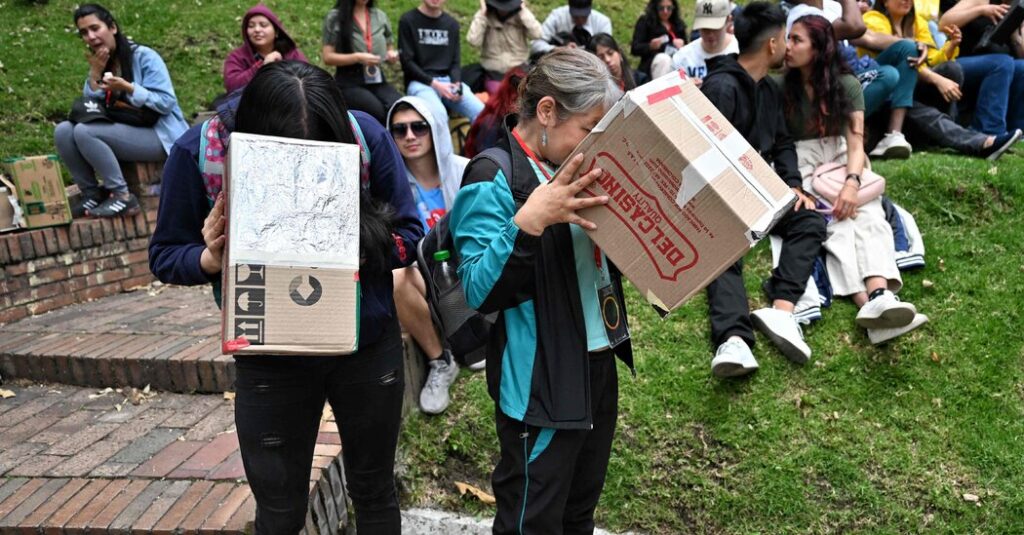
This one is a craft club classic. The most advanced version requires a piece of cardboard (the larger the better), a sheet of paper, some aluminum foil, tape and a pin.
First, cut a two- or three-inch hole in the cardboard sheet. Over that hole, tape a square of aluminum foil. Then delicately prick a hole in the foil with a pin or thumbtack, piercing the surface as gently as possible without advancing the pin the whole way through.
Facing away from the sun, hold the D.I.Y. projector above the surface you are using as a screen — a sheet of paper will work. Adjust the distance between the projector and the screen until the light comes into focus.
A simplified version of this method requires a pair of white index cards. Cut a tiny hole in the middle of one card using a thumbtack. Then, facing away from the sun, allow the light to stream through the pinhole.
Position the second card underneath to function as a screen, adjusting the distance between them until the projection comes into focus.
The colander method
If you’re lacking in craft skills, try any household objects with tiny holes. A colander, straw hat, or even perforated spoon will do.
Standing with your back toward the sun, hold the perforated object in front of the eclipse, allowing the sunlight to stream through the holes onto a surface. Each tiny circle of sunlight will be eclipsed.
Try looking around you, or beneath a tree
Some of the most beautiful visions of the eclipse will actually be in the unusual shadow forms cast by the everyday objects around us, said Professor Lockwood, who encourages viewers to observe their surroundings during the moment of eclipse.
“We tend to be obsessed by looking at the sun. But especially during partial eclipses, some of the best things you’ll see are when you look away from the sun,” he said. Any tree that casts a dappled shadow through its leaves will transform into a multiple pinhole camera, said Professor Lockwood, carpeting the ground beneath its canopy with hundreds of miniature crescents of light.
The beauty of the effect will depend on the height of the canopy and the gaps between the leaves. “Just let the tree do the work,” he said. “It’s absolutely beautiful.”
The post Here’s How to Make Sure Your Eclipse Glasses Are Good, and What to Try if They’re Not appeared first on New York Times.