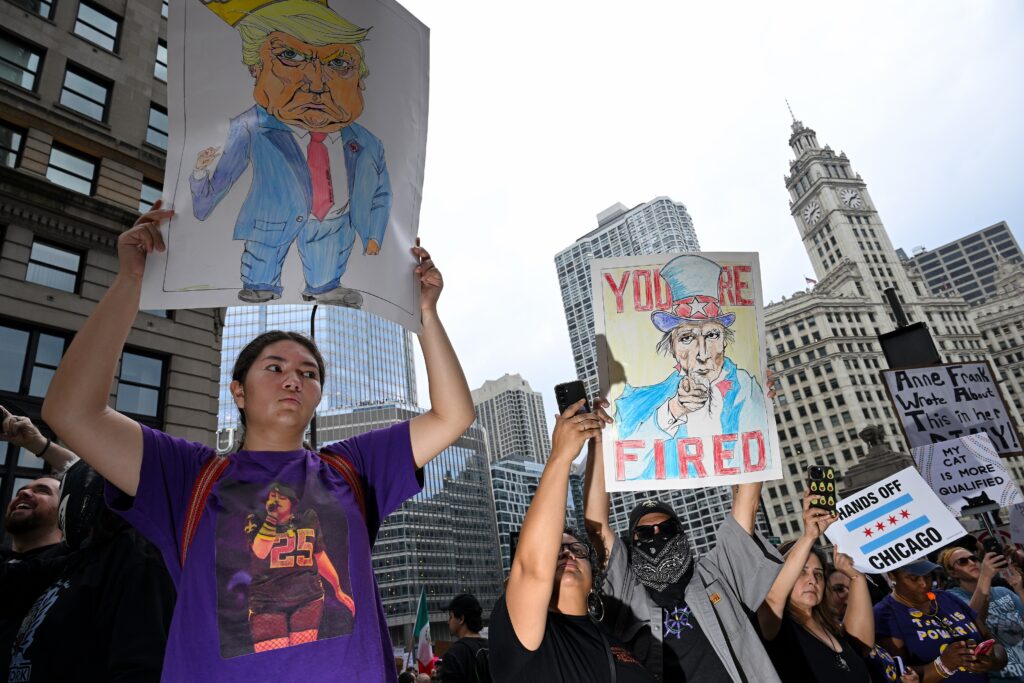
For almost 20 years, Americans have grown considerably more angry toward the federal government.
Gone are the days of the late 1990s and early 2000s when only about 1 in 10 Americans were angry with Washington. In that era, polling showed three times as many people described themselves as “basically content” with the federal government than those who were outright angry.
Now, after at least a decade of hyperpolarization in President Donald Trump’s era, Americans are registering record levels of anger toward the government seemingly based solely on the party affiliation of the occupant of the Oval Office.
“Frustration is common across the political spectrum regardless of which party holds the presidency. But the shares of Republicans and Democrats feeling anger and contentment shift dramatically depending on who’s in the White House,” wrote Shanay Gracia, a Pew Research Center analyst, in an updated study on voter attitudes.
“The partisan gaps in these views are wider now than at any point since we first asked this question in 1997. The share of Democrats who are angry toward the federal government has hit a new high,” Gracia wrote in the report released Thursday.
Democrats today are the most angry bloc of partisans in Pew’s history of research: 44 percent say they “feel anger toward the federal government.”
That’s considerably more anger than the research center’s previous high-water mark of rage, when roughly a third of Democrats told Pew they felt angry about the government during the spring and summer of 2020. That came as Trump led the response to the global pandemic and publicly clashed with civil rights activists.
The largest share of Republican anger, 38 percent, came in October 2013, almost a year after Barack Obama had been reelected and as congressional Republicans forced a federal government shutdown that ended with no concessions for their side.
This increased anger comes at a time of growing political violence across the United States, both at the highest levels (assassination attempts in 2024 against Trump) and on local levels (the assassination of a Minnesota state Democratic leader earlier this year).
There is often little evidence linking a criminal’s actions to the political words of the other party’s officials, but each side often immediately blames the other.
Just hours after the Nov. 26 shooting of two National Guard members in downtown Washington, Trump blamed the “act of evil” on how the Biden administration vetted refugees from Afghanistan, the native country of the shooting suspect.
Some Democrats responded by questioning Trump’s decision to bring the Guard into Washington in the first place, making them targets for mentally imbalanced peopleprone to violence.
A moment of silence on the House floor in September for the killing of Charlie Kirk devolved into a partisan dispute, with lawmakers shouting at one another about the request from a few conservatives to hold an actual prayer for the Christian conservative activist.
It’s impossible to determine a single root cause for the overall sense of anger and frustration with government, but there is a fairly obvious hinge point after which voter fury grew, about 20 years ago.
That’s when the Iraq War grew deadlier while the stated purpose of the invasion — to eliminate Saddam Hussein’s weapons of mass destruction — turned out to be false. The housing market had blown up by 2008, causing a financial collapse that left millions of homeowners underwater and, the following year, led to an unemployment rate of 10 percent.
Around that time, cable news began breaking away from its early focus on crime and trials and was instead becoming focused wall-to-wall on politics and government, fragmenting into ideological corners just as technology turned phones into instant echo chambers.
In October 2006, just before Democrats won the congressional majorities in a landslide rebuke of President George W. Bush, just 21 percent of voters told Pew researchers they were “content” with the federal government — the first time that statistic had fallen below 29 percent since they started asking the question in 1997.
From 2006 to this year, Pew researched this data point 15 times. And every time but one, fewer than a quarter of Americans felt content with the federal government. Nine of those results showed fewer than 20 percent felt contentment toward Washington.
(In April 2021, just as the coronavirus vaccines were being distributed to the general public, 29 percent of Americans felt at ease with their government.)
Americans were not always so dour, so frustrated and so outright enraged by their government, and it wasn’t that long ago when things were different.
In the late 1990s and early 2000s, large blocs of voters felt good about the federal government.
Sure, more Democrats felt better about the government in the final years of Bill Clinton’s presidency, and more Republicans felt better in the first years of George W. Bush’s presidency.
But in a span from 1997 through 2004, at least 20 percent of voters from the opposition party registered a feeling of contentment toward the federal government. The highest Democratic mark in Bush’s reign came in late 2001, after the terrorist attacks in New York and Washington, when 45 percent felt content with government.
In early 2000, as the economy boomed and the annual federal deficit briefly disappeared, almost 3 in 10 Republicans felt contented with Clinton’s stewardship of the federal government.
Another way to think about the recent past is how much Americans actually liked both parties’ presidential nominees.
An October 2000 poll by CNNfound that 59 percent of voters had favorable impressions of both Bush and then-Vice President Al Gore, just a couple of weeks before the closest election in more than 100 years ended up being decided by the Supreme Court.
That CNN poll showed that both nominees grew more likable as the campaign went on to the broader public.
Similarly, in 2004, Sen. John F. Kerry (D-Massachusetts) grew more likable to voters after completing three debates against Bush, according to Pew polling.
And on the eve of the 2008 elections, a majority of voters had a favorable view of both Sens. Obama and John McCain (R-Arizona): 63 percent of voters liked Obama, while 54 percent liked McCain, according to Washington Post-ABC News poll.
We now live in the era of what political scientists call “double haters,” in which a significant chunk of voters dislike both nominees and must choose between what they see as the lesser of two evils. Before the 2016 election,just 38 percent of voters held a favorable view of Trump while 42 percent liked Hillary Clinton.
The disdain for the other side’s voters came out in that election. Clinton suggested “half” of Trump supporters fit into a “basket of deplorables.”
“The racist, sexist, homophobic, xenophobic, Islamophobic — you name it. And unfortunately there are people like that,” she said at a fundraiser.
Trump’s insults of “Crooked Hillary” and characterizations of Mexicans as “rapists” fueled his grievance-driven campaign.
Not surprisingly, they were two of the three least-liked presidential nominees in Gallup’s 70-year history of studying favorability ratingsfor White House contenders.
Nowadays, as Pew’s research shows, the shirts-and-skins nature of the federal government will turn up one side or the other’s sense of anger toward Washington.
In March 2016, during Obama’s final year in office, 33 percent of Republicans felt angry toward the federal government and 9 percent felt contented by Washington.
In April 2020, during Trump’s final year of his first term, just 14 percent of Republicans felt angry toward the government and 31 felt contentment.
As angry as Democrats are now, in Trump’s second term, back in May 2024 they were relatively happy: 28 percent felt contentment and 10 percent angry.
This overall trend has left little trust in the government to do the right thing, an issue Pew has studied since 1958,back when 3 in 4 Americans trusted the federal government to do what is right “just about always” or “most of the time.”
Today, just 17 percent of Americans believe that.
“The current measure is one of the lowest in the nearly seven decades since the question was first asked,” Pew wrote Thursday in that report.
The post Anger is a defining character trait for both parties, new study shows appeared first on Washington Post.