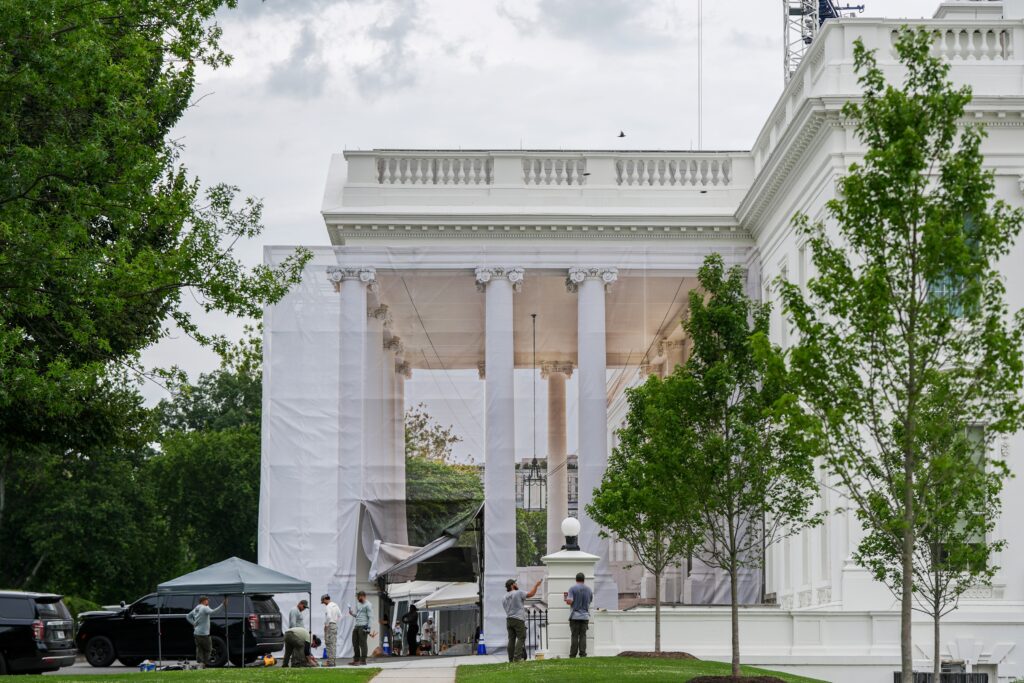
The Trump administration plans to spend at least $900 million for construction projects on the White House grounds, a significantly larger price tag than has been previously reported and one that would be covered primarily by taxpayers, according to records reviewed by The Washington Post.
Instead of securing money directly from Congress, the records show, the administration has pieced together funding from other agencies and private donors and directed it to a little-known account that typically holds a few million dollars for routine maintenance of the executive mansion.
Confidential contracts and related planning documents indicate that the administration plans to use money in that account for White House “modernization projects” — the administration’s term for President Donald Trump’s planned overhaul of the property, at the center of which is a gilded East Wing ballroom.
Together, the records reveal in the greatest detail yet how the Trump administration has sidestepped Congress and shielded visibility into what would become the most expensive overhaul of the White House in more than 80 years.
A federal appeals court struck a blow to Trump’s plans on Friday, ruling that the administration needed congressional approval to continue building the East Wing ballroom. Trump vowed to appeal the ruling, which applied only to the ballroom, setting up a Supreme Court battle over the limits of his authority to remake the White House.
“Congress has exclusive authority to regulate the construction and demolition of White House structures,” Judges Patricia A. Millett and Bradley N. Garcia wrote in the accompanying opinion.
In the past, administrations planning major changes to the White House grounds have done so by submitting budget requests to Congress, receiving appropriations, and directing agencies to seek approvals and hire contractors, according to historians and budget records.
The Trump administration has not disclosed the total cost of all planned White House construction or shared details about the sources or original intended purposes of most of the money it has assembled. Trump has repeatedly said that the East Wing ballroom project would be covered by private donations.
The Post previously reported that the projected cost of the East Wing construction alone was $600 million, with half coming from taxpayers. The confidential contracting documents include the costs of upgrades to nearby Lafayette Square, construction of a helipad, a new visitor screening center and other previously reported projects that would drive the total cost of work on the grounds to at least $927 million.
The contracts reviewed by The Post leave open the possibility that the work will not move forward as planned and that the money will not be spent. As of the end of June, administration officials had issued orders for over $100 million of work to be paid from the White House maintenance account, budget office records show.
The White House did not answer questions from The Post about the source of all the funding or the total cost of the planned work, but said the money is being spent in a “manner consistent with” Congress’s original intent.
“President Trump continues to implement long-overdue and necessary renovations to beautify the People’s House as we celebrate our great Nation’s 250th anniversary of independence,” White House spokesman Davis Ingle said in a statement. “Thanks to the Builder-in-Chief, the White House will be properly glorified and remain in excellent condition for generations to come.”
The contracts and money for the work are being routed through the Executive Residence, a White House office with fewer than 100 employees that maintains the president’s private home. The office is not subject to rules that require most federal agencies to disclose government records, rendering the contracts confidential.
The Executive Residence, which employs housekeepers, curators, calligraphers and carpenters, has not previously managed major construction efforts, experts said. In recent years, Congress has appropriated $2.5 million annually to its maintenance account, known as “White House Repair and Restoration.”
Since Trump took office, the administration has directed $875 million to that account, public budget records show.
“That is incredibly unusual,” said Cerin Lindgrensavage, counsel for Protect Democracy, an advocacy group that is suing the Trump administration for allegedly withholding public information about federal spending.
To assemble funding in that account, the White House budget office authorized a series of transfers from the U.S. Secret Service and the White House Military Office totaling $500 million, planning and budget documents indicate, while an additional $305 million came from private donations. The documents reviewed by The Post show another $70 million directed to that account but do not identify the source.
Most of the $415 million in Secret Service funding was directed to the account in June after Trump allies on Capitol Hill were unable to pass legislation that would have allocated $400 million toward the East Wing and the visitor screening facility.
That Secret Service funding was appropriated by Congress in part to recruit and train Secret Service agents, The Post previously reported, raising concerns from members of both parties on Capitol Hill that the administration was improperly using funds.
After his confirmation hearing in June, Hal Duncan, Trump’s pick to be deputy budget officer, wrote in response to questions from Sen. Gary Peters (D-Michigan) that using the money for White House construction was consistent with the Secret Service’s mission because the project “includes security enhancements related to the East Wing Modernization Project, to include structural hardening.”
Ingle, the White House spokesman, told The Post that the ballroom itself would be paid for by $400 million in private donations and that it was appropriate for the Secret Service and the White House Military Office to be involved in providing security infrastructure on the campus.
“Recent events such as the foiled attack on the historic UFC Freedom 250 event at the White House proves exactly why the East Wing Modernization Project is severely needed for large scale events, which include drone proof structures and drone ports among other critical security enhancements,” Ingle said.
A Secret Service spokesman referred questions to the White House.
The Constitution reserves for Congress the power to decide how tax dollars should be spent. The White House budget office is permitted to move funds from one account to another, for purposes that are consistent with the original appropriation, but experts said the extent to which the Trump administration has relied on such transfers is unusual.
“If the executive can do anything they want with appropriated funds, then the executive can do anything they want, period,” said Joe Carlile, who served as an associate director of the Office of Management and Budget during the Biden administration and now runs a firm that analyzes federal appropriations data.
In scope, Trump’s plans rival those of Franklin D. Roosevelt, who oversaw the completion of the East Wing in 1942. Trump’s vision dwarfs all White House construction projects since, according to Ed Lengel, former chief historian for the White House Historical Association.
Roosevelt’s successor, Harry S. Truman, carried out what Lengel said was the most extensive overhaul of the private residence of the White House, where the president and his family live. At Truman’s request, Congress approved around $80 million in today’s dollars to refurbish and bolster the structure, which had fallen into disrepair, and established a six-person commission to oversee the work.
To fund the most recent major White House construction project, in 2009 the Obama administration requested $376 million over multiple years for electrical upgrades and structural repairs to the East and West wings. Congress appropriated money over the next several years to fund the work, and it was largely managed by the General Services Administration, which typically oversees government real estate projects.
The federal lawsuit now headed to the Supreme Court alleges that the Trump administration illegally circumvented Congress when it demolished the East Wing in December. In response, government lawyers argued that the president is permitted by law to spend funds on “the care, maintenance, repair, alteration, refurnishing, improvement” of the executive mansion.
The D.C. Circuit court disagreed, upholding a lower court’s decision.
“Whether or not a massive ballroom should be constructed is for Congress to decide and is not a matter for Executive self-help,” the judges wrote.
Jake Spring and Riley Beggin contributed to this report.
The post Trump administration set to spend at least $900 million on White House construction appeared first on Washington Post.