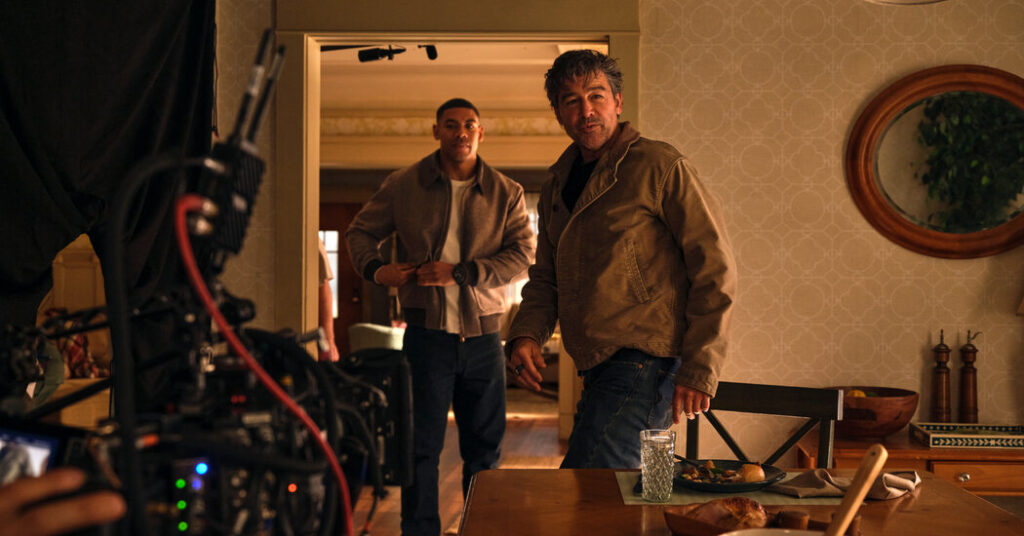
For many months, people eager for information about the new HBO series “Lanterns” had a single production still they could inspect. Many obsessed over the green ring peeking out from the actor Kyle Chandler’s middle finger. What hints might it hold?
“Somebody did a 20-minute YouTube video zooming in on this ring,” Jeffrey Johnson, the show’s property master, recalled last year on a Warner Bros. soundstage in Burbank, Calif. He slid the ring into the show’s meticulously crafted lantern. “The level of scrutiny,” he added, “is fascinating.”
Johnson knew the ring would be a “big thing.” And the people involved with this ambitious Green Lantern drama are hoping it will be, too. It is the next major undertaking from DC Studios, coming on the heels of James Gunn’s “Superman” movie, which won wide acclaim last summer, and Craig Gillespie’s “Supergirl,” which flopped this summer. Now the pressure is on the creators of “Lanterns,” which premieres on Sunday, to turn things back around.
“I think of Sunday Night HBO,” said the showrunner, Chris Mundy (“Ozark,” “True Detective: Night Country”), who created “Lanterns” with Damon Lindelof (“Lost,” “The Leftovers”) and the comic book writer Tom King. “Even just hearing that whole thing when the HBO sign comes on — it’s kind of a terrifying challenge because it needs to live up to that little crackle.”
What the art department tried to do with the ring — wrap a thing that “can unleash all this power” inside a relatively “pedestrian” package, as the production designer John Paino described it — is a reasonably good encapsulation of what the creators want to do with the show. That vision became clearer during two days on set in June 2025, when I spoke with about a dozen people involved with the production, and in conversations with cast and crew members since.
As the writers put it: Sure, it’s a series about intergalactic superheroes. But they wanted “Lanterns” to be firmly grounded on Earth — more “tactile” and “‘True Detective,’” Mundy said, than the usual comic-book adaptation, more “sweaty and grimy” than “glowing and green screen.”
It’s an approach that HBO has used to great success in adapting DC properties before — recently with the gritty, noir-inflected drama “The Penguin,” which won nine Emmys last year, many in creative arts categories like hair, prosthetics and costumes. Lindelof’s 2019 HBO adaptation of “Watchmen” was similarly rooted in DC Comics lore while taking place in a world that felt all too real. It, too, collected several Emmys, winning 11.
“Our central objective going into this was to take this canon that has all these sorts of spectacular things, and keeping the spectacular,” Mundy said later on a video call, “but also making sure that it’s relatable.”
THE HISTORIC WARNER BROS. LOT was the hub of “Lanterns.” On the afternoon I visited, more than 80 people were hard at work on the production. Between takes, crew members raced to thread cables through doorways, adjust lights in the kitchen and push cameras on massive dollies. The pleasant smell of freshly planted jasmine wafted through the air.
For all its superhero underpinnings, “Lanterns” is at base a buddy cop show — the buddies (or in this case, co-worker frenemies) just happen to be space cops, known as Green Lanterns (there are a bunch of them), with supernatural powers derived from the ring. (Yes, there is also an actual green lantern — effectively a fancy charging station for the ring.)
Set mostly along two timelines — one in 2016 and the other in 2026 — the series follows an older Lantern, Hal Jordan (played by Kyle Chandler), and a new Lantern recruit, John Stewart (Aaron Pierre), one of DC’s first Black superheroes when he was introduced in the early ’70s.
Each timeline turns on a central mystery, though Mundy argued that the relationship between Hal and John is what drives the show.
Hal is brash, arrogant and impulsive. “He knows everything, and he’s never wrong,” Chandler said during an interview inside one of the Burbank production offices. “And he has no problem telling people that he’s never wrong and that they’re always wrong. So it’s a fun character, because he gets to evolve from there.”
John is to some degree Hal’s opposite: dutiful, driven and poised. A former Marine sniper and an architect, John embodies two “seemingly juxtaposed things coexisting in one individual,” Pierre said.
When the series opens, Hal and John are investigating a murder in Rushville, Neb. The two men are supposed to work together. But they are very much in each other’s way.
King, the comic book writer and a co-creator of the series, credited Chandler and Pierre for embodying the “epitome” of who Hal and John are in the comics. (In a costuming trailer, a mood board for Hal included a picture of Anthony Bourdain. One for John included Mahershala Ali in “True Detective.”) Yet the writers also sought to stretch those characters to their limits, King said.
So many details seemed geared toward keeping “Lanterns,” a show in which characters fight aliens and can fly, as earthbound as possible. Hal’s suit, for instance, stood in the corner of the costuming trailer looking more battle tested than high-tech. “Sci-fi futuristic was something that we were trying to definitely dial back,” said Cynthia Ann Summers, the costume designer.
It took 20 tries before everyone settled on a design for the lantern, Johnson, the prop master, said. It lights up in four directions but is also weathered and worn.
“It’s been around for generations,” Johnson said. “It’s traveled.”
That lived-in quality infused the set designs as well. On Stage 19, designers had built the Stewart family home, whose patio ceiling was flecked with dirt and grime. A big carton of goldfish crackers sat atop the refrigerator. On the wall hung family pictures and on the windows floral curtains that had seen much better days.
The house was tidy — Mrs. Stewart, John’s mother, is “house-proud,” said the set director Amy Wells — but not too tidy. Mrs. Stewart has three boys.
“Would she have a white sofa?” Wells said of Mrs. Stewart. “Absolutely not.”
“The hardest thing to do for my job,” Wells added, “is to get it to be real.”
A FEW DAYS AFTER visiting Burbank, I drove 40 miles northwest to a flat, unincorporated town called Piru, where the production was filming scenes set in Rushville. When Piru was selected as a Nebraska stand-in, everyone knew the imposing mountains abutting the town would need to be removed in postproduction. Otherwise, the place felt perfect.
Rushville — in real life, a city of fewer than 1,000 people — is the domain in “Lanterns” of Sheriff Kerry (Kelly Macdonald). As Macdonald had said while stopping by a production office on the Warner Bros. lot, that means a total of three cops are all patrolling the very small town, and “they’re all sort of butting heads at various points.”
Sheriff Kerry “just wants them gone,” she said of Hal and John. “And the more she wants them gone, the more Hal Jordan knows that there’s something to stay for.”
For some months, Piru’s main street became downtown Rushville. (King’s father is from Rushville, and Mundy, the showrunner, is from Nebraska.) Knock on the brick facade of Sheriff Kerry’s Sheridan County Sheriff’s Office and you would have discovered it was hollow. But knock on the wall of Rush Valley Coffee a few steps away, and you would have hurt your hand. It is an actual business called Corazon de Piru that was being used to house the wardrobe department.
On the day I visited, cast and crew were filming a scene inside a diner they built, which hosts several important meetings during the series. The roadside place advertised itself with orange block letters spelling “CAFE.” As crew members prepared lights inside, food stylists out back put the finishing touches on half-eaten-blueberry pancakes.
Although it is part of the broader DC Universe, “Lanterns” is a free-standing story, Mundy said. It was also conceived as a multi-season show — Green Lanterns, after all, can get pulled into all kinds of jobs in all kinds of places.
“We’re trying to really put John Stewart on his feet inside our own show, but then, once he’s on his feet, he can walk around in the rest of the DC-verse,” Mundy said.
As the 2026 mystery unfolds, another Green Lantern, Guy Gardner, will make a cameo, offering a bit of connective tissue to the “Superman” movie. But “we had no directives,” Mundy added, to make it fit with some other show or movie.
That gave the creators a lot of freedom compared with some other franchises, where writers can be hemmed in by maddeningly byzantine lore. But with that freedom comes pressure, as with the outsize fan attention to that early image of the ring.
King hinted at a major plot twist and a break with canon, both of which could prove controversial. Lindelof acknowledged “a real fear of screwing it up,” emphasizing that “the thing that matters to me the most” was that fans could “feel how much we cared about Hal and John.”
But as Lindelof also noted, “Lanterns” is a show with two protagonists who are fixated on the idea that one can abolish fear. No one is going to want to watch a “scaredy cat” version of the show, he said; this story — their version of it at least — has to have risk embedded in it.
“If it doesn’t,” Lindelof added, “it’s going to fall on its face.”
The post Even With Space Cops and Magic Rings, ‘Lanterns’ Keeps It Real appeared first on New York Times.