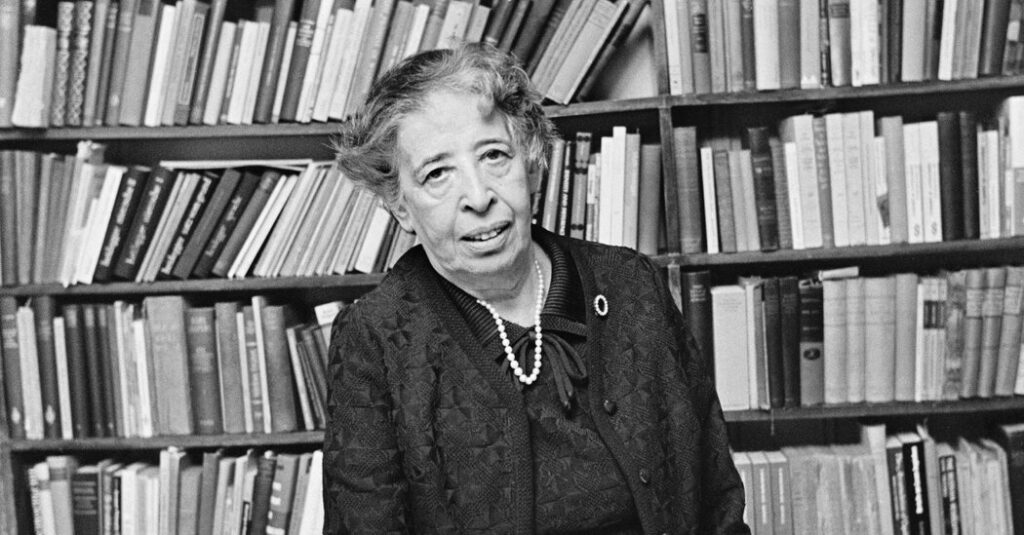
HANNAH ARENDT: A Life of the Mind, by Thomas Meyer; translated by Shelley Frisch
Biographers of towering intellectual figures stare down two formidable tasks at once. There is, of course, the research: all the reading and archival digging required to piece together the life of a person whose primary preoccupation was thinking. And then there is the writing of the biography itself. How do you shape this raw material into a lucid and memorable portrait?
In “Hannah Arendt: A Life of the Mind,” the German philosopher Thomas Meyer clearly did some heroic work in the archives. Arendt’s unusually eventful life has been chronicled extensively in the half century since her death, including in the major 1982 biography by her former student Elisabeth Young-Bruehl. Writing about her, while always plentiful, seems to have proliferated in the last decade, as Arendt’s work on power and authoritarianism became relevant again with a new, anxious audience.
Meyer explains what makes his book different. “The approach used in this present biography,” he says by way of introduction, “diverges from all earlier studies of Arendt by evaluating previously unknown archival material and other documents that have been overlooked, but that situate Arendt in her own era.”
A worthy project, as far as it goes. But Meyer’s dry description of it is an ominous foreshadowing of what’s in store. This biography is an uncanny mix of stiff and undisciplined; its unwieldy shape seems to derive from Meyer’s insistence on letting his archival discoveries dictate his narrative. Flooded by so much detail about overlooked episodes in Arendt’s life, Meyer’s book reads like a sprawling record of his diligent research. The fascinating and powerful thinker ostensibly at its center nearly gets lost.
Scholars who are already familiar with Arendt may well find Meyer’s granularity useful. He is nothing if not thorough. His first chapter opens with a prelude laying out her family’s history and the situation of Jews in Königsberg, Germany (where Arendt was raised), before finally, 25 pages later, announcing: “On Oct. 14, 1906, at 9:15 in the evening in Linden, after 22 hours of uncomplicated labor, Johanna Arendt was born, weighing in at 3,695 grams (8.14 pounds), as her mother noted two months later in a diary dedicated to her child.”
The sentence is typical. Seemingly every record, every scrap of paper, gets its own exegesis. A novella by Ann Birstein, which features a condescending character based on Arendt, receives two pages of minutely detailed plot summary. Elsewhere, Meyer makes the puzzling decision to quote nonessential texts in full, including an entire New York Times article about Arendt’s funeral.
At the same time, certain consequential life events get awkwardly short shrift, presumably because they have already been covered in previous books. Arendt’s arrest and detention by the Nazis in 1933, for instance, gets a single paragraph.
Meyer wants to focus instead on the phase in Arendt’s life that followed her detention: the years from 1933 to 1941 that she spent in France and that included her work for Youth Aliyah, helping rescue 120 Jewish teenagers from Europe by relocating them to Palestine. The fact that these efforts are another “overlooked” part of her life means that Meyer keeps turning back to them, asking why they “went unmentioned by her or by others” after the end of the war. He states that Arendt’s commitment to Youth Aliyah reflected a “staunch Zionist’s battle for the survival of her people,” and therefore “Arendt’s work requires a reassessment from this perspective.”
Does it? After moving to the United States, Arendt wrote and spoke openly about her complicated relationship to Zionism. She worked for Zionist organizations when they offered some of the only chances for her to help save people’s lives; as she later put it in an interview, “If one is attacked as a Jew, one must defend oneself as a Jew.” This is known. She later became critical of Zionism when she believed the movement betrayed its emancipatory ideals. This is known, too. (A forthcoming book by Roger Berkowitz, “A World We Share,” explores Arendt’s friendships, including her disagreements with Zionist friends like Gershom Scholem.) The information offered in Meyer’s book certainly supplies more detail, but for the nonspecialist reader of Arendt, it hardly calls for a “reassessment.”
Meyer’s archival sleuthing does turn up some interesting nuggets, including the story behind the extraordinarily hostile appraisal of Arendt’s “Eichmann in Jerusalem” (1963) that ran in The Times Book Review. The reviewer, a judge at one of the Nuremberg trials named Michael Musmanno, had been a witness for the prosecution in Jerusalem — a glaring conflict of interest that even the assigning editor seemed aware of. Meyer also offers some incisive commentary about Arendt’s attraction to literature and poetry, which could “anticipate future historical events” by capturing “the whole spectrum of human action.”
But any glimmers of insight are mostly swallowed up by the rest of the book, with its ungainliness and endless longueurs. Those looking to read a recent biography of Arendt may want to try “We Are Free to Change the World,” by Lyndsey Stonebridge, published in 2024. Stonebridge doesn’t uncover new archival material about Arendt, but she reinterprets and redescribes what we assumed we knew. The book is vibrant and original, embodying Arendt’s approach to thinking as an imaginative act. As Stonebridge says of her subject: “Her trick is to make us look again carefully at what is already there.”
HANNAH ARENDT: A Life of the Mind | By Thomas Meyer | Translated by Shelley Frisch | Penguin Press | 539 pp. | $35
The post A Dense Life of Hannah Arendt Doesn’t Justify Its Prodigious Research appeared first on New York Times.