The AI boom is putting a new kind of pressure on American universities.
The topic of AI has long been a point of contention within higher education from educators, students, and university administrations discussing the presence and use cases of the technology. But now it’s turned to a much more physical threat.
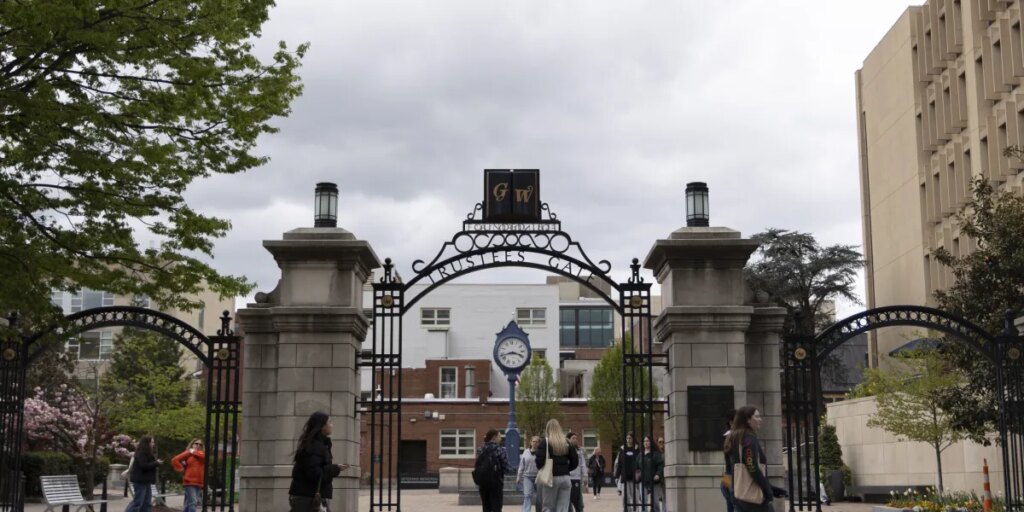
As data centers compete for large parcels with access to electricity, water, and fiber infrastructure, universities are finding themselves sitting on property that can be worth more as AI infrastructure—not classrooms, laboratories or research space. The George Washington University’s sale of its Virginia campus to Amazon, for example, illustrates the encroachment of AI onto higher education’s doorstep. The University of Michigan, meanwhile, is pursuing a $1.25 billion high-performance computing and research center in Ypsilanti Township.
One former GW professor who worked at the university’s Virginia Science and Technology Campus said the sale was symptomatic of a broader shift in higher ed, where financial pressures are colliding with the enormous appetite for data center real estate.
“Universities are large landholders, and there is a land grab going on with the data centers these days,” former professor Ellen Scully-Russ told Fortune.
GW’s $427 million campus sale
In February, GW announced it had sold its roughly 120-acre Virginia Science and Technology Campus in Ashburn, Va. The university initially declined to identify the buyer or disclose the sale price, citing confidentiality provisions.
“It just came as a sudden announcement one day that they had sold the property, and that they couldn’t disclose the buyer because there was some kind of a confidentiality agreement,” Scully-Russ explained. “But of course, a student newspaper did their due diligence, and by the end of the day, they knew who it was, and they knew the price, and they communicated that to the community.”
The buyer was later identified as Amazon Data Services, which paid $427 million for the property. The campus sits in Loudoun County, at the center of Northern Virginia’s so-called “Data Center Alley,” one of the world’s largest concentrations of data centers.
GW said the sale was intended to strengthen its long-term financial position. Under the agreement, the university can continue using the property for up to five years while it determines how to move the programs and offices located there. The university also said a significant portion of the proceeds would be placed into a new endowment, while eligible faculty and staff would receive one-time bonus payments of $2,500 for benefits-eligible full-time faculty and part-time faculty receiving $1,250.
For Scully-Russ, however, the sale represented the end of a campus that had struggled for years to find a sustainable role within GW. The professor joined GW in 2009 to teach and lead a program at the Ashburn campus and said the facilities were newer and, in some respects, better equipped than those at GW’s Washington DC campus. But the university never fully figured out how to make the Ashburn campus a central part of its strategy, the professor told Fortune.
“It never really got any legs, in my opinion,” she said.
The campus had also experienced a gradual erosion of resources. The former professor described the process as “drip, drip, drip,” over five or six years, with faculty lost through attrition and not being replaced.Meanwhile, teaching assistants were eventually eliminated due to budget constraints. She even said faculty and students were not told in advance the university was considering selling the property.
“There was no transparency,” she told Fortune. “The faculty, the student body, as far as I know, were not even aware that there was a discussion about selling to anybody, let alone to Amazon.”
The George Washington University did not immediately respond to a request for comment.
The university ultimately held town halls after the sale was announced to discuss how programs, faculty, and staff would transition from the campus. But for Scully-Russ, that consultation came too late.
“It’s kind of like, do you really care?” she said. “Did you care what I thought before you made this decision? Did you care to let me know that this was in the works?”
GW’s financial circumstances made the decision easier to understand, Scully-Russ said. The university has faced pressure from declining federal research funding, changes affecting international students, and broader financial challenges facing higher education. GW itself has said the sale is part of a strategy to strengthen its finances and invest in its academic mission.
But the professor also says the transaction raises a more fundamental question about what universities should be doing with their land at a moment when AI infrastructure is booming.
“We’re chipping away at our higher ed resources to make room for this technology to expand without any accountability,” she told Fortune, “or any other kind of thoughtful progression, which is really a concern for me.”
In regards to the long-term impact of higher ed and its investment into data centers, Scully-Russ had little faith in the outlook.
“I think it’s just a short-term bubble,” she said. “We’re just one technological leap away from having those huge ugly buildings being obsolete. Then what happens?”
Michigan is taking a different route
The University of Michigan’s project in Ypsilanti Township is another way universities are participating in the AI infrastructure craze. UMichigan and Los Alamos National Laboratory are planning a $1.25 billion research computing center designed to handle enormous computational workloads. The university says the facility will support research ranging from medicine and materials science to clean energy, engineering, and national security.
For its part, the administration denies the term “data center” on its site, preferring “computing center.” This has not come without opposition from locals in Ypsilanti. The university outlines the use of the center for “applying AI and high-performance computing.”
The university has been acquiring land for this project. In 2024, U of M’s Board of Regents approved purchases of 19.82 acres and 6.03 acres in Ypsilanti Township specifically to support a future computing center. In 2025, the university also received authorization to purchase roughly 124.7 acres on Textile Road for the future facility.
While it has acquired acres of land, the university is careful to distinguish the project from a commercial data center. The administration calls it a “specialized research hub” rather than a commercial facility, saying it will be dedicated to high-performance computing for scientific research.
That means essentially, the computational power output of the center will not be used for “cloud computing, streaming, e-commerce and other consumer or business applications,” and will instead focus on scientific research. That research comes at a cost, however, starting at about 50 megawatts and eventually reaching 100 megawatts according to the university report.
However, the Ypsilanti Township Board of Trustees unanimously passed a resolution opposing the proposed computational research facility, “declaring strong and unequivocal opposition.”
The University of Michigan did not immediately respond to Fortune’s request for comment.
The post Universities are buying and selling property for data centers, prompting concerns about an AI brain drain appeared first on Fortune.