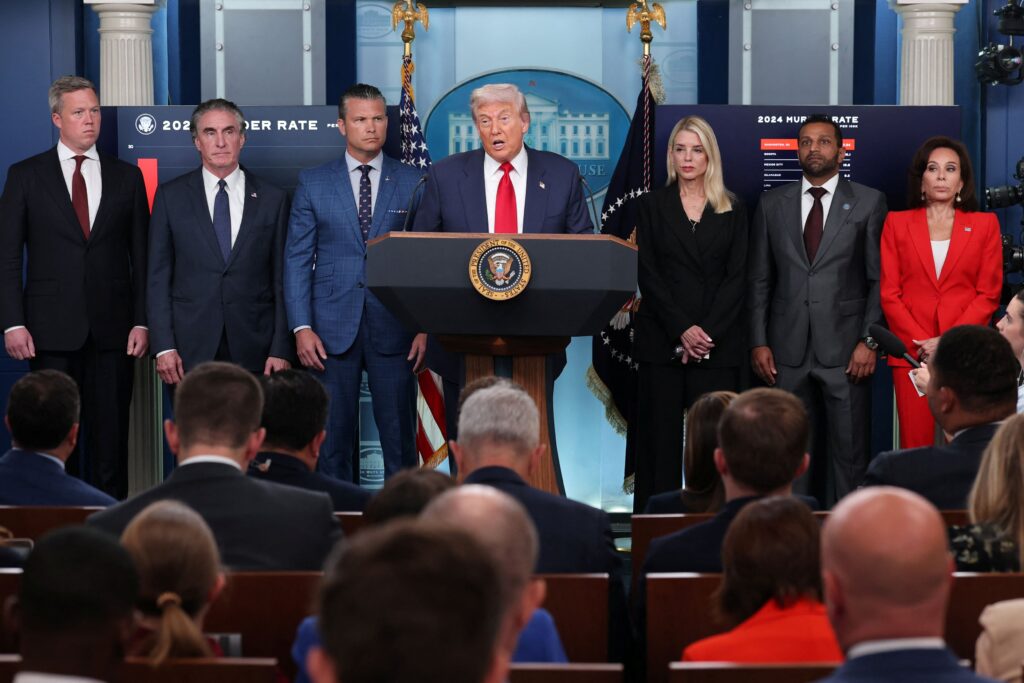
In recent weeks, President Donald Trump has asserted on social media and at news conferences that his administration has “stopped crime in Washington.”
On July 10, he posted on Truth Social: “Washington D.C. went from High Crime to NO CRIME — Thank you President Trump!”
On Aug. 3, the president told reporters in the Oval Office that crime in D.C. had dropped by 92 percent, “maybe more.”
“This was the crime capital, frankly, of the world,” he said. “It was the most unsafe capital of any country in the world. Now, it’s one of the safest, and it’s one of the safest places in the United States.”
To better understand Trump’s impact, The Washington Post analyzed thousands of records of arrests that have occurred in the city since Aug. 11, 2025, when the president declared a crime emergency and signed the “D.C. Safe and Beautiful” executive order, which deployed a “task force” of federal law enforcement agents to partner with local police and brought out-of-state National Guard members to the city.
The analysis and interviews with crime data experts show that the president’s remarks oversimplify and overstate the impact of the federal intervention.
The Post’s analysis scrutinized more than 16,000 arrest reports, sifting for keywords that either directly referenced or hinted at federal partnerships to identify and quantify task force activity.
Roughly 3 out of 10 arrest reports analyzed by The Post mention federal partners over the last year.
Trump and White House officials have referenced an 88 or 92 percent drop in crime in the District. When pressed to explain the numbers, White House officials identified decreases in rates of arson, of which there was one this year compared with four last year, according to D.C. police statistics. White House officials also pointed to a double-digit percentage drop in the homicide rate, which mirrors similar decreases across the country.
In the face of Trump’s claims, critics have noted the slight uptick in overall violent crime, about 3 percent year over year, driven largely by a 41 percent increase in incidents of assault with a dangerous weapon — a category that was at the center of a crime misclassification scandal, rendering year-over-year comparisons fraught.
Crime policy experts also have pointed out that many categories of crime were dropping in Washington well before the president took office.
Even when narrowing the scope on the 30-day crime emergency that saturated the District with National Guard members and federal law enforcement, it would be difficult, they said, to untangle the effect of that surge on top of trends that were already underway in D.C. and elsewhere.
“If you want to argue that there was an additional decline on top of that due to all these interventions, you could plausibly make that argument,” said Jeff Asher, a crime data analyst, pointing out that rates of violent crime have been falling across the country since a peak in 2023. “But you can’t make the argument that the intervention caused that decline or even was a major factor in those trends turning over.”
The factors driving increases and decreases in gun violence, Asher added, are so complex that researchers are still struggling to understand why rates of violent crime dropped in the 1990s.
“This is what happens with crime data,” he said. “It’s the ultimate ‘Failure is an orphan, success has many fathers’ issue.”
The federal footprint
The president’s emergency declaration a year ago resulted in three separate tracks for an increased law enforcement presence in Washington: a wave of National Guard troops patrolling the streets, ramped-up immigration enforcement and a surge of federal law enforcement agents partnering with local police.
National Guard troops don’t have law enforcement powers, and the impact of their presence on deterring crime is difficult to parse. Similarly, many immigration detainments and arrests happen in ways that are hard to scrutinize.
Zeroing in on the federal partnership with the D.C. police department, The Post analyzed court documents spanning August 2025 through this month.
Of the roughly 30 percent of the arrests that mention federal partners, at least half occurred in Wards 6, 7 and 8.
Nearly a quarter were for violent offenses, 13 percent involved weapons, 14 percent involved drugs, 21 percent were property crimes, and 18 percent were traffic-related, according to the analysis.
Of the arrest reports examined, about 16 percent explicitly referenced the “Safe and Beautiful” executive order or task force. The order was meant to last only 30 days, but the joint patrols pairing police and federal agents have continued.
Donald J. Mihalek, a retired senior U.S. Secret Service agent and the executive vice president of the Federal Law Enforcement Officers Foundation, said The Post’s analysis shows that federal officers have exercised restraint in patrolling Washington.
“Early on, it was being painted as this aggressive, disruptive, cowboy atmosphere, but those numbers dispute that,” Mihalek said. “It shows that federal officers are fighting crime in a lawful and smart way, and being judicious about the arrests they make.”
It’s unclear to what extent federal agents were involved in D.C. police arrests before Trump’s executive order. A D.C. police spokesperson declined to comment on whether 30 percent of arrests happening in conjunction with federal partners would be an increase on top of the status quo, saying the department does not track federal involvement in department arrests.
But The Post analyzed about 1,300 additional arrest reports from the two months before the executive order and found that federal agents were referenced in roughly 11 percent of them.
The vast majority of the 16,000 arrest reports do not mention the race of the defendant, but of the 3,191 that do, some 90 percent of those arrested were Black. That reflects a continuation of trends first reported by The Post shortly after the surge began.
Some D.C. officials continue to push back on the administration’s influx of federal agents and their continued presence.
D.C. Council member Brooke Pinto (D-Ward 2), chairwoman of the council’s public safety committee, said in a recent statement: “We unfortunately continue to experience an alarming and obstructive surge in federal law enforcement officers conducting patrols in DC — and it must end.”
Mayor Muriel E. Bower (D) recently released a statement about Trump’s “unprecedented federal intervention” that “brought national attention to DC’s lack of statehood and autonomy.”
“At the time, we were in the midst of driving down crime to a 30-year low following a post-COVID crime spike,” Bowser said in the statement. “Since then, we’ve continued that progress.”
The ripple effect
Looking at the past year, U.S. Attorney Jeanine Pirro announced in a statement Monday that prosecutions in D.C. Superior Court have increased 67 percent.
Pirro attributed that in part to prosecutors moving forward with charges at a higher rate than previous administrations and said the work has restored “a sense of safety in neighborhoods across the District.”
Doug Buchanan, a spokesman for D.C. Superior Court, said in a statement that the influx of criminal cases has brought the underfunded court system to its breaking point.
“The truth of the matter is that federal prosecutors are moving forward with more cases rather than declining them, pushing more workload into an already overloaded system,” Buchanan said in a statement. “Every filing requires personnel: courtroom staff, case processors, interpreters, court reporters, juvenile probation officers, IT specialists, and security officers. Without these roles, cases simply cannot be heard.”
Defense attorneys and others have described having their time in the courtroom stretch past 11 p.m., prompting arraignment court in June to start earlier in the day at 11 a.m., instead of 1:30 p.m.
Charles Murdter, a retired attorney who stands in for clients’ initial appearances in arraignment court, said that in the past the U.S. attorney’s office had operated with more scrutiny in screening cases to decide which arrests warranted prosecution.
“For the past year, they are exercising less discretion,” he said.
The clog in the system also hurts victims of crime, said Misty C. Thomas Zaleski, executive director of the Council for Court Excellence, a nonprofit that advocates for a more just local legal system. Victims are “waiting longer periods of time to know what justice is going to look like in their matter,” she said.
The increase in arrests, prosecutions and case loads is a threat to curbing crime and keeping residents safe, Zaleski added.
“Public safety isn’t promised with just an arrest. Public safety depends on the full continuum of law enforcement, prosecutors, defense, court staff and judges, corrections, [and] treatment providers all working together and having capacity to do their job,” she said. “That is what keeps our community safe — our prevention, accountability and reentry all working together. And right now, there’s been such a myopic focus on only one piece of that puzzle.”
Yvonne Edwards still has not finished cleaning out the apartment where her daughter, Rayven Edwards, lived in Glover Park and was killed by an ex-boyfriend in February.
She started therapy a month ago, she said, and a recent session helped her recognize the extent of the loss’s impact, not only emotionally but physiologically, as well.
“I didn’t even realize that I was walking around holding my breath,” Edwards, 55, said Monday in an interview with The Post.
In the six months since Rayven was fatally shot, Edwards said she’s seen and heard stories of others who have been killed by gun violence despite Trump’s repeated claims that crime is nonexistent in Washington. Last month, Edwards said her daughter’s childhood friend lost the father of her child when he was killed by a stray bullet in broad daylight not far from the Walter E. Washington Convention Center where National Guard troops regularly patrol.
Since Trump took to the podium to announce the federal law enforcement surge and declare a crime emergency in the city, there have been 97 homicides in the District, D.C. police data shows.
Who gets the credit?
Crime data experts have questioned Trump’s messaging on what has driven the decrease in D.C. crime.
Thomas Abt, a gun violence expert and director of the University of Maryland’s Violence Reduction Center, said the federal intervention is too recent to have produced any peer-reviewed studies, but three working papers attempting to quantify it are “various shades of skeptical.”
The first problem, he said, is that crime was already falling in most cities where those interventions took place, including in Memphis, where Abt’s Violence Reduction Center works closely with city officials.
“The second major problem is that crime continued to fall all around the country and in a very substantial amount,” Abt said.
Thaddeus Johnson, an assistant professor at the Andrew Young School of Policy Studies at Georgia State University who studies crime statistics, said he built a predictive model that measured the decline of crime trends in D.C. and attempted to gauge the federal intervention’s impact on that downward slope.
Johnson said his analysis revealed that the surge of law enforcement and National Guard troops pushed property crimes and auto thefts below the expected benchmark.
But violent crime was “more mixed,” Johnson found.
“Homicide was notably below expected during and after the surge, although we’re more cautious with that finding because the numbers are relatively small,” he said. “Robbery and broader community violence also moved lower, while assault with a dangerous weapon did not show the same clear citywide pattern.”
Johnson added that while the surge may have been temporarily effective, he questioned whether the deterrent effect of an increased law enforcement presence would be a long-term solution to combating gun violence.
“One would be hard-pressed to say that it didn’t play a role,” he said, “but you would also be hard-pressed to say it was the only or primary reason why we’ve seen reductions.”
Steve Thompson contributed to this report.
The post A year after D.C. takeover, Trump says crime has plummeted. It’s not that simple. appeared first on Washington Post.