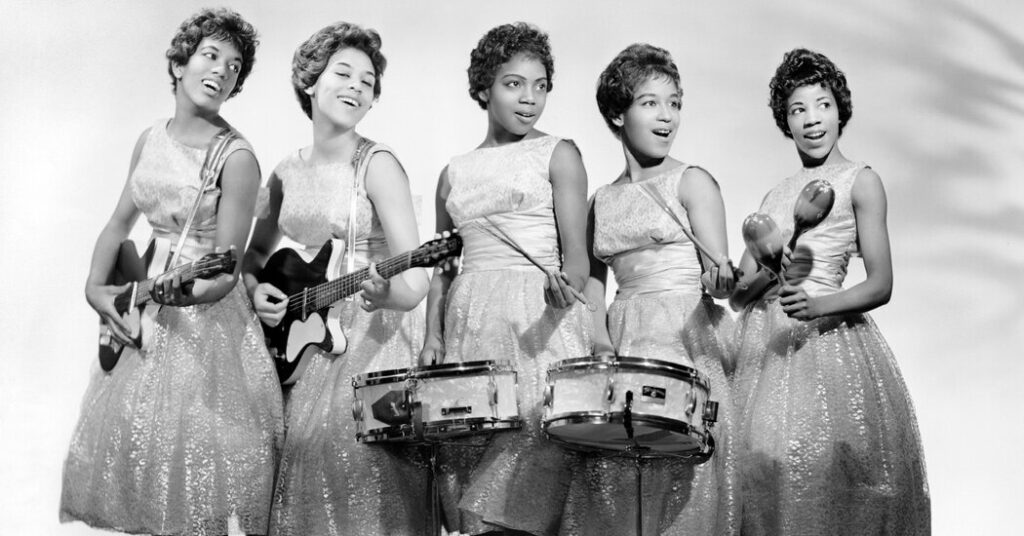
Arlene Smith, the lead singer and songwriter of the Chantels, a quintet that in the late 1950s helped start the “girl group” wave with a ballad, “Maybe,” that became one of doo-wop’s most enduring hits, died on July 29 in the Bronx. She was 84.
Her death, in a hospital, was caused by a heart attack, Paul Errante, her manager and friend, said.
The Chantels — Ms. Smith, Sonia Goring, Lois Harris, Renée Minus and Jackie Landry — were in their midteens when they convened in a Manhattan church basement in October 1957 to record “Maybe.”
The song is a stately eruption of romantic loss and hunger that showcased the group’s soaring harmonies and Ms. Smith’s raw, pleading lead vocals. It was written by Ms. Smith — although she was initially denied credit by her label. (The label owner took credit, as was common practice at the time, to keep the songwriting royalties.)
Released in December, “Maybe” shot to No. 15 on the Billboard Hot 100 chart and to No. 2 on the R&B chart.
Even that strong performance was exceeded by the song’s influence. In a 2016 interview with The Wall Street Journal, Ronnie Spector of the Ronettes — which scored its own girl-group classic with “Be My Baby” in 1963 — recalled hearing “Maybe” for the first time on her grandmother’s Philco radio as a teenager.
“The power of her voice was electrifying,” Ms. Spector said, adding: “There was so much vulnerability and yearning there. It was heartfelt and pure girl power. Arlene on that song was inspiring. I wanted to record a record like that.”
At that point, doo-wop — born of city street corners — was dominated by male acts like the Penguins (“Earth Angel”), Frankie Lymon and the Teenagers (“Why Do Fools Fall in Love”) and the Del-Vikings (“Come Go With Me”).
Despite the fact that a few pioneering Black female groups like the Teen Queens (“Eddie My Love”) and the Bobbettes (“Mr. Lee”) had hits before the Chantels, the record industry “didn’t know what to do with us,” Ms. Smith later said in an interview with the site ClassicBands.com.
Their gender was one challenge. Race was another. For their 1958 debut album, their label, End Records, replaced the original cover — featuring the group in matching starched pink dresses and white gloves — with an image of two sock-hop-worthy white teenagers huddling over a jukebox.
“Things were going on in the country,” Ms. Smith said in a 1995 interview with The New York Times. “There was a lot to transcend.”
Even so, the fuse was lit. As Rolling Stone observed in 2003, “Maybe” was a “towering doo-wop song” that “became a template for a generation of girl groups” in the early 1960s. That wave included the Shirelles (“Will You Still Love Me Tomorrow”), the Chiffons (“He’s So Fine”) and the Shangri-Las (“Leader of the Pack”).
“The Chantels forced listeners to reconsider doo-wop as something more than a man’s domain,” the music critic and NPR contributor Tim Riley wrote in his book “Fever: How Rock ’n’ Roll Transformed Gender in America” (2004). “And the reality of a girl group holding forth on guys’ turf laid out cultural possibilities in an entirely new way.”
Arlene Smith was born on Oct. 5, 1941, in the Bronx, the elder of two children of Ray and Iola Smith.
Arlene took classical voice lessons from an early age, and became friends with the other future members of the Chantels in the first grade at St. Anthony of Padua School. By their early teens, they were honing their harmony skills performing Gregorian chant and Latin hymns in church and singing in the school choir.
Before long, the girls had started a group and were appearing at talent shows and parties.
According to the 1995 Times article, they got their break when they performed a few songs for Richard Barrett, the tenor lead of the doo-wop group the Valentines, after approaching him for an autograph after a concert.
Mr. Barrett met with the girls’ mothers, who agreed to let him manage the group, which adapted its name from a rival of St. Anthony of Padua, St. Frances de Chantal School.
Ms. Smith quickly proved herself a prodigy as a songwriter. With Mr. Barrett’s help, she came up with “He’s Gone,” the Chantels’ first single, which was released in August 1957 and made it to No. 71 on the Billboard pop chart.
After vaulting to fame with “Maybe,” the group scored two minor hits in 1958: “Every Night (I Pray),” which made it to No. 40, and “I Love You So,” to No. 42. During their brief peak, the Chantels played the Apollo Theater in Harlem, appeared on “American Bandstand” and toured the country by bus, performing on the same bills as Chuck Berry, LaVern Baker and many others.
They faced death threats while touring the Deep South, where “they wouldn’t let us use the dressing rooms,” Jackie Landry, now with the married name Jackson, told The Times in 1995. “We dressed in the cashier’s booth with a sheet over the door.”
Ms. Smith left the Chantels in 1959 to pursue a solo career. In 1961, she released the single “Love, Love, Love,” under the guidance of the storied producer Phil Spector, the architect of the girl-group sound with the Ronettes, the Crystals and others. After the song failed to chart, Ms. Smith enrolled for a time at Juilliard, where she studied music theory and composition.
She eventually earned a master’s degree in education and worked as a schoolteacher in the Bronx.
She continued to perform, touring with a new version of the Chantels from 1971 to 2012. The original Chantels reunited multiple times in the 1990s, including in 1999 at a star-studded “Doo Wop 50” concert televised by PBS.
She is survived by her brother, Ray Smith.
Her vocals on “Maybe” had a plaintive quality that may have had something to do with the 50 or so takes the group needed to get it right. But in a 2015 video interview, Ms. Smith said she was happy to attack the song time after time.
“I had to give 150 percent,” she said, adding, “I wanted to make sure what I was feeling was being communicated, even through a car radio.”
The post Arlene Smith, Whose Song ‘Maybe’ Helped Define Doo-Wop, Dies at 84 appeared first on New York Times.