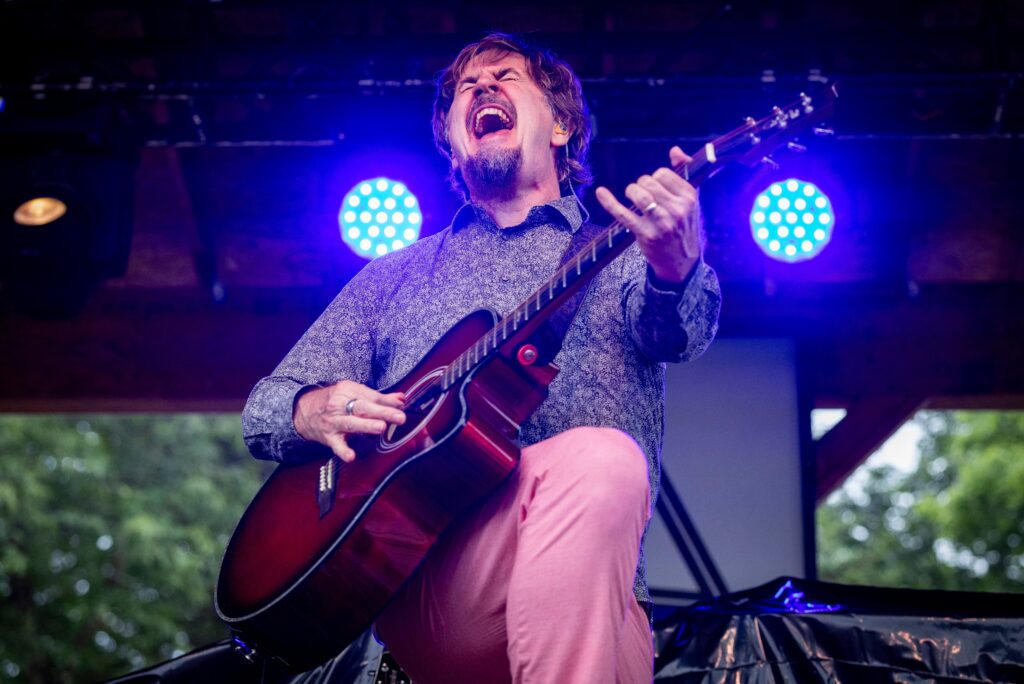
I can’t remember the first time I encountered the great indie rock band the Mountain Goats, perhaps because to know them at all feels like having known them forever. Even on a first listen, their music has the redolence of a childhood memory, more like something forgotten and remembered than like something wholly new.
I say “their,” but perhaps I shouldn’t. Though many musicians have cycled through the band since its inception in 1991, a single Goat is the constant at the heart of the operation: the 58-year-old novelist, general eccentric and once-in-a-generation songwriter John Darnielle. As he explains in his new book, “This Year,” he adopted the name the Mountain Goats in an attempt to signal to listeners that he was not always speaking in his own voice. The gesture is understandable: Darnielle has a habit of releasing songs narrated by fictional characters, several of them murderous. Then again, as he confesses in “This Year,” “the most personal songs aren’t the ones that recount actual moments from an extant past.” Often, the least obviously autobiographical pieces of art are in fact the most intimate.
“This Year” may help devotees of the Mountain Goats decipher some of these mysteries. It is a compendium of three decades’ worth of strange, startling, funny and often beautiful lyrics, each set accompanied by some sort of note or riff or explanation, each corresponding to a day of the year — though not necessarily the day on which it was written, recorded or performed. The entries are broadly chronological, beginning with early songs from the 1990s that have what Darnielle describes as the “hallmarks of having wanted to be a poem” and culminating in several compositions from 2023 that are perfectly comfortable with their status as songs — and wonderful ones at that.
As Darnielle explains, most of the works transcribed in the book “were first released on records, or tapes, or compact discs, but some of what you’ll find here has only ever been played live; a few songs in what follows have never been seen or heard by anyone but me until now.” Reading the lyrics to these new songs is as thrilling as learning a secret; confronting the lyrics of the older ones, many of which I have never before seen in print, is like meeting a dear friend in an unexpected place.
It may sound as though “This Year” is of interest only to Mountain Goats obsessives — as I am firmly convinced anyone discriminating ought to be — but Darnielle is good company for everyone. He is charmingly digressive, and his frame of reference is dizzyingly wide, ranging from video games to professional wrestling to Italian filmmaker Pier Paolo Pasolini to German playwright Bertolt Brecht. Personal details emerge piecemeal, in no particular order, always in connection with the music with which they are entangled. One song, Darnielle tells us, is about “the Tasmanian tiger, the dodo, and the golden toad,” three species that humans have tragically obliterated; another is about the time he “woke up handcuffed to a hospital bed” after an overdose.
By and large, Darnielle is not a confessional songwriter, but there are several notable exceptions to this general rule. Most famously and movingly, the 2005 album “The Sunset Tree” recounts the abuse he endured as a child at the hands of his alcoholic stepfather. The album’s third track, which gives this book its title, is perhaps his best-known and most immediately legible song. “This Year” is narrated by someone who is “seventeen years young,” raw and addled and agonized, playing “video games in a drunken haze … the taste of Scotch rich on my tongue.” He knows and dreads what awaits him when he gets home from hanging out with a girl named Cathy: He pictures “the look on my stepfather’s face,” and sure enough, “the scene ends badly, as you might imagine/ in a cavalcade of anger and fear.”
Still, “The Sunset Tree” is a quavering mixture of despair and obstinate hope. The chorus of “This Year” is grimly defiant: “I am going to make it through this year if it kills me.” Per the liner notes, the album is “dedicated to any young men and women anywhere who live with people who abuse them, with the following good news: you are going to make it out of there alive.”
The preponderance of Darnielle’s work is no less affecting than “The Sunset Tree,” but it is more slyly allusive. To be sure, many Mountain Goats songs have something to do with Darnielle’s period as a methamphetamine addict in Oregon, his subsequent stint as a nurse in a psychiatric hospital in California, his four years studying classics and English at Pitzer College (I can think of no other band with as many songs about Euripides and Sophocles), his various moves across the country, his happy marriage, and his lapsed and then ambivalently unlapsed Catholicism (“I tried to square my politics, which are radical, with the Church’s, which are a mixed bag”) — but the exact connections can be hard to pin down. They materialize mostly in ambiance and atmosphere, theme and tone. Darnielle writes often of desolation and addiction, and perhaps just as often of improbable bouts of grace, but he writes about them at a distance, in the guise of fictions — in an album about an alcoholic couple on the verge of divorce, in a song about a sinner who desecrates a church before pleading, “Let my mouth be ever fresh with praise.”
In Darnielle’s case, the prayer has been answered — and in this book, we learn why. Early on, he writes about “emerging from an extended blackout” during his period of addiction. “I’d walked out into the early spring in Portland, Oregon, and seen flowers in a planter on the corner. I’d thought to myself then: You don’t seem to have died yet; fancy that.” The surprise and exultation have persisted. Of the aptly titled “The Cow Song” (chorus: “I love the cows/ I love the cows”), he remembers thinking, “Someone should sing about that lovely animal.” Later, he effuses, “It’s probably better not to get me started on how I feel about trees, what is better than trees, ‘nothing’ is your answer, that’s your answer right there, nothing is better than trees and it’s wonderful that trees have names.” A poem by the Polish poet Miron Bialoszewski that he cites as an inspiration is subtitled “My Inexhaustible Ode to Joy.”
But if “This Year” makes sense of Darnielle’s singular worldview, it cannot quite explain the peculiar magic of his music. He is rightly emphatic that most of his songs are, well, songs, intended to quiver and dissipate. They feel so immediately familiar, so much like memories, in part because of their elliptical lyrics — but in large part because of their crackling, lo-fi sound. “I now think the ideal place for a song lyric is in the air, and that a transcription of one is a rough approximation of what happens when you listen,” Darnielle writes. To reduce music to mute lyrics is to still what is meant to move. There are many reasons for this. One is that transcription clarifies what sound leaves fruitfully ambiguous: “The pure song can only exist in the air, where its phrases do and don’t have punctuation.” Another is that a song’s essence consists in its transience: “Even the recording is only the physical evidence that something happened, something spectral and momentary.”
To say that the Mountain Goats’ best songs are curiously bereft without the accompanying tumult is no insult to them. On the contrary, it is a measure of the full extent of their power. “This Year” is no substitute for the live, thrashing artifacts. But the book is something else very worthwhile — an introduction to the sensibility behind a remarkable body of art and a chronicle of both the nearly fatal pain and the stubborn awe behind it. “I am glad I am alive,” sings the narrator of the 1994 song “Going to Tennessee.”
I am so, so glad that Darnielle is alive, too.
This Year
365 Songs Annotated: A Book of Days
By John Darnielle
MCD. 539 pp. $36
The post John Darnielle takes Mountain Goats fans on a tour of his lyrics appeared first on Washington Post.