To the Editor:
Re “Trump Signs Executive Order Calling for Fewer Childhood Vaccinations” (news article, Aug. 11):
The president’s action will kill children. This is not hyperbole. The science is clear. In my 30 years of medical practice, I am certain that one of the most effective things I have done is to provide vaccinations to tens of thousands of patients.
Sadly, in the past few years I have also seen many people die from the lack of vaccination, either by choice or because of lack of access.
I have no doubt that irreparable damage has been done by this administration, but we must raise our voices and do our best to limit this scourge of misinformation. Vaccines are safe and effective, and any attempt to limit access is unconscionable. Any missed opportunity to provide this lifesaving care will cause unnecessary harm.
John Butler Huntingdon Valley, Pa.
To the Editor:
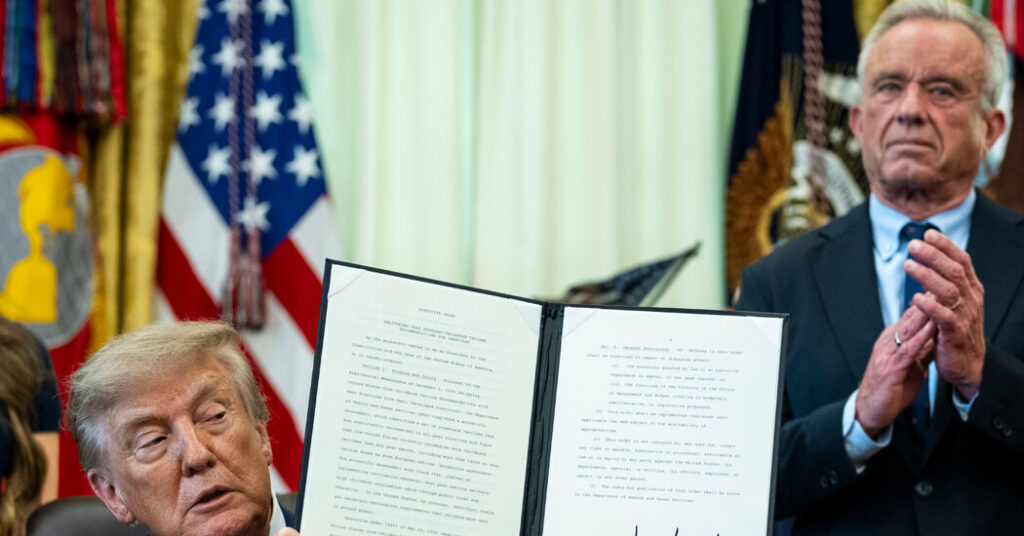
On Monday we saw the spectacle of the uninformed President Trump issuing an executive order to scale back the number of childhood vaccines while the misinformed health secretary, Robert F. Kennedy Jr., stood by in support. Mr. Trump rationalized his action by invoking the repeatedly debunked claim that vaccines cause autism in kids.
Mr. Trump and Mr. Kennedy’s claims during the signing ceremony were false, misleading and based on deep ignorance. Up until the end of the 19th century, 40 to 50 percent of children died by their 15th birthday, many in the first year of life. The development of vaccines against a range of childhood illnesses in the 20th century was one of the great public health successes, estimated to have prevented over 500 million cases of disease.
Infants’ immune systems are not very active in producing antibodies against infection until about six months of age, and antibodies provided to them by the mother’s immune system during pregnancy decline after birth. This is why infants are so vulnerable to disease during their first year.
The Advisory Committee on Immunization Practices has historically recommended that children receive up to 32 vaccines by age 5. By trying to ordain that young children receive fewer vaccinations, Mr. Trump and Mr. Kennedy are exposing millions of them to an increased risk of contracting life-threatening diseases. If they are successful in their effort, many children and their parents will suffer needlessly.
Eliot Brenowitz Seattle The writer is a professor emeritus in the biology department at the University of Washington.
Trump, A.I. and the Environment
To the Editor:
Re “Trump Risks Befouling Air in A.I. Push” (front page, Aug. 7):
President Trump’s decisions against the environment continue to be catastrophic for our country’s and the world’s future. This article demonstrates one such contemptuous effort against our ecosystem.
Mr. Trump’s relaxation of federal regulations will place data centers in the heart of countless communities that have supported him since 2016. His exit from the Paris climate agreement in 2020 was just the beginning of his war on science.
One wonders when his base will realize that Mr. Trump cares only for himself and the expansion of his billionaire class. His push for an A.I. boom is just the latest example of this truth.
Amy M. Ferguson Dunmore, Pa.
Support Global Health
To the Editor:
Re “U.S. Restores Some Global Health Aid With Big Grants” (front page, Aug. 3):
It is essential that the State Department build on its positive recent release of funds for Ebola virus responses and health security globally, as well as for the treatment of AIDS through the President’s Emergency Plan for AIDS Relief (PEPFAR) and programs advancing child health, disaster mitigation and nutritional assistance to enable food security.
These programs are lifesaving and necessary first and foremost for their beneficiaries. But they also make the United States safer by creating a world with less transmission of illness, less extreme poverty, with its destabilizing effects, and stronger, more reliable relationships between the United States and other countries.
Humanitarian aid advances justice, compassion and solidarity across nations. But it is also in the interest of the United States; it is not an act of charity, and it should have bipartisan support.
A hungry or sick child needs urgent food and medicine, not politics and partisanship.
Noam Schimmel Albany, Calif. The writer is a lecturer in development studies at the Goldman School of Public Policy at the University of California, Berkeley.
The post Reducing Childhood Vaccinations Is ‘Unconscionable’ appeared first on New York Times.