Sadev Parikh is a visiting associate professor of law and technology at George Washington University Law School.
As a scholar studying artificial intelligence regulation, I’ve found that policymakers too often debate the impacts of generative AI without hearing from those already affected. And like many lawyers, I fancy myself an artist who never took the leap.
My brother is an actual artist, working in a medium that has fueled Americans’ imaginations for over a century: animation. The spirits possessed him early. I could see the signs. He had watched our favorite film, “The Incredibles,” more than 50 times before I graduated high school, savoring and dissecting each frame.
Earlier this summer, I cajoled him into inviting me on his annual pilgrimage to the Annecy International Animation Film Festival in France, so I could hear what animators thought about the new technology.
Over local wine by Lake Annecy’s turquoise waters, I learned that animators do not fear AI itself. One indie studio exec told me that animators have long adopted and pioneered technologies that extended their craft, including machine learning. They fear, though, that studios’ cost cutting is shattering the pipelines that transform junior animators into masters.
A Spanish animator explained what was going on: The irony, he said, is that AI hasn’t removed humans from the process. It’s changed who remains. He described studios in their AI honeymoons firing and rehiring veterans to repair faulty AI outputs: six-fingered hands, inconsistent lighting and what Pixar’s chief creative officer, Pete Docter, calls “the least impressive blah average of things.” The new role already has a nickname: “slop janitor.”
It’s easy to envision AI automating how we produce something that looks animated. But what exactly? As I sat in screening after screening, from wonderfully weird shorts to a coveted preview of Brad Bird’s “Ray Gunn,” I began to understand what we are on the verge of losing: judgment.
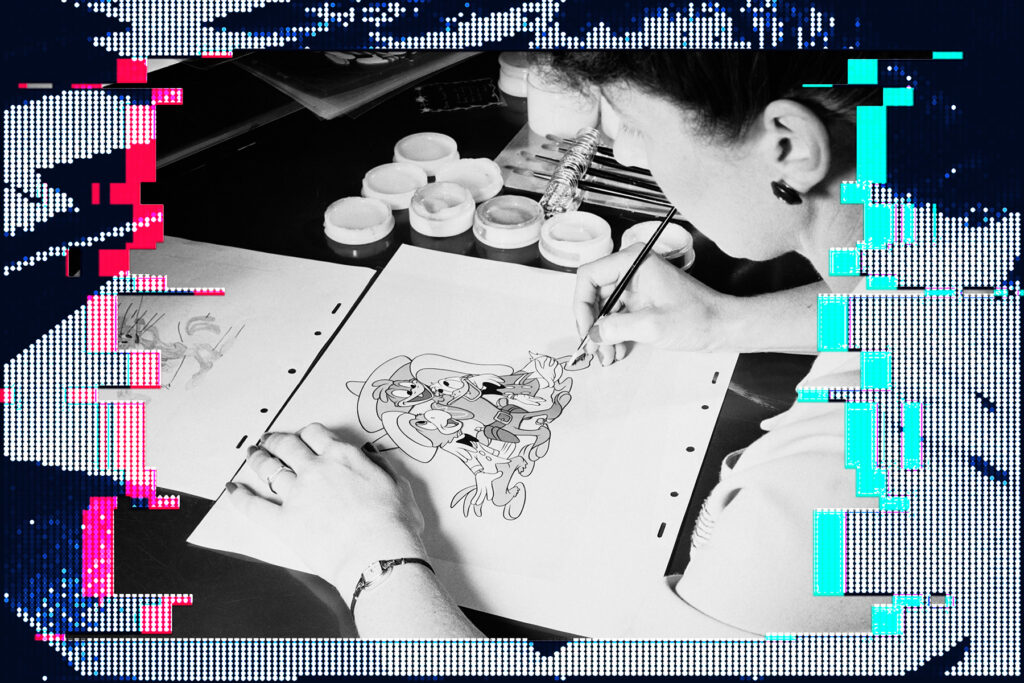
The festival featured a captivating new documentary titled “Walking With Animators.” It details how judgment is formed through thousands of hours spent observing motion, in exercises like breaking down the walk cycle. That judgment is what great animators share with great actors, and it is what makes audiences see life instead of drawings. To animate, after all, means to give life or spirit. Audiences love characters like Glen Keane’s Ariel, Tarzan and the Beast because they are an extension of Keane himself, each micro-movement and expression based on his observations and experiences.
That judgment can’t be generated with a prompt, nor can life be breathed in by lifeless machine intelligence. If the junior jobs where judgment is built are eliminated, even as interest in animation grows, will any animators be left to guide the AI outputs? Mere weeks after I left Annecy, Pixar fired more than 100 employees on Mrs. Incredible letterhead.
As the token lawyer at the conference, I was often asked how law might help. My mind first drifted to copyright lawsuits. Studios are already suing AI labs for training models on their material. But I couldn’t see how those battles would stop studios from damaging their own pipelines.
As the Animation Guild has conceded, copyright for a member’s work “almost invariably resides with [the] studio.” Unsurprisingly, even as they sue AI labs, studios seem to be building in-house models that train on their employees’ outputs. When animators’ master contract expires next July, they can demand what writers and actors won this year: that no studio can force them to use AI or license work for training without telling their union. That could make a small difference.
Antitrust law could also apply. Regulators could focus on “monopsony,” an economic concept for markets with too few buyers for labor. The Biden-era Justice Department set guidelines, retained by the Trump Administration, to block mergers lessening competition for “workers, creators, suppliers.” DOJ successfully blocked one in book publishing in 2022 based on harm to authors.
Using similar logic, 12 state attorneys general are suing to stop the $110 billion Paramount-Warner Bros. merger, citing Disney’s record after buying Fox (about 450 people lost their jobs when Disney shuttered Fox’s Blue Sky Studios). Paramount faces an antitrust trial in March 2027.
And Hollywood has paid for alleged harms to workers before. In 2017, roughly 10,000 animation and visual effects workers won a $168.95 million settlement after alleging the major studios agreed not to poach each other’s staff.
But how all these precedents could apply is difficult to predict.
As my brother and I left Annecy, we recalled Syndrome, the envious villain of “The Incredibles” who devises gadgets to make everyone super, because “when everyone’s super … no one will be.”
America’s animators have superpowers the rest of us don’t. And like Syndrome’s inventions, generative AI is harmless without humans deploying it harmfully. Deployed Hollywood’s way, it shatters the delicate portal through which animators shepherd spirit into this world, leaving animation fans with an AI-generated flatland.
The post How animation studios are killing their future with AI appeared first on Washington Post.