In early June, the power went out at Stephanie Hart’s bakery on Chicago’s South Side, during an intense storm and a suffocating heat wave.
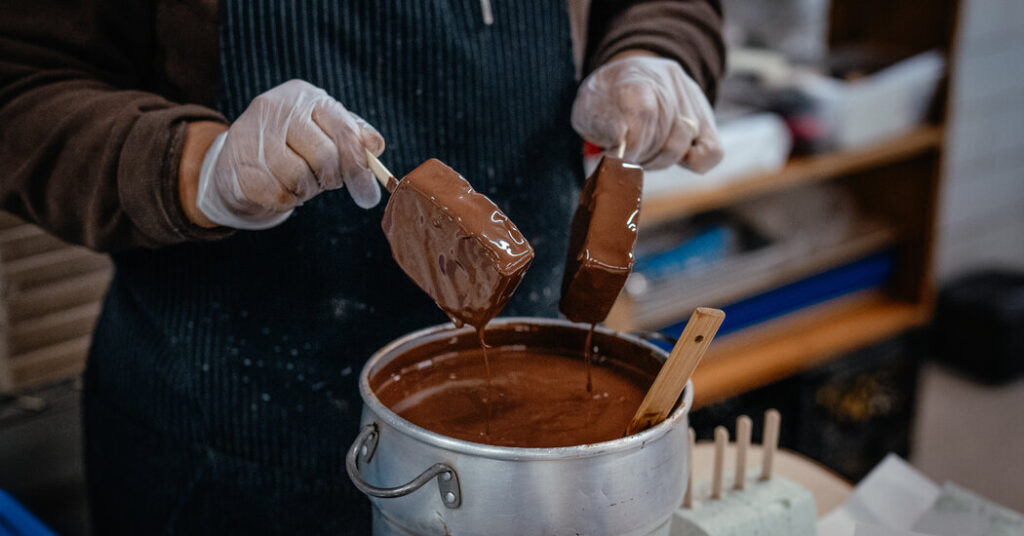
Five hundred ice cream bars meant for a restaurant customer had already perished, along with chocolate candies, and $30,000 worth of cakes in her walk-in freezer were at risk.
Ms. Hart quickly directed her staff to pack the freezer with dry ice, which cost $1,700. Then she began calling every politician she knew. “Every good-will thing I’ve ever done, I called it in,” Ms. Hart said. Finally, it worked: The utility turned her power back on the next day, and her cakes were saved.
Ms. Hart was relieved. But she’s not resting easy — the power outages that have followed more frequent summer storms in Chicago could still wipe out her inventory. So she has been making more of her cakes to order, which means slower delivery times and more intermittent work. For next summer, she’s contemplating an expensive backup generator.
“That was a lot of pressure, and who knows if I’m going to able to pull it off again?” Ms. Hart said. “Cake is just not meant for extreme weather.”
Take that stress and that expense and multiply them by thousands to understand what this summer has been like just in Chicago, where torrential rain has repeatedly brought down power lines to crash a grid already strained by the relentless need for air-conditioning.
Multiply them by millions to understand approximately the financial toll this brutal summer of heat, fires, smoke and storms has taken on businesses and households around the world. This July was the hottest month on record in the contiguous United States, according to federal data, and Western Europe experienced its hottest June-to-July average ever recorded.
Economists have long studied the worsening impact of climate change on economic growth, inflation and employment. Most estimates for damage caused to date have been moderate, while projections for damage over the long run become more drastic. But the past year has delivered climate-related shocks that are becoming impossible for businesses to avoid.
“Without these reoccurring annual events, it’s easy to say, ‘It’s part of our enterprise risk-management system, so we’re going to get to this,’” said Alexander Heil, a climate-focused economist at the Conference Board. “Nothing focuses the attention more than an emergency.”
Higher Costs, Less Income
Consider the effects of heat in isolation, without accounting for the attendant wildfires and storms. Allianz Research, an arm of the global insurance company, analyzed the likely economic impact over the next five years if they looked like the five hottest years from 2014 to 2024. The economic output of the most exposed countries, including France, Japan, Italy, Germany and Spain, would be 5 to 7 percent lower than their base-line trajectories by 2030.
There are also serious fiscal consequences. Heat hits tax revenues by reducing production and consumption, and requires more spending on damaged infrastructure. Across Europe, the Allianz Research authors found that annual government deficits would rise by 0.5 percent of gross domestic product, potentially destabilizing the debt loads of the worst-affected countries.
The projection is likely conservative. “When I proposed the scenario, some people said, ‘You are taking the five maximum heat waves during the last 10 years — this is a bit of a pessimistic scenario,’” said Hazem Krichene, an Allianz Research climate economist who started working on the project last fall. “Already 2026 is going higher than that.”
Heat affects economies through two main channels. The first is energy costs. Nearly all forms of generating electricity — solar panels, wind turbines, dams, gas turbines — operate less efficiently in extremely high temperatures. At the same time, outside of the northernmost nations, energy demand increases as households and businesses crank up their air-conditioning. Both of those dynamics boost prices and raise the risk of outages.
The second channel is productivity. Construction sites have to shorten their hours, and sleep suffers. When schools and child care facilities can’t operate, parents can’t get to their jobs. One recent study found that every day of school-based child care canceled because of wildfire smoke reduces the probability of employment by 1 percent for mothers of young children, likely because inflexible workplaces make repeated absences untenable.
Paloma Corona is feeling both of those effects. She runs two day care locations in Los Angeles, and the heat and smoke of the past few years have doubled her electricity bills. Sometimes the temperatures force her to keep the toddlers inside all day, and multiple times this summer she has had to warn parents that the power might go out or send her charges home early because of heat.
“It’s a huge impact,” Ms. Corona said. “Not only us as a business, but also the families, because they don’t know if I’m going to call them today and ask them to pick up their babies because we don’t have electricity.”
Collectively, abnormally high temperatures degrade economic well-being even in rich nations. A working paper published in July found that state-level economic conditions in the United States deteriorated for months after a heat wave.
Those effects count just the “soft” impact of heat on people’s costs and ability to work. But the destructive power of wildfires shifted into a new gear this year in Europe, as fast-moving blazes ravaged landscapes, choked cities and forced thousands to evacuate.
Sarah Meier, an economist who studies interactions with natural systems, published a study that found European wildfires from 2010 through 2018 slowed the annual growth rates for affected regions, especially for the retail and tourism industries. This summer could soar past those figures — the bills for fighting the fires have exceeded the overall economic cost she had detected.
“I think the difference now is wildfire has never been so close to major cities in Europe,” Ms. Meier said. And there’s no reason to think this is the worst of it. “For Portugal, Greece and Spain, we saw there is no natural ceiling of how these fires can get statistically,” she said. “Each record can blow the last one by a wide margin.”
No Easy Fixes
This year, rather than relief, autumn will bring new strains. An unusually strong El Niño weather pattern is expected to impose severe droughts on some parts of the world and excessive rainfall in others, disrupting planting and harvest cycles and reducing production of staples like wheat, corn and sugar.
Hens even lay fewer eggs as temperatures rise. The meat processor Pilgrim’s Pride noted on its second-quarter earnings call that production may be depressed as a result. Heat waves also attack the food supply chain, spoiling crops as refrigeration fails on the way to markets. Scarcity is likely to drive food costs higher.
The macroeconomic consequences have already put central banks in a difficult position. This year’s climate disruptions have come during a trade war that has pushed up prices in the United States and a conflict in the Middle East that has squeezed energy and fertilizer supplies around the world. The central banks may raise interest rates to keep costs in check, even if doing so ratchets up financial strain.
“Raising interest rates doesn’t create more supply of food, so central bankers have typically not wanted to go there,” said Richard de Chazal, an analyst at the investment house William Blair. “Now, if solutions aren’t coming from other areas, the fiscal side of things, then they feel they need to address it.”
With little aid from governments, and insurance policies that cost more and cover less, businesses are scrambling to adapt.
Nikki Bravo owns Momentum Coffee, a small cafe chain in Chicago. Even though she hasn’t experienced power outages like Ms. Hart’s bakery, she had to close one location during a smoky day and sustained water damage in one of her locations after a storm. But the big drag has just been the intensely rainy days, which are increasingly frequent in Chicago and depress weekend tourist traffic.
Ms. Bravo had expected Lollapalooza, the four-day music festival at the start of August, to generate big sales at her downtown location. But it rained most of the weekend, and she generated 40 percent lower sales than last year. Going forward, she will try to adjust staffing more quickly, and bring more customers in during the week.
“It now becomes incumbent on me to say, ‘I need to look at the forecast and be ready to pivot,’” Ms. Bravo said. “Part of it is really understanding, or accepting, what is. We have to figure out, what to do with that? Is there a way to weatherproof our business?”
The cost of shielding people from climate change, with measures like burying power lines and shrouding crops to blunt the sun, would be likely to more than pay for itself in avoided damage, according to the consulting firm McKinsey. But it is still expensive upfront: Full protections would cost around $540 billion annually, the firm estimated.
In the short term, businesses and governments are taking obvious steps, like shifting work schedules and trying to protect residents and workers with cooling centers and water breaks. And there is a push toward more air-conditioning in places that never needed it before, like France and England.
But Eleni Myrivili, the chief heat officer for the United Nations Human Settlements Program, cautions that air-conditioning can’t be the only solution. Although it has allowed wealthy societies to develop in the desert, committing to energy-intensive cooling systems may not be feasible on a global scale, as electricity becomes more difficult and expensive to generate.
That’s why in the medium term, she’s pushing for building designs that keep interiors cooler and greenery-filled streetscapes that absorb heat rather than reflect it, and pushing against new development in the hottest places.
“What seems to be the way forward, and what a lot of companies are looking into right now, is to look at cooling less as less of an appliance issue and more of a systemic issue,” Ms. Myrivili said.
Longer term, avoiding further warming by reducing greenhouse gas emissions is the only way to contain the damage. “Adaptation is buying us time, but mitigation will determine whether adaptation remains affordable,” she said.
The post In a Summer of Climate Misery, Businesses Confront the Need to Adapt appeared first on New York Times.