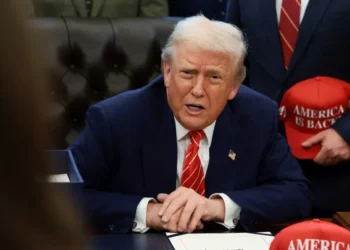
President Trump’s popularity appears to be slipping in the Republican Party and with the American people. This week Republicans eked out a victory in a Tennessee special election, but only after national groups spent millions of dollars shoring up their chosen candidate. Meanwhile, G.O.P. lawmakers seem skeptical of the Trump administration’s justification for boat strikes in the Caribbean. On this episode, the Opinion national politics writer Michelle Cottle discusses the ramifications for the president with the columnists Jamelle Bouie and David French.
Below is a transcript of an episode of “The Opinions.” We recommend listening to it in its original form for the full effect. You can do so using the player above or on the NYTimes app, Apple, Spotify, Amazon Music, YouTube, iHeartRadio or wherever you get your podcasts.
The transcript has been lightly edited for length and clarity.
Michelle Cottle: You’re both in my town this week. How’s D.C. treating you? Have you popped down to the White House yet to check out Melania’s infamous Christmas décor?
David French: I mean, Michelle, when am I not in the White House?
Cottle: You are a man of the Trump era.
French: I walk into D.C., and they’re just there with open arms. The gold is beautiful.
Cottle: They rolled out the gold carpet for you?
French: Well, I would say the only problem is not enough gold. If there were just a little more gold, I would feel happy.
Cottle: OK.
Jamelle Bouie: I don’t know anything about this Christmas display. I have not paid a lick of attention to it.
Cottle: What? No! Melania every year has put up some vaguely disturbing decorations. One year it was blood-red trees. One year it was the White Witch of Narnia, with everything kind of dead and crystally. So I always look forward to what she’s doing.
Bouie: I admire her being weird about Christmas.
Cottle: Well, there you go. Jamelle is firmly on the “let’s get weird about Christmas” train.
All right, let’s get down to it. This week, in addition to Christmas, we’re talking about the president’s popularity among the American people but also specifically within his own party.
I want to start with this week’s special election for the House in Tennessee’s Seventh District. David, it’s right in your backyard.
French: Yeah.
Cottle: Last year, as you know, Trump easily won it by more than 20 points, but then this week, the G.O.P. candidate won by just nine — and this was after the party sank millions into shoring him up.
What does this tell you about what’s going on? Even though the Democrats lost, it’s being seen as a very bad sign for the president and his party.
French: Yeah, for good reason. But before we start, let me establish my Tennessee’s Seventh street cred here for a minute.
Cottle: Please do.
French: It was my district until late May of this year. This is where I spent a lot of time. My sister-in-law was the campaign manager for the current Republican mayor in Franklin, which is part of that district. My brother-in-law is the chairman of the school board in Williamson County, and a big part of the district is Williamson County.
I’ve been living, eating, breathing these local politics for a while now. Here’s a good way to understand what’s going on: What you’re looking at is the beginning of the fragmentation of the G.O.P. after the Trump era.
If you look at the presidential numbers, that district is overwhelmingly Republican — loves them some Donald Trump. Plus-22, I believe, in 2024 for Trump, and I think if you had Trump on the ballot right now, it would still be close to that. At this point, supporting Trump is just a matter of identity for a lot of Republicans. It’s beyond normal political debate.
But if you lift up the rock here, you will know that in Tennessee’s Seventh, there have been vicious Republican-on-Republican fights for years.
The fight is between the more establishment — what you might call Reagan-Bush wing of the party — and the new insurgent part of the party. And those two factions don’t get along locally at all.
Moms for Liberty, for example, when it was trying to ban the book “Ruby Bridges Goes to School” from the elementary school curriculum — a lot of the people who resisted that were Republicans. When Moms for Liberty had a big slate of candidates that it was running in local elections and when you had more radical candidates running for mayor, you had big, intense fights, and these were not between Democrats and Republicans. There’s not a ton of Democrats there. My neighborhood was 85 percent Republican, for example.
Cottle: It was gerrymandered last go-round, right?
French: Oh, totally. What you’re seeing, I think, is the beginning of the division of the Republican Party post-Trump. Now you’re getting into “I don’t like these MAGA guys. I’m tired of this.” And that’s one of the real stories, going forward.
Cottle: Jamelle, what do you think about that?
Bouie: As far as the election results go, two things really strike me. The first is the swing. A 13-point swing for a special election — that’s striking.
Cottle: Big old swing.
Bouie: And what’s even more interesting is that it’s more or less the exact same swing that happened in New Jersey and Virginia, as well. Of course, because those are Democratic-leaning states, it resulted in big Democratic wins.
But having the same swing in a suburban district, in a very different political environment, suggests that that actually just might be where the nation is right now: a 13-point swing away from Republicans, especially in suburban areas.
And I’ll say the Republican Party nationally is basically being sustained by overwhelming dominance in rural areas and then being able to win majorities in conservative suburbs. But if the second part of that equation begins to deteriorate, then it’s big trouble everywhere, right?
At the end of the day, most Americans live in suburbs. It’s just a numbers game, and you really cannot sustain a big national majority. If I were looking at this from 30,000 feet, that is the thing that would really be keeping me up at night if I were a Republican strategist: What’s going on in these suburbs? And are Democrats simply mobilizing more voters, or was this some persuasion? Is this some people switching sides?
The fact that turnout appears to be about 90 percent of the 2022 midterm turnout is insane. Typically special election turnout is among the lowest turnout you can get. That’s why they’re not particularly representative of future trends.
But if you’re getting general-election-esque numbers in a special election and you’re getting a 13-point swing on top of that, then that does suggest a good amount of persuasion is happening — that people who voted for Republicans in the 2022 cycle voted for the Democrat in this special election cycle.
If it’s a big national swing and there’s persuasion happening, as well — “persuasion” as just a general term for people switching sides — then that’s like early retirement. If I’m a Republican lawmaker, I’m going to, after Christmas, announce that I intend to spend more time with my family.
Cottle: It will be interesting to see what kind of retirement announcements we get — that always kicks up after they’ve gone home and spent some time. But one of the things that I am interested in, as well, is if you’re talking about a 13-point swing, this could make life very interesting in those places that Donald Trump has been pushing to redistrict, so then we get into lots of dummymandering.
If you’re talking about a big swing, what starts out looking like you’re rigging things for your team could wind up meaning that you’ve actually rigged yourself out of some seats. The way they gerrymander is they take these safe seats, and they shuffle things around so that you still have a red district, but it’s not quite as red, so maybe instead of being plus-10 Republican, it shrinks to plus-four Republican.
But if you’ve got a big national swing, then you could lose some of those seats, which I think would be really just magic karma. That would be sweet.
Bouie: The other thing I’ll say is that in a lot of these gerrymandered districts, you have lawmakers that just aren’t used to competitive partisan elections.
If you’ve been coasting along in a gerrymandered district and all of a sudden you have someone out for blood on the other side, someone really hungry, and your winds are against you, as well, then you’re in a bad place.
French: I’m glad you said that, Jamelle, because if you look at the dynamics in the race in Tennessee, Aftyn Behn, the Democratic candidate, worked hard. She leaned into the race, and I think that that’s one of the things that led to the sudden alarm from the national Republican Party. That “Wait, what? This race could be close?”
And then, trust me, they poured in the resources.
Cottle: The money came in on both sides.
Bouie: Like $3.5 million to the Republican candidate.
French: It was unreal. My phone — I’m still on all these texts. Donald Trump personally texted me multiple times.
Cottle: Oh, that is so sweet.
French: Urging me. Yes.
But the other thing that’s very ominous for Republicans here is that they were down 13 points running against a left-wing Democrat. This is somebody who’s called locally the A.O.C. of Tennessee.
Cottle: Yeah. That’s not a compliment in Tennessee.
French: That’s not a match. She wasn’t a match for the district. What happens if you have Democratic candidates who are closer matches for the district? Does that eke out another 4 to 5 percent, maybe? We’ll see.
Bouie: If the Democratic Party is thinking strategically — which is a big ask — next time around, they should find someone who’s a better fit for the district. Actively recruit and run again. You’ve just softened the ground for a potential flip in the next cycle.
Cottle: So they can play everywhere next cycle.
Bouie: Right. I’m a big believer that it’s actually important to lose in ways that lay the ground for future wins. You’re not going to win all the time. But running good campaigns on a regular basis builds up an infrastructure, builds up familiarity and creates the conditions for, “Oh, maybe I can win in this next thing.”
Cottle: So what we’re looking at now is a Democratic loss that nonetheless has the Republican Party, especially those in Congress, super nervous. And when that happens, people start assessing: “Well, what do I need to do to survive next year during the midterms? Trump’s not going to be on the ballot. Trump’s popularity is in the toilet. A lot of things are not really going his way. How much do I need to start distancing myself from him?”
We’ve been seeing some splits. Most notably, the boat strike kerfuffle this week has prompted not one but both chambers of Congress to announce investigations with the Armed Services Committees. The chairman on those committees saying: We have to get to the bottom of this. Pete Hegseth, the secretary of war, is taking a lot of heat on this.
I want to know how you guys think about this. How serious a problem is this — either the individual issue or just what it portends?
French: There are a couple of factors here. One is: If you’ve been a Republican for 10 years now, especially a Republican member of the House, the main threat to your career has been the disapproval of Donald Trump.
But if you have a situation where they’re looking at potentially a 12-to-18-point group swing in the Democratic direction, then all of a sudden you get to numbers like 50, 60, 70, 80 Republicans for whom the primary threat to their career now begins to shift to become the general election voter.
And if the general election voter is the primary threat to their career, then you’re going to see more people standing up, because now their career is at stake in a different way. They may recast it as “I am outraged morally” — they’ll cast it in these moral and strategic terms — but for many of them, it’s just the career calculus is shifting.
Cottle: Jamelle, how have you been viewing this boat strike? For those who may not pay attention, the Trump administration has been blowing up boats in the Caribbean, saying that they are running drugs — which is not necessarily an unpopular move with a lot of his voters.
But there is one episode when there was a second strike that may or may not have been ordered on some survivors, which may or may not constitute a war crime. That’s what’s got everybody completely up in arms.
What have you been looking at Jamelle?
Bouie: I want to say real quick, just on the substance of all of this, that this is reprehensible. We’re not at war with Venezuela.
The administration provided no evidence that these boats are trafficking drugs, and these boats are in international waters. So the administration presents it as “We’re destroying terrorists.” But take away their spin, and what’s actually happening is the U.S. Navy, under orders from the president, is blowing up random boats in the Caribbean and saying, “Oh, they’re terrorists.”
On a broad scale, even under the most expansive vision of the unitary executive, Article II does not grant the president the right to make a unilateral designation that someone is a terrorist and is going to be murdered by the state. That’s not a power the president has.
I’m sorry. I’m getting animated.
Cottle: No, I like the passion.
Bouie: I am at this point right now where I won’t even describe these as potential war crimes. This is criminal murder. This alleged double-tap — if it is the case that we did an illegal strike, first of all, and blew up this boat — we have no idea who these people were. They could have just been innocent fishermen. Then there is a second strike at two survivors.
Cottle: Which is a no-no. David, you’re the expert.
Bouie: All respect to David, and I will defer to his expertise, but I’ll say this has been a no-no since there’s been war. If you go back to antiquity, you’ll have people observing that you can’t do that. It’s recognized as a part of human civilization that if there are survivors floating in the water, you have an obligation to at least not kill them.
I just watched the second Pierce Brosnan James Bond movie, “Tomorrow Never Dies.” And in that film, one of the inciting incidents by the villain is exactly this. The villain has his soldiers blow up a ship and then kill the survivors. And it’s a huge international incident in the world of the film — as it should be.
I really want to say how absolutely morally reprehensible this is. And if it is the case that Pete Hegseth ordered that second strike, in my view, he should be arrested and held criminally liable for homicide. Because that’s what it is.
Cottle: My suspicion is that there were plenty of Republicans who were very squidgy about this, but they were still going along. Again, you don’t want to get Trump upset with you.
And this just gives them an opportunity — combined with the softening of his popularity and getting their clocks cleaned in the November elections — this is just their opportunity to separate themselves from something they were really unhappy about anyway.
Bouie: I think your suggestion, Michelle, that if this were February of this year, there might not be so much speaking up. It would be much more behind the scenes. But the fact that polls are consistently showing Trump in the mid-30s to the very low 40s — for comparison’s sake, when George W. Bush left office in 2009, his approval was about 33 percent. Trump right now is in late-stage W. territory.
Cottle: I think the calendar has come into play here. He is a second-term president. He is a lame duck. And you combine that with his sliding popularity. He’s underwater on pretty much all the issues, even immigration, which he was doing pretty well on for a while there. That was the last thing to go.
Then they had those very upsetting off-year November elections, which are always seen as referendums on the president. If we were back in February or if he were popular or if he were not a second-term president — all of those things could make a difference.
But because we are where we are, I think he is entering a phase that’s just going to be increasingly frustrating for him, because there is, on balance, going to be more and more impetus for Republican lawmakers to try to separate themselves.
French: It is telling to me that in all of this, 99 percent of the heat is being aimed at Hegseth and not Trump, so we’re still in this dynamic where the permission structure allows Republicans to fight each other one layer below Trump but still not really about Trump.
But just to Jamelle’s point, and I’m very glad that Jamelle interjected and brought this point in, and you’re very kind to say that I have expertise, but I will say that expertise here is not necessary in the slightest. Just literacy. Let me read from Page 1,088 of the Department of Defense Law of War Manual.
Cottle: Oh, I love it when you get the war manual out.
French: Who doesn’t love that? I just carry it with me to parties.
Cottle: You are fun at parties.
French: “The requirement to refuse to comply with orders to commit law of war violations applies to orders to perform conduct that is clearly illegal or orders that the subordinate knows, in fact, are illegal. For example, orders to fire upon the shipwrecked would be clearly illegal.”
What are we doing here? That’s just black-and-white stuff right there. I agree with everything that Jamelle said about the underlying legality of the actual strikes themselves. There’s no congressional authorization. There’s no act of war. Crime is not war. Suspected criminals are not terrorists.
And if you want to see the absurdity of it all, you’ll see that the administration is saying: Well, the second strike was fine because these terrorists — or these drug runners or whatever — were still in the fight. What fight?
Cottle: Clinging to a boat?
French: You can see how this just doesn’t fit within the war paradigm. For example, if you are in war on the high seas and a ship is burning, you can keep firing on that ship until it ceases fire or it strikes its colors. This is designed for navy-on-navy combat.
What’s the equivalent here? I mean, the speedboat is going down, and then all of a sudden it blows up. Is one of the surviving members of the crew supposed to say, “Strike the colors, lads. The Navy has bested us”? No. What are we doing here?
This is being treated with summary executions that we would call murder in America. If you’re in America and you see somebody running away and you think that they have drugs, you can’t gun them down. You can’t even gun them down if you know they have drugs.
Traditionally, we have used the Coast Guard — we have used military assets for drug interdiction in the past. But you know what we do? We stop, we search and we arrest, and then we prosecute. And guess what? That’s better than just blowing people up, because you can’t question a dead person.
Cottle: I want to expand this beyond just the boat strike incident.
President Trump is taking an awful lot of heat over his Ukraine peace plan. People from his congressional team are pushing back on that. The Jeffrey Epstein mess was an abject disaster for him. There are a few cracks that he can’t quite control. Speaker Mike Johnson had to tell the White House that the president’s idea for expanding Obamacare subsidies was not playing in the House.
People are starting to say, “Hmm, no, I don’t think I’m just going to go along immediately. We’re going to fight this out a little more.”
And I do think that resisting Trump’s will or complaining about Trump’s policies is going to become a more common thing. And I don’t think that it helps that there’s this sense that Trump, in addition to being a lame duck, is also slipping.
There has been another story about how he keeps falling asleep during the Oval Office meetings, things like that. I think once people start smelling blood in the water or a little virility slippage, that is going to accelerate this whole process.
Bouie: I’ll also say, capable presidents — not necessarily good ones but capable ones — can respond to events. They can make course adjustments to try to recover their public standing because they recognize that they need public opinion. Public support is an important resource they have to marshal in order to pursue their agendas.
There are many problems with Trump, but one of the political problems is that because he isn’t really that interested in governing, because he is mostly interested in sort of self-aggrandizement and lining his pockets, it seems he’s not so responsive to public opinion in the way that a president with an actual governing agenda might be responsive to public opinion. He has no desire or sees no point in trying to recoup or save or marshal those resources for future agenda items.
And then he, as a personality, does not have any other mode but relentless escalation. If he’s entering a situation where his popularity is on the decline, where he seems to be a lame duck, there are precedents from presidents for how you might handle that situation. He can’t do it. On a very basic level, he can’t do it.
To look ahead: There will be crises. There will be challenges. Is the president equipped, either politically or psychologically, to handle them in a way that might bolster his standing with the public? And I think the answer is no. I’m not going to make any predictions, but I will say it feels as if right now is the most popular he’s going to be over the next year.
Cottle: I have a more basic question: Do we think he knows what the situation is? Who’s going to tell him? Is JD Vance, who basically is sucking up as hard as he can at any given moment — is he going to march in there and say, “Sir, we have a problem”? I mean, who’s in that position? Is he even aware?
Bouie: That’s a great question, and I would say no.
I wrote about this last year before the election, and it was one of my frustrations about election coverage, which is that we talk about the presidency in terms of policy, but in a real sense, the president can’t do that much policywise directly.
The president needs to have a legislative agenda and should have some sense of what he wants to do with the executive agencies, but the job of the presidency isn’t a policy job; it’s a management job. And all management jobs are fundamentally information jobs. They’re about cultivating information. They’re about filtering information. They’re about processing information. And they’re about getting the best information you can to make decisions, and the presidency, in particular, is bombarded with information.
But good presidents are aware that the best kinds of information they can get is often political information — how the dynamics of the agencies are looking, how the dynamics in Congress are working, how everything looks from a political standpoint.
And Trump has created this bubble for himself where none of that information gets in. He’s completely blind to so much of the necessary information for being a barely competent president. I think you’re right, Michelle, to suggest that stuff about public opinion, stuff about his standing, he just may not even be aware of it.
Cottle: If he has any sense of this as he goes along, or if he just gets the vibe that he’s being handled differently in Congress, does this make him more or less dangerous as he enters this new phase?
French: I think he’s going to be more dangerous but with the possible ameliorating effect of Congress being less loyal.
If Congress is less loyal, it can temper his worst impulses. But we’re in a race between Trump’s danger and congressional revival, and these two things go hand in hand.
But one thing about the Trump bubble is, I think, it’s just true that all presidents are in a bubble, to some degree. It’s a bubble that exists naturally because we human beings have weird reactions to both fame and power. Presidents are among the most famous people in the world and the most powerful, and they’re used to interacting with human beings who are impacted by that presence. So it is difficult to live in a truth-based environment in that circumstance, just normally.
You have to actually try to encourage people to speak truth to you, to disagree with you. This is one of the reasons there’s this long recent history of incumbent presidents not doing very well in their first presidential debate.
In ’84, Reagan kind of falls on his face in front of Mondale. In 2012, Obama doesn’t do his best job against Romney. In both circumstances, ’84 and 2012, they righted the ship the second time. I think the Biden debate is partly a product of that. Who does this debate on those terms and that timing if they’re living in a truth-based environment, right?
But then with Trump, as you do with all things, you just turn it to 11.
Look at the recent cabinet meeting. Is he living in a truth-based environment? By no means. This idea that what he’s doing might not be popular, that people are rejecting it, that his legacy could be in ruins in a relatively short order — all of that is just alien to him right now.
And compounding it is that MAGA is, believe it or not, more online than the wokest woke people on the left in 2019 and 2020. They have taken the problem that Democrats had in the recent past — being too online — and they’ve turned that one to 11, to the point where you now have major figures in the Trump administration who are much more focused on what obscure, angry podcasters on the right say about them than they are concerned about a 38 percent approval rating in the larger public.
They’re constantly tacking toward the pet angry issues of the MAGA podcasting base, and that’s just going to make all of this worse. That just reinforces the walls of the bubble.
Cottle: On that note, I say we land this plane. Before we go, I need to hear from you. It’s recommendation time. What do you have for me?
Bouie: I’ve been reading a very interesting book. It is by the great Civil War historian James M. McPherson, sort of the dean of Civil War historians. His Pulitzer Prize-winning volume on the entire war, “Battle Cry of Freedom” — I still recommend it to people as the one thing you should read about the Civil War. I recently finished a collection of essays he wrote in the mid-’90s, “Drawn With the Sword,” which are great.
But I’m recommending his more recent work, in 2014. It’s called “Embattled Rebel: Jefferson Davis and the Confederate Civil War.” It’s a study of Davis as president of the Confederacy, as leader of the Confederate military effort, trying to offer a nuanced and balanced perspective on Davis’s conduct as Confederate president.
I think it’s fascinating. I suppose some viewers and listeners may be surprised that I’m interested in reading this stuff, but I’m interested in the Civil War generally, and I’m interested in both sides of the conflict.
McPherson’s argument is that Davis is often blamed for the Confederates’ defeat, but he tries to make the case that Davis, more than pretty much any other political leader in the Confederacy, always understood that the goal of the fight was winning Confederate independence, not necessarily beating the Union militarily. And this singular focus, more likely than not, actually kept the Confederacy in the fight longer than it should have been, based on its resources and its standing at the outset of the war.
It’s sort of a revisionist take on Davis’s leadership during the Civil War. If that kind of thing sounds interesting to you, I recommend the book.
French: Jamelle, that kind of thing sounds fascinating to me, and I can’t agree more on McPherson’s “Battle Cry of Freedom.”
When you grow up in the South, like I did — I was in college before I was taught anything other than the Lost Cause story. And if you have grown up steeped in Lost Causism, then “Battle Cry of Freedom” will blow up that paradigm.
I’ve got a book recommendation. It’s not a brand-new book. It’s called “France: The Dark Years” by Julian Jackson, a British historian, and it’s tracing Vichy France from 1940 to 1944.
It’s so fascinating on a very particular basis, and that is when you read it and you read the ideology and, crucially, the theology of Vichy France and the Pétain government, it will sound eerily like parts of the MAGA Christian nationalist right.
In other words: much more concerned about the leftist enemy within, than the enemy without; a great deal of focus on recreating the religious household as the centerpiece of the society; and doubling down on religion and work, as opposed to liberalism and liberty.
It’s very fascinating, and you realize they had this very coherent ideology and theology that allowed them to accommodate themselves to Hitler while believing they were being good people by purging what they deemed to be the worst elements of French society.
It is chilling and shockingly relevant, so I really recommend it.
Bouie: Can I throw in some supplementary material that is something of a streaming recommendation? The 1969 documentary “The Sorrow and the Pity,” which is about Vichy France and Nazi Germany and the collaboration and involves — since it’s ’69 — a lot of interviews with collaborators and people who were involved in the regime. It’s four hours long. But it’s a real masterpiece of documentary filmmaking, and I highly recommend it.
Cottle: Isn’t that what Woody Allen is always talking about in “Annie Hall”?
Bouie: Maybe. It’s been many years since I saw “Annie Hall.”
Cottle: I am going to take David’s streaming gap and fill it. I am a huge “Landman” fan. For those who don’t watch, Taylor Sheridan did “Yellowstone.” I got tired of the “Yellowstone” universe after a few seasons, but it was hugely popular.
But he also has moved his attention to West Texas, and Billy Bob Thornton plays an oil land man. He’s out there dealing with the cartels and the environmentalists. We’ve just started Season 2. It is the best I’ve ever seen Billy Bob Thornton in anything over the years.
French: That’s saying something. He’s been good in a lot of things.
Cottle: And now they’ve promised me some Sam Elliott, who — I’ll just watch Sam Elliott do anything. I’m sorry. I don’t even care. He can just read the phone book to me, and I’ll watch it. We’re just a few seasons in, but it makes West Texas oil fields, the roughnecks and wildcatters so entertaining. I have to highly recommend it.
French: You can’t talk about Sam Elliott without talking about one of the greatest classics in American cinema.
Cottle: “Road House.”
French: “Road House,” yes.
Cottle:
French: You’re my best friend, Michelle, for knowing that.
Cottle: David, when we’re done here, you’re just going to come over, and we’re going to spend the afternoon watching “Road House.” Jamelle, you’re invited. I was going to suggest we go to the White House, but this is better.
Bouie: I was just going to say “Road House” isn’t a bad movie, though. It’s good.
David: Jamelle.
Cottle: I’m not even sure how to process it. It’s magic. That’s all we’re going to say.
Thoughts? Email us at [email protected].
This episode of “The Opinions” was produced by Jillian Weinberger. It was edited by Alison Bruzek and Kaari Pitkin. Mixing by Carole Sabouruad. Original music by Pat McCusker, Isaac Jones and Carole Sabouraud. Fact-checking by Mary Marge Locker. Audience strategy by Shannon Busta and Kristina Samulewski. The director of Opinion Audio is Annie-Rose Strasser.
The Times is committed to publishing a diversity of letters to the editor. We’d like to hear what you think about this or any of our articles. Here are some tips. And here’s our email: [email protected].
Follow the New York Times Opinion section on Facebook, Instagram, TikTok, Bluesky, WhatsApp and Threads.
The post Republicans Are Quietly Pushing Back Against Trump appeared first on New York Times.