In early November, a conservative Supreme Court justice showed a cleareyed understanding of the threat that President Trump poses to the constitutional order. During an oral argument in a case involving tariffs that Mr. Trump unilaterally imposed by claiming emergency powers, Justice Neil Gorsuch suggested that the move could weaken Congress in an enduring way. “What president’s ever going to give that power back?” he asked.
Justice Gorsuch’s realism in a case involving a signature policy of Mr. Trump’s second term raises the so far elusive prospect that the court may constrain his worst abuses of power. But it’s not clear whether a majority of justices share Justice Gorsuch’s view, since the court has yet to rule in the case. And the comment was noteworthy because it was a rare sign of independence from the conservative wing of the court, highlighting how little the majority has done to rein in a president who has challenged the nation’s laws, norms and balance of powers.
A key test will come on Monday, when the court hears a challenge to Mr. Trump’s power to fire a member of the Federal Trade Commission — an action that flew in the face of a 90-year-old Supreme Court precedent. The court announced on Friday that it would also hear a challenge, likely in the next few months, to Mr. Trump’s attempt to revoke birthright citizenship, which the 14th Amendment explicitly protects.
Many lower courts have responded heroically to Mr. Trump’s ill-founded efforts to centralize power and weaken democracy. Judges on the district courts and courts of appeal have blocked his policies hundreds of times since he retook office in January. The judges stepped in to prevent the president from cutting off spending that Congress appropriated, dismantling departments it created, firing the heads of federal agencies and deporting people without due process.
In many of those instances, however, the Supreme Court later overruled the lower courts, allowing Mr. Trump’s power grabs. It did so almost entirely on its emergency docket, issuing rulings that are preliminary but often last for at least a year or two, with little or no explanation. The justices have wholly denied only one of Mr. Trump’s 32 emergency petitions in his second term (and even then, they effectively reversed themselves later).
Still, we continue to hope that the Supreme Court will yet restrain Mr. Trump’s unlawful actions. In addition to Justice Gorsuch, Chief Justice John Roberts and Justice Amy Coney Barrett also conveyed some skepticism of Mr. Trump’s power to impose sweeping tariffs during oral argument. And during his first term, the Supreme Court regularly ruled against him. During his second term, however, the six Republican-appointed justices have smoothed the path for Mr. Trump’s dangerous campaign to undermine the Constitution and our system of government.
One explanation is that these justices believe that American presidents in general, and not just Mr. Trump, should be more powerful than they historically have been. Several of the justices, including Samuel Alito and Brett Kavanaugh, have previously promoted an idea known as the unitary executive theory. Taken to its limit, it holds that Congress is powerless to impose any conditions on how the president controls executive branch agencies. There are reasonable arguments about whether the federal government — which often is not effective enough, frustrating liberal as well as conservative goals — would improve if agency heads were more accountable to the president who is in office. But the Supreme Court is flirting with a maximalist version of executive power that facilitates an unaccountable White House — one that, for instance, blows up boats without due process. The court’s approach downplays the primary role that the founders assigned to Congress, making it the subject of Article I of the Constitution.
The justices also seem friendlier to claims of executive power under Mr. Trump than they were under President Joe Biden. They blocked Mr. Biden’s efforts to use his authority to forgive student loans and manage the Covid-19 pandemic. Today, they are enabling a Republican president as he goes much further while relying on weaker rationales.
Just as important, the justices are ignoring the evidence that Mr. Trump is not acting in good faith. In the past, the government has enjoyed what legal scholars call the “presumption of regularity.” Judges assume they can rely on government officials to present facts accurately and give true reasons for their actions — and can defer to those officials at times as a result. The Trump administration does not deserve this presumption. As lower court judges appointed by presidents of both parties have noted, the administration’s actions have been “egregious,” “capricious,” “nonsensical,” “unconscionable,” “baseless,” “cringe-worthy,” “Kafkaesque,” “blatantly unconstitutional” and “a sham.” Judge Karin Immergut, whom Mr. Trump appointed to the U.S. District Court for the District of Oregon, wrote that his professed reasons for deploying the National Guard in Portland were “untethered to the facts.”
Yet the Supreme Court remains blithely credulous of the administration. To take one example, Justice Kavanaugh minimized the burden of wrongful stops on legal immigrants by saying they would be briefly questioned and then could “promptly go free.” That is often not the reality of the Trump administration’s immigration roundups. Instead, immigration agents conduct military-style raids that terrify children and hold even citizens in custody for hours or days or even weeks.
The court’s overarching mistake has been to allow Mr. Trump to grab power in dubious ways. Take, for example, the court’s decision in September letting the president withhold $4 billion of foreign aid that Congress had directed to be spent by the end of that month. In a single paragraph of explanation, the majority let the policy stand, citing a president’s authority to conduct foreign policy. That is a far-reaching claim at odds with the country’s long history of respecting Congress’s power of the purse. Mr. Trump’s impoundment of appropriated funds is unconstitutional, full stop.
Other rulings have shown a similar dynamic. The conservative majority has let the president begin to dismantle the Department of Education even though only Congress has the power to abolish an administrative agency. The court gave Mr. Trump a green light to fire members of the National Labor Relations Board and other agencies without cause, contravening the vision of independence Congress had when it created those agencies. In 1911, for example, Senator Francis Newlands of Nevada, who helped create the Federal Trade Commission, said that the new agency should be “independent of executive authority.” The Supreme Court upheld this principle in a 1935 case, Humphrey’s Executor v. United States.
This court may yet enable Mr. Trump to go further. In the case the justices are to hear on Monday, they signaled an openness to overturning the 1935 precedent by asking the parties to prepare for arguments about whether a federal court could prevent anyone’s removal from public office, including lower-level employees with civil service protections. At best, this could bring a return to the patronage system that proved unsuitable to the work of modern government. At worst, it raises a chilling prospect, as our colleague David French has pointed out: Combined with the president’s unfettered pardon power, the authority to fire any government employee could effectively allow a president to run the federal government as a criminal enterprise. He, too, would probably be immune from future accountability, given the court’s misguided 2024 decision shielding presidents from prosecution for most official acts.
What should the Supreme Court do differently? There are still plenty of chances for it to stand up for the American system of checks and balances.
First, the court should show that facts matter. Judges on lower courts, including some appointed by Mr. Trump, have upbraided the Trump administration for its falsehoods and bad faith and begun to treat its arguments with the basic skepticism they have earned. The justices should do the same. They will have an opportunity in several upcoming cases, including on immigration roundups and the Federal Reserve Board. In the Fed case, Mr. Trump has tried to fire Lisa Cook from the board on the basis of an allegation that she committed mortgage fraud. The justices should consider the lack of evidence for that in the record when they hear the case. They should pay attention to what’s really going on here: Mr. Trump’s play to bend the Fed to his will.
Second, the court should recognize that Mr. Trump is taking power that Congress will be hard pressed to take back. At least Justice Gorsuch and the three liberal justices looked ready to do this in the tariffs case. They need a fifth vote. A sixth or seventh would send the president an even stronger signal. It is a shame that neither Justice Alito nor Justice Clarence Thomas seems willing to restrain Mr. Trump in any case of significance.
Third, the court should be faster to block Mr. Trump’s most blatant abuses of power. His order to end birthright citizenship is patently unconstitutional. His use of the Alien Enemies Act, a wartime statute, to deport hundreds of Venezuelans who were subsequently subjected to torture and violence in a notorious prison in El Salvador, was also legally untenable. His administration’s reinterpretation of another immigration law to detain just about anyone seeking protection has been rejected by all but eight of the 225 judges who have ruled in such cases, according to Politico.
Given the largely supine nature of Congress under Republican control, the stability of American democracy depends more than it should on the Supreme Court. So far, it is failing to live up to its constitutional role. But we’re only in the first quarter of this term. There’s a long way to go.
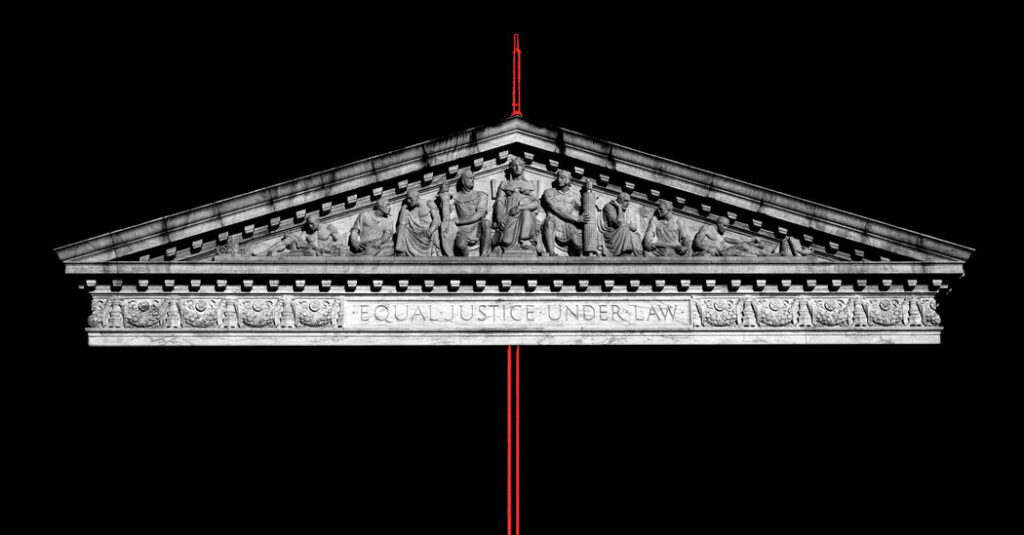
Source photograph by Roberto Schmidt/AFP, via Getty Images.
The Times is committed to publishing a diversity of letters to the editor. We’d like to hear what you think about this or any of our articles. Here are some tips. And here’s our email: [email protected].
Follow the New York Times Opinion section on Facebook, Instagram, TikTok, Bluesky, WhatsApp and Threads.
The post The Supreme Court Is Failing at Its Most Important Job appeared first on New York Times.