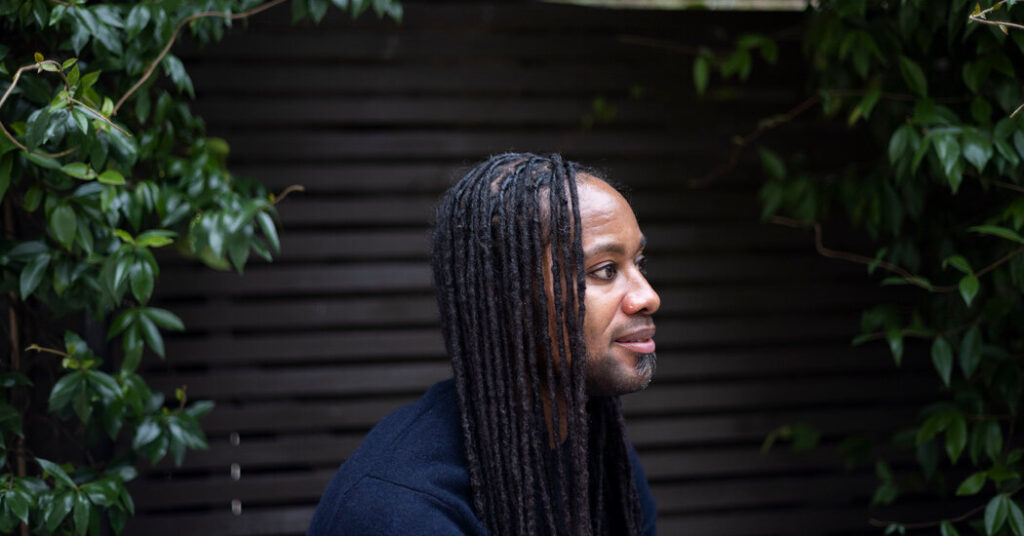
It’s the book release that the academic world can’t stop obsessing over: “Great and Unfortunate Things,” a memoir by Jason Arday, the British scholar who stepped down from his professorship at Cambridge amid accusations that he had plagiarized other scholars and embellished his personal accomplishments.
In his resignation letter, Arday did not acknowledge any wrongdoing, and said, “The relentless accusations, speculation and public commentary have taken a profound toll on me and on those I love.”
“Great and Unfortunate Things,” which goes on sale tomorrow, takes Arday from childhood up to his appointment at Cambridge. Here are some takeaways from it.
He was nonverbal until “miraculously, just a few days shy of my 12th birthday, I spoke”
By his own account, Arday, the son of Ghanaian immigrants who was raised in public housing in southwest London, spent most of his childhood and adolescence struggling with autism and other disabilities that he said left him nonverbal until almost age 12.
“But miraculously, just a few days shy of my 12th birthday, I spoke,” Arday writes, recalling an exchange with his speech therapist. “It was at the start of one of my sessions, and Katrina had just said, ‘Hello, Jason.’ At that moment, I was fiddling with my hearing aid, which was bothering me, and then I took it out of my ear and said hello back to her.”
School was difficult: “It could take me … an hour to read and absorb a single page”
Not until he turned 18, Arday laments in his memoir, could he read or write.
When he decided to go to college, his girlfriend “wrote out the entire application for me — including my personal statement.” AtSt. Mary’s University in London, he scored just 9 percent on his first exam. He worked hard, raising his grades so quickly that a professor at the school accused him of cheating.
“When you succeed against pretty much insurmountable odds, it weirdly makes people question your credibility,” he writes.
College and graduate school were slogs. Arday writes that because he had dyslexia, “sometimes it could take me as much as an hour to read and absorb a single page of academic text.”
At one point in graduate school, he realized that his 3-year-old daughter’s reading skills were not that far behind his. She scolded him at story time: “Daddy, you’re not reading all the words.”
Arday forgave the young men who attacked him: “Both of them gave me a huge hug, which I returned”
According to Arday, at one point he was beaten so brutally by four boys at a bus stop that he developed epilepsy. His attackers were arrested, and when he gave a victim impact statement, Arday writes, he told the court that they should be spared jail time.
Several years later, two of them showed up in one of his classes. “After the case was closed, we weren’t allowed to contact you,” Arday says they told him. “But we really wanted to say thank you for your forgiveness, so maybe it’s fate that we’re getting to meet you now.”
“Both of them gave me a huge hug, which I returned,” Arday writes, adding, “The two men remained in my class for the rest of that semester, proving themselves to be brilliant and diligent students.” Arday says “they often asked me to write job and character references for them, and I would happily oblige,” adding that “one of them … asked me to be the godfather to his child, and I gratefully accepted.”
Weeks before his thesis defense, “when I’d try to recall something I’d read or written, I’d draw a blank”
In 2015, Arday writes, a doctor found a small tumor pressing on the pituitary gland near the base of his brain. It was removed less than five weeks before he was scheduled to conduct the oral defense of his Ph.D. thesis.
During his recovery, Arday collapsed and “was taken to the hospital, where the doctors told me I’d had a transient ischemic attack (TIA) — a ‘mini-stroke,’” he writes, “and now I was dealing with a new problem: I couldn’t access my short-term memory. When I’d try to recall something I’d read or written, I’d draw a blank.”
“I’d worked on my thesis for over 30 months, and now I was reading it as if for the first time,” he continues.
Arday was unprepared, he said, for the “immediate hostility” he encountered at his thesis defense. But after a rough start, he rallied.
“Congratulations, Dr. Arday,” one of the professors told him when it was over. “You have passed with minor amendments.”
Of running 30 marathons in 35 days, Arday says, “I don’t really know how I did it”
One of the parts of Arday’s personal story that has received the most scrutiny involves his claim that he completed 30 marathons in 35 days in 2010 to raise money for charity.
Two-thirds of the way through the challenge, he writes in the book, he had a seizure during a race and collapsed, resulting in a hairline fracture to the fibula in his right leg. Against doctors’ advice, he continued running.
“The next nine marathons were truly an ordeal,” he writes. “It took me well over five hours to complete each one. Even though I used painkillers, I was in agony throughout. My right leg ballooned to twice its size. To this day, I don’t really know how I did it.”
In his last marathon, Arday says, he was buoyed by hundreds of supporters in the final stretch. “Just like the famous scene in ‘Rocky II,’ where Rocky sprints away from the pack and up the steps of the Philadelphia Museum of Art, I forced myself to speed up to a sprint and break away from the rest of the runners. I’ll never forget the crescendo of cheers as I turned the corner towards Piccadilly Circus, like I was being carried along by a wave of sound.”
“What if my story ends up being a cautionary tale like Icarus about flying too close to the sun?”
In the book, Arday’s trials are numerous. His brain tumor returns. He and his wife decide to split. During Covid, he suffers from autistic burnout, is barely able to get out of bed and thinks about ending his life.
But in April 2022, Arday writes, a prestigious university in London reached out to him about a job. “I’d often been head-hunted in academia, both domestically and abroad, but this was my first time being sought out by an elite British institution.”
Shortly after that, he learned about a position at the University of Cambridge. He dithered about applying for it but finally did, even though he was wracked with uncertainty: “What if I have completely overestimated my capabilities? What if my story ends up being a cautionary tale like Icarus about flying too close to the sun?”
The post Takeaways From Jason Arday’s Memoir appeared first on New York Times.