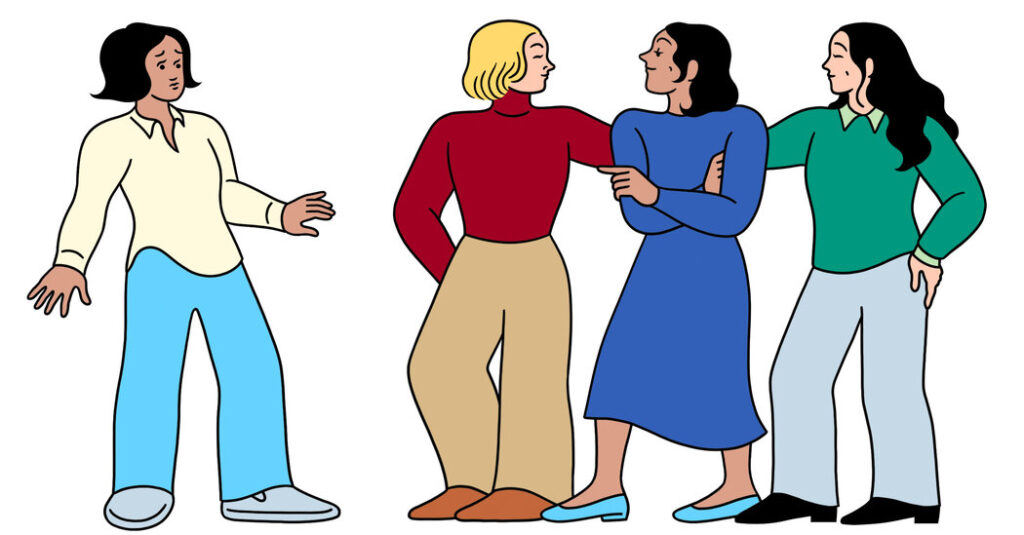
I’ve been part of a small circle of friends for decades. We’ve shared everything: children, divorces, work struggles, the care of aging parents. But over time, the deep intimacies we once shared have now flattened, and our conversations have become mostly exchanges about food and travel and cattiness about specific family members.
There is one member of our circle who is witty, generous and charming — but guided chiefly by self-interest. Years ago, when I declined to help her pursue something she wanted, she felt betrayed and has quietly resented me ever since. I sense it, and others have confirmed it. Now at our gatherings, I feel more like a bystander than a participant, knowing from experience that any vulnerability I expose will be used by this person. Although I often feel like a potted plant at our meetups, even a potted plant can bring oxygen into the room, so I aspire to be an interested and caring listener.
But that self-protective stance collapsed recently when, in the middle of a discussion about a global crisis, this person leaned over and, sotto voce, used a racist, dehumanizing epithet for the people affected. Stunned, I did the wrong thing: I pretended not to hear, something for which I’ll always be ashamed. Part of me feared that at least one other friend might have shared her sentiment. This shame will be my burden to grapple with going forward, and I’ve promised myself never to stay silent again in the face of such cruelty.
This episode, however, has forced me to reconsider my place in this group. Were it not for the others, people I truly love, my relationship with this particular woman would not survive. But she is deeply woven into the circle, and staying means continuing as an abridged version of myself. That, in turn, feeds the very shallowness I lament: a friendship defined by habit, history and pretense rather than honesty and growth. This is what gnaws at me. — Name Withheld
From the Ethicist:
Old friendships, like long marriages, rarely sustain the free-form intensity of their early years. What you call flattening may also be a kind of deepening, where the dramatic highs and lows of youth give way to a lower-key, lived-in familiarity, built from countless small gestures of care and recognition. So it may help to distinguish between your general disaffection with the group and the specific behavior of this particular person.
About her appalling remark: It’s not unusual to freeze in situations like this, and the intensity of your self-reproach may be related to your own well of anger toward her. She showed herself as morally small. But it’s also clear that she’s long made you feel small. Your effusiveness about your shame here may be another way of indicting her.
Imagine, for a moment, that this person moved across the country. How would you want your friendships with the others in the group to evolve? Maybe you’d diplomatically discourage the cattiness and begin sharing more of yourself without fear that your vulnerabilities will be used against you. Or is your sense that the relationships would still feel hollow? If so, you might want to explore this broader sense of disconnection.
Given that she is still there, there’s no reason you can’t tell her, calmly and directly, how her behavior has affected you. If you fear she’ll retaliate by turning others against you, consider first confiding your concerns with one or two trusted friends in the group. Doing so could help create a less pressured atmosphere.
If being candid about your experience with this charming, egocentric and vindictive person leads others to be supportive of you, a result could be to reaffirm the value of the friendship circle. If doing so strains the friendships, you’ll have learned something about their limits and have reason to think more about the kind of community you want to participate in. Friendships, like marriages, evolve or end, and even later on in life it’s possible to forge new ones. You deserve friendships that make room for your unabridged self.
Readers Respond
The previous question was from a reader who was debating whether to tell their siblings about their father’s infidelity. They wrote:
My mother died almost 10 years ago, and as heartbreaking as it was, our family was so thankful to have incredible hospice support so she could pass peacefully at home. In the months leading up to her death, my siblings and I were able to spend about half of our time at my parents’ house. … When I traveled there, I did not bring a computer with me and occasionally would use my dad’s computer, with his permission. One evening as I opened the laptop, his Gmail screen was up. Without opening any emails, I could see from the text snippets that he was sending intimate emails to another woman. … Although I know my parents’ marriage was none of my business, I have every reason to believe that this was not a relationship my mother was aware of. My mother passed away about two weeks later. … I have not told my siblings, nor have I acted in such a way that my father would know. … We were never particularly close, and this information has strained my relationship with him. I have some guilt about not telling my siblings, as well as not making the most of what most likely are the last few years I have with my dad. … I have not yet been able to decide in my mind and heart if I will tell my siblings before he passes, after he passes, or ever. Please help! — Name Withheld
In his response, the Ethicist noted:
You stumbled, unwittingly, on a very narrow slice of your father’s private life at a moment of extraordinary strain. … But you don’t know what the relationship amounted to, or whether it continued. What you do know is that he didn’t end up with this person. A decade after your mother’s death, the question is what to do for the living. You can’t do anything for your mother; you can, however, spare your siblings unnecessary distress. You say you’d want to know if they were in your position. But wanting to know isn’t the same as having a right to know, and it’s not the same as being better off for knowing. Unless there’s some family decision that would properly turn on this knowledge, telling them risks spreading your pain without purpose. … Your feelings matter. But they aren’t all that matters, and there may be other ways of healing. What about speaking with your father? You might tell him what you saw; let him know that it still troubles you. He may or may not have an explanation or, anyway, a story that complicates the one you’ve told yourself. … That you were close to your mother and not to your father may make you especially inclined to see this as a simple matter of betrayal. But it’s far from clear that telling your siblings really would bring anyone closer to peace. Keeping your own counsel, in this case, might be better described as merciful than as evasive.
(Reread the full question and answer here.)
⬥
As someone who helps people find their way through the dying process — both the dying person and their loved ones — I can report that it’s not that unusual for a spouse to find solace with another person. The dying person can’t soothe the survivor, can’t make that person feel like a life they’re familiar with can continue. So they find someone else. It’s a symptom of fear of loss and grief. I know the letter writer is hurt on behalf of their mom. But I hope they can give their dad grace and see him as a frightened human who didn’t intend harm, but looked for a quiet way to put one foot in front of the other. — Jane
⬥
I strongly disagree with the Ethicist on this one. It is not good mentally to keep secrets. Obviously, after 10 years, the letter writer is still grappling with this one. I would talk to my dad about it and let him know I would be telling my siblings. Perhaps the father might want to tell them himself, and explain his reasoning for the affair. — Susan
⬥
Some time ago, I read a letter to another advice columnist from a dying woman who found out, in a similar fashion, that her husband was having an affair. She didn’t mind, given that their time together was coming to an end. He was still supporting her as she was dying. She was trying to figure out whether to tell the children, so that they wouldn’t hold it against the father, should they find out. I don’t think the letter writer here should hold it against their dad. Their mother may have known, and likewise not cared. — Ruth
⬥
Any revelation the writer makes to their siblings could upset them terribly. I was an 11-year-old girl when my adored father died. My older brother told me later that the man whom my mother went on to marry was spending time with her while Dad was on his sickbed. I could forgive neither of them, and the thought that my father might have had the slightest suspicion of what was going on brings tears to my eyes, even 60 years later. — Karen
⬥
My much beloved husband has suffered from dementia for the past five years. I have watched this kind, vibrant, brilliant man diminish in front of me. It is so very lonely and sad. I would give much to have someone with whom to share this nightmare. Family and friends are wonderful, but there is nothing like the intimacy of a relationship for support going through the worst time of my life. This father deserves some grace and understanding from his child. — Mary
The post What Should I Do About the Bully in My Social Circle? appeared first on New York Times.