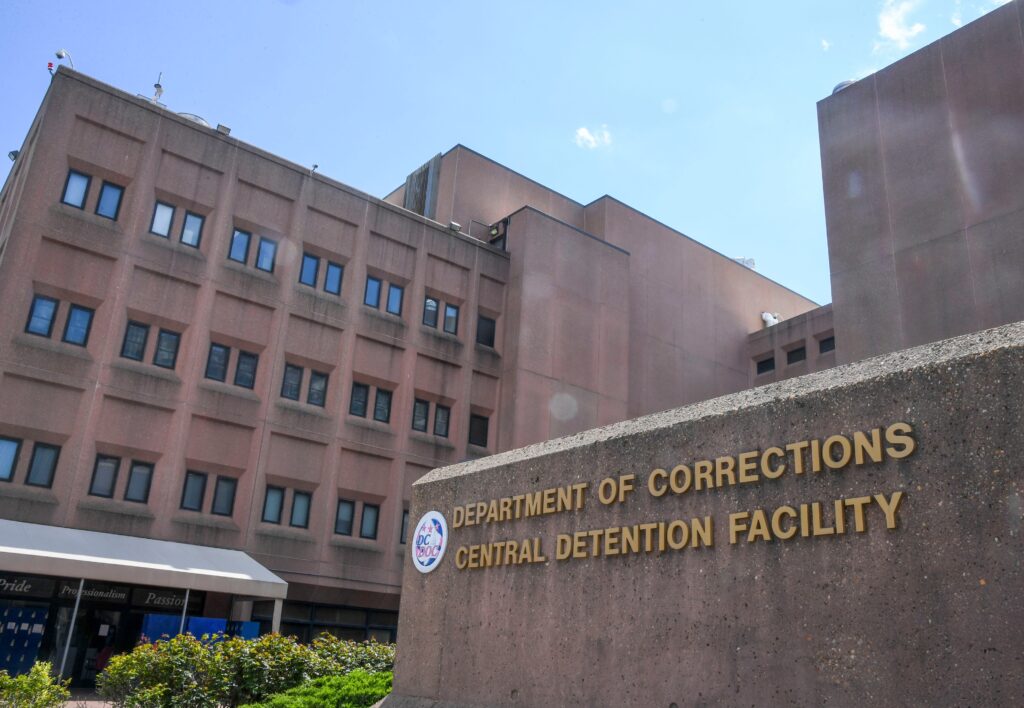
At a time when the D.C. jail is crumbling, crowded and in urgent need of replacement, a Republican bill that passed the U.S. House would overhaul the city’s bail system for the first time in more than three decades and could cause the jail population to balloon — one of about a dozen bills moving through Congress targeting D.C. criminal justice and policing policies.
D.C. virtually eliminated cash bail in the early 1990s, moving to a system that allowed judges to order people detained before trial if they found the suspects might pose a danger to public safety, while others are released under certain conditions. Now, after President Donald Trump issued an executive ordertargeting jurisdictions with cashless bail policies, congressional Republicans want to upend D.C.’s system, in the one place where the Constitution gives them power to make local policy.
The GOP legislation, introduced by Rep. Elise Stefanik (R-New York) and awaiting action by the Senate, would return money bail to D.C. in certain cases and also bring more draconian preventive detention, requiring judges to automatically hold suspects in jail before trial if they’re charged with a violent or dangerous offense — moves that Republicans argue are intended to protect public safety.
D.C. criminal justice watchdogs say it could push an already overburdened jail system to the brink, put more people at risk of the destabilizing effects of jail while they are presumed innocent, and regress to a time in D.C. in which a person’s liberty was dictated by their wealth or poverty in many cases, rather than the risk they pose.
“To hold folks in the jail who could be safely managed in the community is both expensive and ineffective,” said Tracy Velázquez, policy director at the Council for Court Excellence, which researches D.C. justice policies. “It can actually make public safety worse by destabilizing people, through their losing a job, losing housing.”
The legislation is part of a broader vision Republicans hope to impose on the liberal city’s justice system, including harsher criminal sentences, stricter treatment of juveniles, loosened restrictions on policing tactics and a drastic curtail of the city’s limited home rule. One proposal would remove the sitting elected attorney general and replace him with a Trump appointee.
Trump began a push to dismantle cashless bail policies during an Aug. 11 news conference, when he also announced he was seizing control of D.C. police for 30 days and deploying the National Guard onto city streets. “The radical left city council adopted no cash bail,” he said, calling the policy a “disaster” in cities that have it nationwide. “We’re going to change no cash bail. We’re going to change the statute and get rid of some of the other things, and we’ll count on the Republicans in Congress and Senate to vote.”
Within weeks, Stefanik — who has railed against cashless bail in New York state, where she is running for governor — followed through with legislation.
“We can’t allow arrested individuals who are awaiting trial to be released back onto the streets to commit more crimes against their communities,” she said.
Data shows that such instances are rare. In D.C., in the first three quarters of fiscal year 2025, 90 percent of people did not reoffend while released, according to the federal Pretrial Services Agency; about 1.2 percent committed a violent offense while released.
A 1990s tough-on-crime solution
D.C.’s system dates to 1992 — when the city was weathering a crack cocaine epidemic and plagued by drive-by shootings that killed innocent bystanders.
High-profile cases involved shooters who were free on bond in other criminal cases, having purchased their release. GOP officials at the federal level and local Democratic officials alike responded with calls for legislative changes described then as “tough on crime”: It was time to hold more people in pretrial detention.
Bill Lightfoot, a former council member who was among the lawmakers who backed the bail reform of the 1990s, said the idea was to give judges a more robust preventive tool to order a person detained, rather than set bail, if there were valid concerns that they might hurt someone or flee justice if released. The idea, he said, was to remove wealth from the equation.
The original system “was really creating a double standard where people who might be violent could get out of jail because they have money,” he said, “while somebody who was not violent had to stay in jail because they did not have money.”
Since then, dozens of jurisdictions nationwide have reduced their reliance on money bail, mostly over the past 10 years. Insha Rahman, vice president of advocacy and partnerships at the Vera Institute of Justice, which advocates against overincarceration, said D.C.’s system ultimately became a model nationally.
D.C.’s Pretrial Services Agency is in charge of assessing defendants’ risk levels, making recommendations to judges about whether they should be released under certain conditions and supervising them if they are. Rahman called it the “Cadillac” of pretrial services, showing how it’s possible to safely release people pretrial if the right conditions are set. People are still subject to consequences if they don’t comply with conditions or show up for court, which could result in an arrest warrant and detention.
“Much like in D.C., we’re seeing strong public safety outcomes as well as strong return-to-court rates. And none of that is contingent upon money or overusing detention,” Rahman said, pointing to a study from the left-leaning Brennan Center assessing the effectiveness of shifts to no-cash bail in numerous jurisdictions.
D.C. jail crumbling
Today, D.C. officials including Mayor Muriel E. Bowser (D) and council members argue the bail system remains effective and there is no need for federal lawmakers to overhaul it without real analysis. The D.C. Council, at Bowser’s urging, passed a law last year intended to ensure more people charged with violent offenses remain detained pretrial.
Data shows that most people charged with serious crimes in D.C. are ordered detained.
According to data from the Criminal Justice Coordinating Council, in 2024, during an initial hearing D.C. judges ordered pretrial detention for about 81 percent of people charged with violent crimes, and about 51 percent of people charged with dangerous offenses, which include some drug crimes and prostitution offenses. Judges may reconsider the detention order at a second hearing several days later; data from a five-month period between last August and January showed people in each group remained detained at similar rates.
If instead 100 percent of people had been ordered detained at their initial hearing — as the GOP bill would require — that could have put about 1,000 more people in jail before trial last year, according to available data.
The population could increase even more with people who would be subject to money bail under the GOP bill but couldn’t afford to pay it — those charged with “public order” offenses, including rioting, destruction of property and lower-level burglaries or robberies, among others.
D.C. officials are pursuing private investment in the construction of a new jail. A recent report from the D.C. Auditor found the facility is in crumbling condition, plagued by vermin and mold, and with a jail death rate more than three times the national average, with many deaths caused by overdoses. The auditor also reported that poor conditions were exacerbated by a rising jail population alongside inadequate staffing and reliance on overtime, among other concerns. Jail officials had pushed back on the audit, noting the jail has met the “gold standard” for corrections by receiving national accreditation.
“If we further crowd the jail with people whose only real offense at that point, who are legally innocent, is that they don’t have the money to pay bail, we’re going to make the jail even more dangerous,” said Ariel Levinson-Waldman, founding president of Tzedek DC, which provides legal aid to low-income people facing crippling debt.
Council member Brooke Pinto (D-Ward 2), who chairs the public safety committee, said the federal proposal would affect more than just the limited bedspace at the jail. A higher jail population would affect all aspects of its operations, including health care contracts and the provision of adequate food and medicine, she said.
“It is very important to think comprehensively about how that affects our entire system, and is yet another reason why it is so inappropriate for Congress to step in and impact our local laws in this way,” Pinto said.
The bill passed the House last month with bipartisan support — 28 moderate Democrats joined Republicans in backing the D.C. bail overhaul. For many lawmakers in support, a ballooning jail population was not a problem; they see incarceration as the best way to ensure someone does not commit a crime.
“It will remove radical progressive loopholes that allow violent offenders to roam the streets of the District, posing a threat to residents and visitors,” Rep. Lauren Boebert (R-Colorado) said of the legislation during a September hearing.
The bill must still pass the Senate, where the filibuster rule requires the support of 60 senators to advance — if all Republicans vote for it, it would still need seven Democrats.
Sen. Marsha Blackburn (R-Tennessee) has introduced a companion bill, which, like Stefanik’s, is backed by the bail bond industry.
The post GOP bill to overhaul D.C. bail system could balloon jail population appeared first on Washington Post.