
The latest round of quarterly earnings disclosures marked the most significant progress for the streaming industry to date, as all five Hollywood studios’ direct-to-consumer businesses reported profits and gains in revenue.
Streaming’s shift from burgeoning growth initiative to key profitability engine is a meaningful inflection point as visibility into subscriber growth becomes increasingly limited, the linear TV business continues to be ravaged by cord-cutting and competition for consumers’ attention remains fierce as the major media companies contend with YouTube, social media, gaming, podcasts and more.
Netflix continues to lead the pack by a wide margin, but its executives have had to fend off Wall Street’s questions about its engagement growth in the wake of the collapse of its $83 billion bid for Warner Bros. Discovery’s streaming and studio assets. In its latest quarter, the streamer revealed it will shift from a biannual to annual publication of its engagement reports.
Trailing in second place is Disney, which under new CEO Josh D’Amaro is going all-in on streaming with plans to transform Disney+ into the company’s “digital centerpiece.” Elements of that vision will start to be introduced in the spring. Disney+ and Hulu remain on track to launch as a unified standalone app by year end and the company is considering launching a free tier to help boost Disney+’s subscriber growth and engagement. It is the first of the legacy players to see streaming overtake linear in terms of revenue contribution.
But WBD and Paramount, the third and fourth largest players, respectively, could pull ahead of Disney if they successfully close their pending $110 billion merger. The deal, which is in limbo as a lawsuit with 12 state attorneys general heads to trial in March 2027, has received the necessary approvals from shareholders as well as regulators and governments representing 66 jurisdictions, including the U.S. Department of Justice, the European Commission and the U.K. Competition and Markets Authority.
During their respective earnings calls, Paramount CEO David Ellison and Warner Bros. CEO David Zaslav expressed confidence that the deal would close as planned, though the former will be on the hook for over $1 billion in ticking fees during the delay. Paramount expects the deal will close five days after the outcome of a trial, or June 1, 2027, whichever is earliest. Under the terms of the merger, the March 4 outside date is subject to one automatic extension to June 4, 2027. If it doesn’t close at all due to regulatory matters, Paramount will pay WBD a $7 billion termination fee.
While Peacock still trails behind its competitors, the service finally turned its first-ever quarterly profit six years after launching. But it still has plenty of work to do to become consistently profitable as NBCUniversal prepares to split from Comcast over the next 12 months.
This analysis does not include Apple TV and Amazon’s Prime Video, which do not break out streaming subscriber, revenue or profitability metrics on a quarterly basis since they remain a small part of each respective tech giant’s business.
Amazon Chief Financial Officer Brian Olsavsky previously said Prime Video has grown into a “large and profitable business in its own right,” but did not disclose specific figures. An NFL presentation to the FCC pegged the streaming service’s total subscriber base at roughly 180 million. While Amazon has not publicly confirmed that figure, it has disclosed that Prime Video’s ad-supported tier reaches more than 315 million monthly viewers globally.
As for Apple TV, the tech giant’s Services Vice President Eddy Cue has confirmed that the streamer has “significantly more” than the 45 million subscribers previously estimated by analysts, but declined to disclose a specific figure.
Check out the full breakdown of the numbers below.
Subscribers
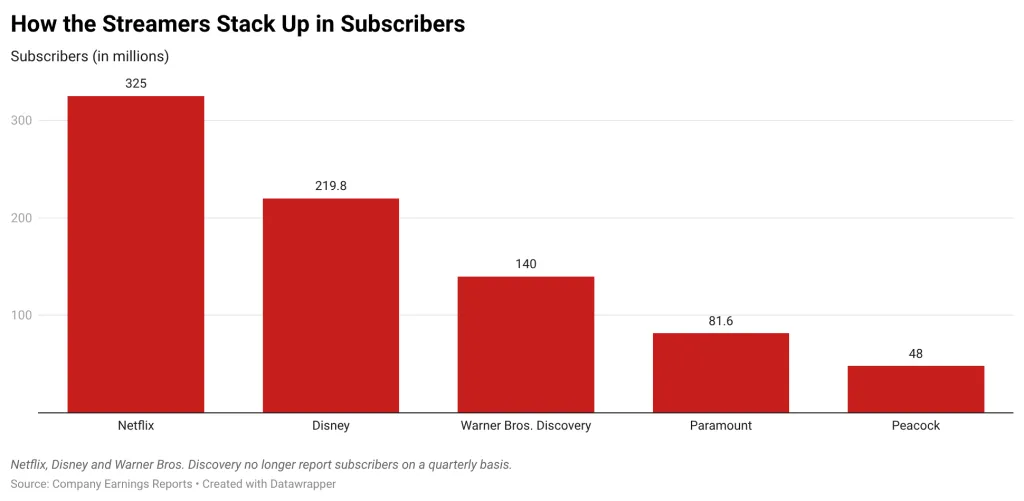
Netflix, Disney and Warner Bros. Discovery have all opted to stop disclosing subscribers on a quarterly basis, making an up-to-date comparison by service difficult.
As of their last available subscriber disclosures, Netflix reported a total of 325 million globally and Disney reported a total of 219.8 million across Disney+, Hulu and ESPN+. Meanwhile, WBD previously said it surpassed 140 million subscribers and forecasts it will surpass 150 million by year end.
Meanwhile, Paramount+ added 2 million subscribers for a total of 81.6 million globally and experienced its lowest quarter of churn in the service’s history, driven by its original and sports programming, including “Dutton Ranch,” the FIFA World Cup and UFC. When combined with WBD, Paramount’s total count would sit at 226.6 million subscribers based on the latest disclosures.
Looking ahead, Paramount+ subscriber growth in the third quarter is expected to be flat quarter-over-quarter. However, total paid subscribers will be modestly higher for the full year compared to 2025, including approximately 4 million strategic international hard bundle exits.
Peacock added 2 million paid subscribers for a total of 48 million, driven by the NBA playoffs, FIFA World Cup and “Love Island USA.” It did not provide guidance for the streaming service’s subscriber growth going forward.
Revenue
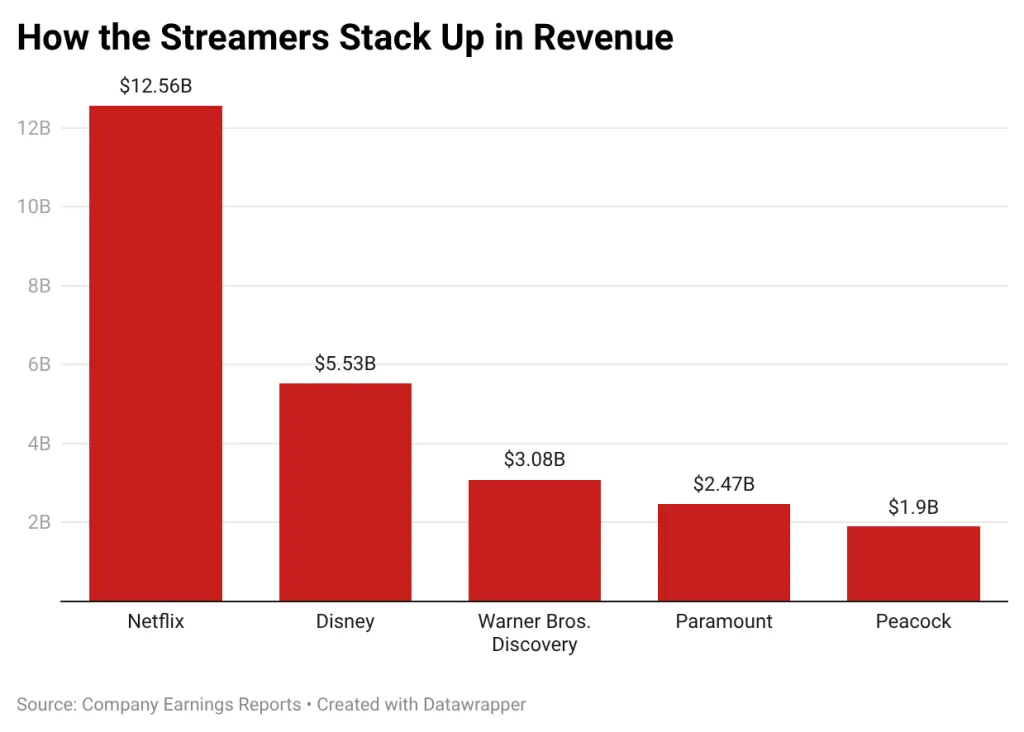
Netflix’s total revenue grew 13% to $12.6 billion in its latest quarter. In the U.S., the company saw revenue growth of 10%, which reflected only a partial impact from its price increase across all of its plans in March. It also surpassed $4 billion in the Europe, Middle East and Africa region and $1.5 billion in Latin America and the Asia-Pacific region.
It expects total revenue to grow 11.7% to $12.9 billion in the third quarter. As for the full year, the company narrowed its forecasted revenue range to $51 billion to $51.4 billion, but remains on track to double ad revenue to $3 billion.
Giving you a sense of Netflix’s lead, Disney+ and Hulu’s combined revenue grew 11% to $5.5 billion, or less than half of the streaming giant. Disney’s results were driven by a 15% increase in subscription revenues and 3% bump in ad revenue, subscriber growth, price hikes and reduced subscriber turnover driven by product and technology improvements.
While streaming has overtaken Disney’s linear business in terms of revenue contribution, the company warned that domestic entertainment streaming revenue in the fourth quarter would be impacted by a softer than expected advertising environment.
Warner Bros. Discovery’s direct-to-consumer revenue climbed 10% to $3.08 billion, driven by HBO Max’s international expansion and growth in existing markets, an increase in ad-lite subscribers and content including “Euphoria,” “House of the Dragon,” “The Pitt” and “Hacks. “ Subscriber-related revenue grew 11% to $3 billion, while content revenue fell 18% to $84 million.
Moving forward, year-over year growth in WBD’s subscriber-related revenue is expected to accelerate in the second half of the year and remain healthy into 2027, driven by its content lineup, continued engagement growth, robust global advertiser demand and ongoing product improvements. It also expects revenues to continue to grow at a “significantly faster” annual rate than operating expenses over the long-term.
Paramount’s total streaming revenue rose 9% to $2.47 billion, with Paramount+ revenue growing 16% to $2.1 billion. For the full year, it continues to expect accelerating DTC revenue growth across subscriptions and advertising.
Peacock revenue grew 54% to $1.9 billion, driven by its subscriber growth, the FIFA World Cup, the NBA playoffs and “Love Island.” Distribution revenue grew over 50%, while ad revenue increased nearly 70%. Comcast did not provide a revenue outlook for Peacock.
Profits
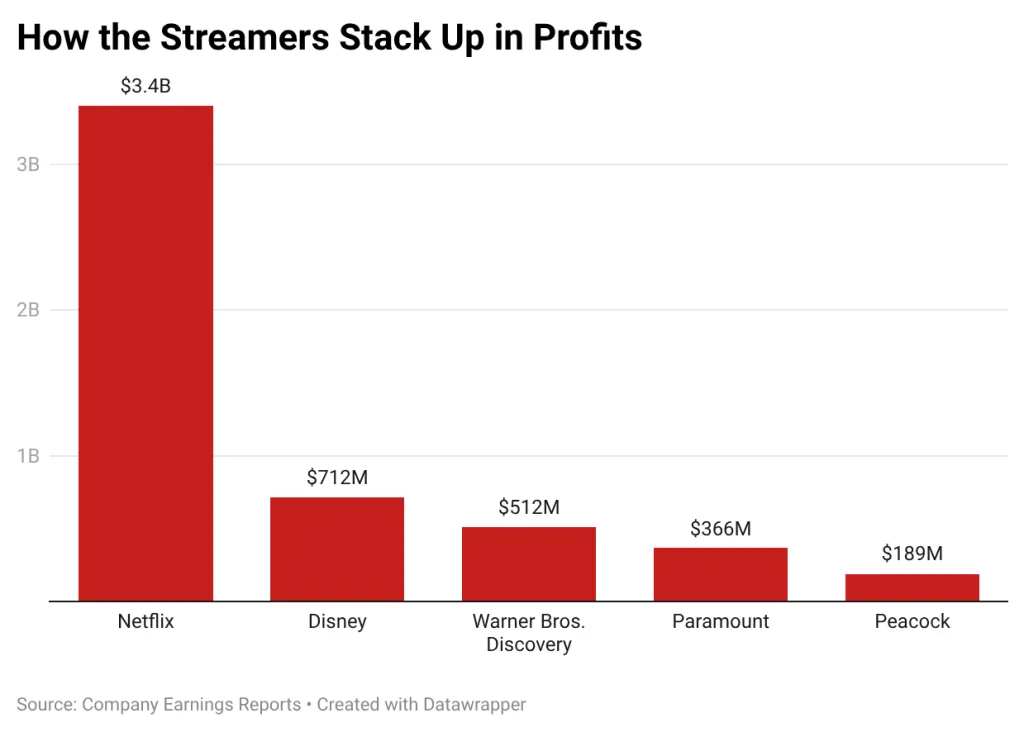
The starkest picture that highlights the gap between Netflix and everyone else comes with the profit chart.
The streaming giant’s profit climbed 9% to $3.4 billion in the latest quarter. For the third quarter, the company is forecasting a profit of $3.45 billion, up from $2.55 billion in the prior-year period.
Disney+ and Hulu’s combined profit more than doubled to $712 million, fueled in part by subscriber growth, price hikes and reduced turnover from product and technology improvements. Its entertainment streaming operating margin was 13% for the quarter and executives continue to expect a double-digit operating margin in the long-term. The company does not break out profits and losses for its ESPN streaming service and no longer discloses the financials of ESPN+.
WBD’s streaming profits soared 75% to $512 million. It continues to target a streaming adjusted operating profit margin of more than 20% over the long-term.
Paramount’s streaming profits jumped 44% to $366 million, primarily fueled by growth at Paramount+. Total streaming profits are expected to grow year over year in 2026, but will be weighted more meaningfully to the first half of the year due to the timing of programming investments in the third and fourth quarters.
Peacock swung to profit of $189 million, compared to a loss of $101 million in the prior-year period. However, Comcast Co-CEO Mike Cavanagh warned its profitability would still vary from quarter to quarter, citing the timing of sports schedules and other content.
“Think of it on an annual basis rather than the lumpiness quarter by quarter,” Cavanagh told analysts. “It’s been improving steadily and we see that continuing to be the case.”
The post How the Streamers Stack Up in Subscribers, Revenue and Profits | Analysis appeared first on TheWrap.