The first time I saw it, I wasn’t quite sure what I was looking at. A northern white-cheeked gibbon at Shanghai Zoo was holding and caressing a mouse that had wandered into its enclosure. It wasn’t trying to eat it or chase it away. Instead, the gibbon treated the tiny rodent with remarkable gentleness. I couldn’t stop wondering why.
Years later, while studying wild black-and-white snub-nosed monkeys in the mountains of south-west China, I watched playful juveniles repeatedly trying to climb onto the backs of domestic pigs. Again, these weren’t the kinds of interactions I expected to see between different species.
A new study my colleagues and I conducted brings together 427 documented cases of primates interacting with other species, spanning several decades from the 1970s to 2025. Our findings reveal that these encounters are far more widespread than scientists had realised.
Over the years, I had begun collecting reports of similar encounters from scientific journals, photographs, videos and observations shared by other primatologists. What initially seemed like a handful of quirky anecdotes gradually turned into a much broader pattern. These interactions appeared to represent a surprisingly widespread aspect of primate behaviour.
This behaviour may shed light on one of the defining features of our own species: our extraordinary relationships with other animals.
I’ve long been interested in how tolerance evolves, not only between members of the same species but also between strangers more generally. Humans are unusual in the degree to which we cooperate with unrelated people. We are perhaps even more unusual in the close relationships we form with other animals.
Scientists have long known that different animal species often associate with one another. Monkeys, for example, can improve their predator detection or increase foraging opportunities when they move around as a mixed-species group. Another example is how birds frequently follow monkeys through forests to feed on insects disturbed by their movements.
But our study focused on social interactions.
The cases we reviewed involved 88 primate species and their interactions with 127 other animal species. The diversity of these species was astonishing. It included mammals such as sheep, tapir, deer, domestic pigs, cats and dogs, as well as owls, lizards, toads and even insects.
The most common behaviour was play and grooming. But we also found reports of primates carrying, huddling and sharing food with and occasionally adopting members of another species. Most interactions were initiated by the primates themselves.
One of my favourite examples is the now well-known case of Japanese macaques grooming and riding on the backs of sika deer. It remains a remarkable example of two very different species repeatedly interacting peacefully over long periods. https://www.youtube.com/embed/Df0lw_tBRu8?wmode=transparent&start=0
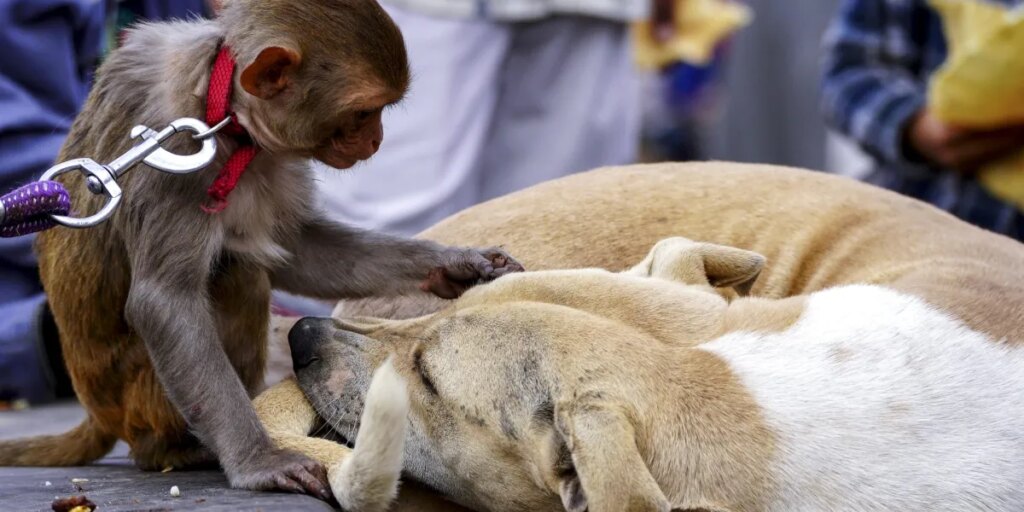
I was also fascinated by some of the less familiar observations, such as a langur attentively stroking a squirrel, a silverback gorilla carefully cradling a tiny wild bushbaby, a bonobo gently holding a mongoose pup and macaques grooming stray dogs.
Many of these interactions may provide benefits similar to those seen within species. Grooming can help remove parasites, improve hygiene and reinforce social bonds. Play contributes to the development of motor coordination, social skills and cognitive flexibility. https://www.youtube.com/embed/3WpQpqUY6Tc?wmode=transparent&start=0
Some interactions happen where primates and other animals spend time together because of shared foraging opportunities or protection from predators. For example, tropical primates form associations with other primate species and jointly forage in the tree canopy. In these cases, social interactions, such as grooming or play, may simply emerge from repeated contact and social familiarity.
Yet not all observations fit this pattern. Why would a langur stroke a squirrel, or macaques groom stray dogs? Such interactions suggest that primates may possess a broader capacity for social flexibility, curiosity and tolerance towards other species than researchers previously appreciated.
We also found consistent patterns in who interacted. Young primates were much more likely to play with members of another species, whereas adult females were more often involved in grooming. This mirrors well-established age and sex differences in many primate societies, where juveniles spend much of their time playing and females often invest more heavily in caregiving.
It would be tempting to describe all these encounters as examples of friendship. But the reality is more complicated. Some primates carried infants of another species in ways resembling adoption or caregiving, yet rough handling or neglect sometimes resulted in injury or death. We also documented cases where primates appeared to abduct a young animal from its group, while a small number of interactions were clearly abusive, involving violence.
Most interactions were probably of relatively short duration. However, there are some reports of cases that lasted for weeks. For example, the adoption of a marmoset by a capuchin monkey.
In zoos and other human-care settings, some species appear to form long-lasting relationships with animals of other species. In 2017, a macaque living in an Israeli zoo called Niv adopted a chicken and treated it like it was her own baby.
Our study found these interactions were not more common among great apes – they occurred across all major primate lineages.
These unusual encounters are more than fascinating natural history.
As forests become increasingly fragmented and wildlife is forced into closer contact with people, livestock and domestic animals, opportunities for cross-species interactions are changing rapidly. Primates now encounter dogs, cats and other human-associated animals more often than they once did.
Some of these interactions may be benign or even beneficial. Others could increase the risk of diseases spreading between wildlife, domestic animals and humans. Understanding when and why different species tolerate one another therefore has important implications for both conservation and public health.
The findings may also help improve animal welfare. Zoos increasingly house compatible species together, and understanding which species are more likely to form positive relationships can help managers make better decisions.
Perhaps most interesting of all, our findings suggest that some of the ingredients (curiosity, tolerance, caregiving and play) underlying those relationships may have deep evolutionary roots.
Cyril Grueter, Adjunct Associate Professor, The University of Western Australia; University of Oxford
This article is republished from The Conversation under a Creative Commons license. Read the original article.
The post 427 cases going back 50 years show monkeys keep pets, too — shedding a light on the origins of animal friendship appeared first on Fortune.