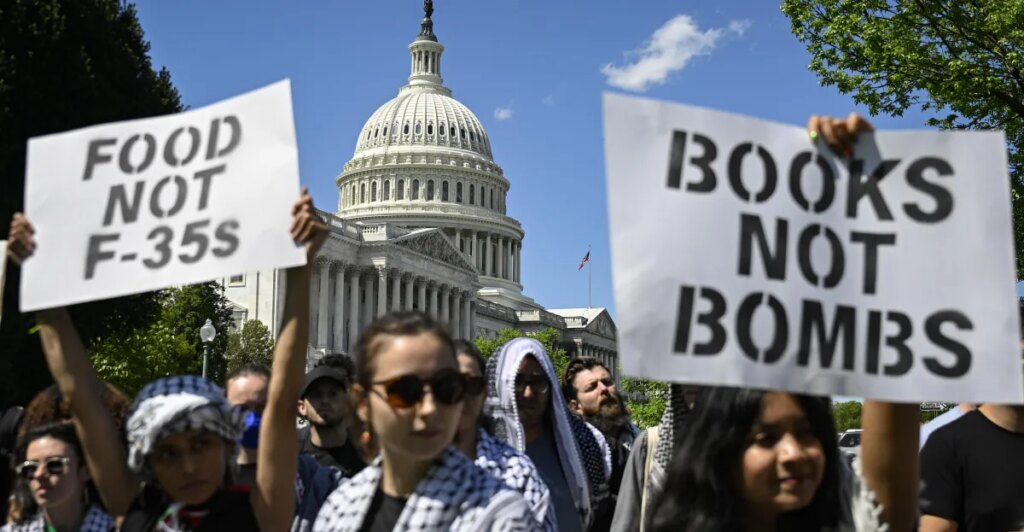
In recent months, two ideas that were once on the fringes of Democratic policy thinking — cutting off financial support and stopping arms transfers to Israel — have gone mainstream.
Nearly half of House Democrats voted to end aid to Israel last month, while roughly 40 percent of the caucus has called for blocking the sale of offensive weapons to the Israeli government until it persuades Congress that it will not use American bombs to perpetrate war crimes.
Key takeaways
- Democrats are increasingly willing to cut aid and arms sales to Israel.
- Ending financial aid would have little effect on Israeli policy.
- Broader weapons restrictions would put more pressure on Israel — but not necessarily enough to make it accept Palestinian statehood.
- Forcing Israel into full compliance with international law would likely require sweeping economic sanctions.
Many of the party’s 2028 hopefuls have also embraced these general concepts. Rahm Emanuel, the former Chicago mayor and consummate centrist, recently suggested that America should end aid to Israel and condition arms sales on its compliance with US law. Progressive Sen. Chris Van Hollen has gone several steps further, saying that Israel should be barred from accessing US-made offensive weapons until it “agrees to a time-bound plan to end the occupation and enact a two-state solution.”
If recent elections are any indication, these ideas will only grow more prominent in the coming years. Over the past two months, a slew of Democratic candidates — often with establishment backing and largely progressive voting records — lost to left-wing rivals who promised to take a more adversarial posture towards Israel. Rep. Haley Stevens’s apparent defeat at the hands of the staunchly pro-Palestinian Abdul El-Sayed in this week’s Democratic Senate primary is the latest and perhaps most consequential example of this trend.
The Democratic Party’s burgeoning support for restricting aid and arms transfers to Israel is well-founded. In prosecuting its war with Hamas, the Israeli government has subjected Gaza’s civilian population to grotesque and illegal forms of collective punishment (if not genocide). Meanwhile, in the occupied West Bank, Israel is expanding illegal settlements and allowing Jewish settlers to violently dispossess Palestinian residents. In this context, supplying Israel with money and weapons is contrary to both America’s moral obligations and security interests. It is wrong to subsidize or provision any foreign military’s assaults on human rights. And doing so undermines global respect for both the United States and the concept of international law.
For many Democrats, however, the purpose of cutting off aid and weapons to Israel is not merely to end America’s complicity in its crimes. Rather, the objective is to effect a radical change in Israeli policy — and ultimately, a peaceful resolution of the Israel-Palestine conflict.
Such Democrats believe that the Israeli government will not seriously pursue a two-state solution (much less, a binational democratic state) unless it is forced to do so. Fortunately, in this view, Israel’s reliance on American aid and military technology provides the US with potent leverage over its internal policies: If America ceases to provide the Israeli military with cash and offensive weapons, then Tel Aviv will eventually have little choice but to start upholding its end of the two-state bargain.
But this is probably too optimistic. Ending aid and conditioning arms sales may be preconditions for realigning Israeli policy. But coercing its government into an acceptance of Palestinian statehood would likely require measures far more sweeping — and controversial — than those that congressional Democrats are presently entertaining.
Israel doesn’t need our money
Of all the Democratic Party’s proposals for disciplining Israel, ending US aid may be the most politically palatable — yet least effective.
The notion that the United States should stop giving Israel $3.8 billion each year has some appeal on the left, right, and center. Which is not surprising: One doesn’t need to be passionately pro-Palestinian to be skeptical of America giving billions in aid to a rich, foreign country. In his Senate race, El-Sayed tried to tap into this isolationist sentiment, describing his plans for slashing aid to Israel — and increasing benefits for US citizens — as an “America First” agenda.
Unfortunately, ending aid would have little impact on Israeli policy. And for the very reason that such assistance is hard to justify, even to those who care little about the Palestinians: Israel is a wealthy nation that can fund its own military.
In 2025, Israel spent about 7.9 percent of its GDP on the military, not counting its use of American aid. To sustain its 2025 level of defense funding — without American aid — Israel would need to dedicate 8.5 percent of GDP to its military. This increase might be slightly inconvenient for Israeli taxpayers. But it’s clearly doable.
And Israeli Prime Minister Benjamin Netanyahu wants to do it.
Or so he told 60 Minutes in May, saying that he would like to “draw down to zero the American financial support, the financial component of the military cooperation that we have.” In the view of some Israeli analysts, forgoing US aid would give Israel a freer hand to pursue its security objectives as it sees fit without worrying about a backlash from politicians thousands of miles away. The American Enterprise Institute’s Daniel J. Samet and former IDF Maj. Raphael BenLevi spelled out the logic of this position back in 2023, writing, “As long as aid continues, the temptation to dictate Israel’s policies will be too strong for Washington to resist, while Israeli officials will be inclined to seek approval for every action they take.”
This doesn’t mean that the US should continue funding Israel’s military; revoking such aid could improve America’s global image while saving taxpayers a little money. By itself, however, canceling all military grants to Israel would not force its government to make any real changes in its security strategies, much less to accept Palestinian statehood.
Blocking bombs would have a bigger impact
Although Israel does not need America’s dollars, it does currently require our weaponry. Between 2021 and 2025, the United States supplied 68 percent of Israel’s imported major arms.
Israel can domestically manufacture many of these weapons — including drones, missiles, air-defense systems, armored vehicles, and aerial, artillery, and tank munitions. But its arms industry is not capable of churning all of these out at the rate required by its intensive, multifront wars since October 7, 2023.
Meanwhile, Israel is wholly reliant on America for its combat aircraft fleet. They don’t make F-15s, F-16s, or F-35s in Haifa. Critically, this doesn’t just leave Israel dependent on the US for new fighter jets but also for the maintenance of its existing ones.
“The F-35 is a system that is deeply reliant on just-in-time delivery of spare parts,” Josh Paul, a former Biden State Department official who resigned in protest of American arms transfers to Israel, told me. “And were the US to say we’re not going to provide you those spare parts, it wouldn’t be more than one or two months before Israel’s F-35s would not fly, certainly at the current operational paces.”
Thus, conditionally freezing sales of US military equipment to Israel would place real constraints on its martial capabilities. Although, the scale of those constraints depends a lot on the details of US policy.
The most prominent proposal for an arms embargo in Congress, the Block the Bombs Act, would freeze the transfer of select classes of weaponry, including bunker-busting bombs and precision missiles. This policy might force Israel to scale back or delay certain aerial campaigns. In the long run, however, Israel has domestic substitutes for these weapons.
By contrast, were the US to choke off military supplies more broadly — leaving the Israeli air force bereft of fighter jets and component parts — the implications for Israeli security strategy would be far more profound.
In either scenario, however, it seems unlikely that the Israeli government would respond to an embargo by agreeing to cede territory or autonomy to the Palestinians, in service of a two-state solution.
The reasons for this are twofold. First, although an embargo would substantially diminish Israel’s military capabilities, those capacities would remain formidable. As already noted, Israel domestically produces a great deal of military hardware — so much, it actually exported more arms than all but six countries between 2021 and 2025.
What’s more, the Israeli government has already launched an effort to achieve “munitions independence.” This entails a $110 billion investment into its arms industry, including initiatives to increase Israeli production of aerial munitions, heavy bombs, and artillery shells.
At the same time, Israel is also developing a plan for expanding its domestic raw materials industry, so that it enjoys sovereignty over the inputs necessary for arms production.
Given all this, even without access to American weapons, Israel would still be able to militarily dominate the West Bank and Gaza.
“Israel’s dependence on US weapons is more about its position in the region; its capacity to deter Iran and so forth, not in the Palestinian context,” Paul said. “Cut off Israel’s access to US weapons, and it would still have overwhelming military superiority over any Palestinian resistance group.”
Further, in the face of a US arms embargo, Israel would not only remain capable of sustaining its subjugation of the Palestinians; it would also likely retain the will to do so.
Israeli opinion on politics in general — and the Palestinian issue in particular — has been drifting rightward for decades. In a 2025 Gallup poll, 27 percent of Israelis supported a two-state solution while 63 percent opposed one. And opposition to Palestinian statehood is even more pronounced among Jewish Israelis, who dominate the nation’s politics. In a Pew survey from last year, only 16 percent of Israeli Jews agreed that peaceful coexistence with a Palestinian state was possible — down from 46 percent in 2013. Support for a binational, democratic state of Israel-Palestine — the “one-state solution” favored by many on the American left — is all-but non-existent among Israeli Jews, with only 1 percent backing the policy in a 2025 poll.
Israeli political leaders share its electorate’s opposition to Palestinian statehood. Netanyahu’s leading rival in Israel’s upcoming election, former IDF chief Gadi Eisenkot, recently told an interviewer, “I have never said two states for two peoples, because I understand the depth of this religious-national-social conflict, and anyone who talks about ‘peace now’ and two states doesn’t understand the conflict.”
Israeli attitudes toward Palestinian sovereignty do shift with events; after the horrors of Hamas’s October 7, 2023, attacks, skepticism of a two-state solution among Jewish Israelis spiked. It is therefore conceivable that Israelis might become more open to Palestinian statehood, were the people of Gaza and the West Bank to unify behind conciliatory political leaders, who were prepared to accept the existence of a Jewish state within Israel’s legal borders. But that is an unlikely prospect in the near or medium term — and one that Israel’s criminality makes evermore remote.
Absent such a development, a US arms embargo is unlikely to realign Israeli politics fundamentally. Historically, when great powers have tried to force weaker states to shift their policies through coercion, the latter often resist, even at a high cost. Iran’s refusal to submit to US demands on its regional policies and weapons programs, amid years of devastating sanctions and months of bombardment, may be today’s most salient example.
The Iranian regime’s recalcitrance may partly reflect its authoritarian character. But democratic states have also routinely bucked the strong-arming of foreign powers. For example, in the 1980s, New Zealand barred the United States from docking nuclear-powered or armed ships at its ports. The US tried to coerce the Kiwis into reversing this policy by suspending America’s commitment to defend New Zealand from military attack in 1986. But New Zealanders remained undaunted; indeed, support for the anti-nuclear policy grew over the ensuing years.
What getting tough on Israel would really look like
This is not to say that no amount of sustained American coercion could shift Israel’s political calculus on its conflict with the Palestinians. But the scale and duration of US pressure would likely need to be much greater than what congressional Democrats are presently contemplating.
Specifically, such a campaign would likely require an arms embargo more far-reaching than the one proposed by the Block the Bombs Act, along with sweeping economic sanctions, and the withdrawal of American diplomatic protection at the United Nations.
The Biden administration created the architecture for such a sanctions policy when it froze the US-held assets and visas of Israeli settlers who’d perpetrated acts of violence in the West Bank, along with those who had materially assisted them. These sanctions could be expanded to cover all involved in settlement expansion, including construction companies, banks, financial institutions and government agencies that facilitate the colonization of Palestinian territory. Should this prove insufficient to change Israeli policy, America could apply sanctions to those populating and serving already-existing Israeli settlements.
For reasons previously noted, Israel’s first response to all of this is liable to be resistance. To the extent that these measures were politically controversial within the US — and opposed by the Republican Party — Israel would probably seek to undermine and wait out a Democratic government that implemented them, rather than making substantial concessions to Palestinian autonomy.
America’s pressure campaign may therefore need to be sustained for a prolonged period — and enjoy a measure of bipartisan support — before having any transformative impact on Israeli policy.
This could be challenging. As El-Sayed’s “America First” message indicates, many Americans favor cutting off aid to Israel because they want to disengage from Middle Eastern conflicts and focus attention on domestic problems. But the case for blocking arms sales, sanctioning large financial institutions — and, more broadly, expending political capital and energy on a protracted fight over a foreign country’s internal policies — cannot rest on mere isolationism.
An effective pressure campaign would also require long-term resolve across multiple administrations, who may be tempted to re-engage with Israel if the US runs into new challenges abroad in which Israeli intelligence, military assets, diplomatic ties, or technology might be useful. When Joe Biden took office, he initially sought to treat Saudi Arabia as a “pariah” over the regime’s appalling record on human rights, only to come calling to its leaders in person, in order to secure its cooperation with regional issues and the global energy supply. Since then, President Trump has drawn the two nations even closer.
In any case, for now, the idea of not merely cutting off aid and select “offensive” weapons to Israel — but rather, forbidding the sale of all military goods to its government, sanctioning all involved in settling the occupied West Bank, and withdrawing US diplomatic support at the UN — remains too radical an agenda for most congressional progressives, much less their Republican colleagues.
Even if Democrats can’t change Israeli policy, they can reduce American complicity
None of this means that ending US aid to Israel — or restricting the sale of offensive weapons to its military — aren’t worthy objectives. Such measures could constrain Israel’s capacity to bomb civilian infrastructure and launch wars of choice. They just might not be sufficient to singlehandedly overwhelm Israeli resistance to Palestinian sovereignty.
Regardless, the congressional left’s Israel agenda would improve America’s moral health and global image. And this should arguably be US lawmakers’ priority.
“The United States played an enormous role in creating Israel’s conventional military advantage as a player in the Middle East,” Daryl Kimball, executive director of the nonprofit Arms Control Association, told me. “And in the face of the devastation that the Israeli government has wrought in Gaza and now on the West Bank — which involves, by any objective measure, serious war crimes — the United States needs to exert its leverage, so as not to be complicit in such behavior. Whether that changes Israeli policy regarding a two-state solution, or its ongoing treatment of Palestinians in occupied territories, is ultimately a separate question.”
The post The left is winning the argument on aid to Israel. The next step will be harder. appeared first on Vox.