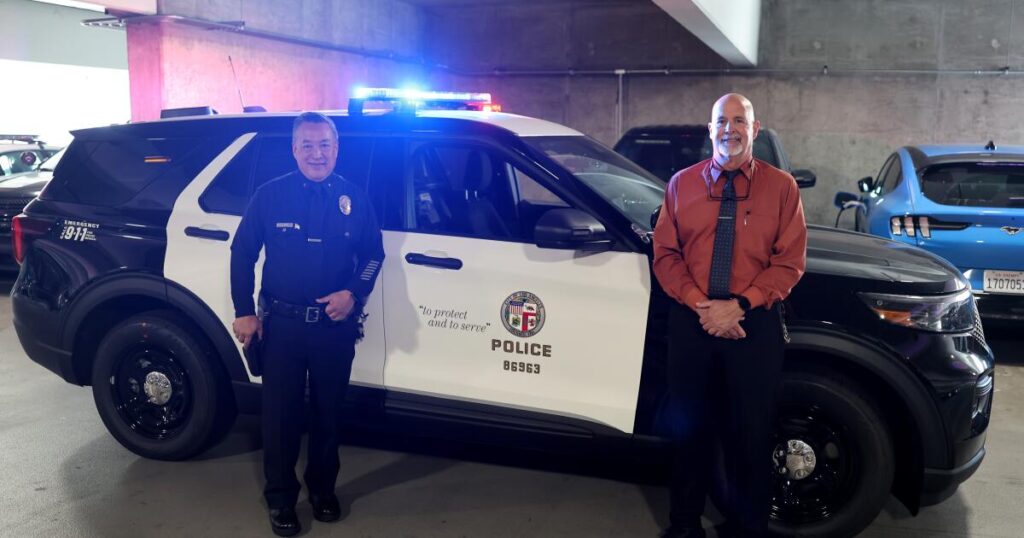
Los Angeles police are rolling out a new siren, and you don’t just hear it. It rattles your bones.
When the New York Police Department started using the Rumbler in 2009, one opponent called it an “acoustic assault” on citizens. But L.A. Police Cmdr. Blake Chow says the new low-frequency siren is the solution to a dangerous problem.
It’s a story that he says plays out for officers far too often. They’re on their way to an emergency with the siren blaring, but a driver fails to clear the path for the police cruiser.
“We had to find a way to get these drivers’ attention,” said Chow, a 36-year veteran and head of the LAPD Support Services Group, which manages core logistical, technical and records infrastructure.
The booming, 10-inch speaker device is intended to connect with drivers who, in the view of law enforcement, are yielding less frequently to emergency sirens. The department announced last month it was installing the Rumbler in a few black-and-white vehicles before a larger expansion.
For Richard Tur, the founder of NoiseOff, an organization that tracks and offers noise pollution solutions, it doesn’t seem necessary for bystanders to feel a siren “pounding through your body.”
What is the Rumbler?
The Rumbler is a low-frequency siren. A standard kit includes two subwoofers, an amplifier and a timing module, with costs ranging from $600 to $1,000 per unit, depending on accessories.
Its manufacturer, Illinois-based Federal Signal, says the siren is “highly effective in dense urban environments with heavy vehicle traffic.”
The Rumbler interacts with a standard police siren, which generates around 110 to 120 decibels, and amplifies that sound through its speakers in eight-second intervals. Whereas the blare of a regular siren may bounce off vehicles and buildings, the low-frequency tones “have the distinct advantage of penetrating solid materials, allowing vehicle operators and nearby pedestrians to feel the sound waves,” the manufacturer says.
The Rumbler then plays a prerecorded message, such as “Move to the right,” in English and Spanish, eliminating the need for the officer to do so, according to Chow.
At the LAPD, the Rumbler’s deployment comes with that of a sound and light syncing system. That allows several police vehicles to broadcast a synchronized public safety announcement while flashing the same light-signal pattern.
Greg Field, a 27-year LAPD veteran and director of the Police Transportation Motor Transport Division, noted the sync systems are useful for mass messages, such as at a fire evacuation or an unlawful assembly.
These enhancements, because of vendor agreements, require no extra funding, according to Chow.
The Rumbler technology isn’t new. Field said it has proved effective in cities across the country. The New York Police Department first installed the system in 2009 in about 150 vehicles before expanding to 500 by the following summer. The Long Beach Police Department also installed the Rumbler into patrol vehicles in 2009, employing the system in most units until 2023. That’s when the department changed to the Howler, whose manufacturer touts its “deep, penetrating tones.”
“Based on user feedback, the consensus among officers is that the Whelen Howler is more effective than a traditional siren at getting the attention of drivers,” a Long Beach Police spokesperson said in a statement.
Cars are becoming more soundproof
Today’s drivers aren’t hearing sirens, law enforcement agencies contend, because modern vehicles are adept at noise-blocking.
Chow said he routinely speaks with officers who tell them that pedestrian vehicles aren’t stopping during chases and other emergency situations despite blaring sirens.
“Sometimes three or four cars go before everyone stops,” he said. “People don’t hear the sirens during pursuit — maybe they’re not paying attention — and you risk cars getting hit in intersections or other places.”
Decades ago, road noise and car noise could make quite a racket in a car’s interior.
The 1970s Chevrolet Light Utility Vehicle itself could register a noise level of 86 decibels, above OSHA’s 85 dBA safety level, with extended exposure potentially leading to high blood pressure, tinnitus, cardiovascular disease and hearing loss.
It’s tough to hear a police siren if your car has made you deaf. By comparison, modern-day insulated car interiors offer aural bliss, but they’re dampening the sound of emergency sirens, law enforcement agencies maintain.
Newer cars and trucks employ opposite frequency technology, which lowers road noise, silicone-based coating on door seals that cuts virtually all high-frequency whistling, and noise-dampening designs on windows, to name a few technologies.
Upscale vehicles such as the 2025 BMW SUV X7 40i, the Volvo X90 Twin Motor Performance and Lexus TX 350 Luxury all scored under 50 decibels, meaning road noise in the vehicle’s interior was the equivalent of hearing the dishwasher running from another room.
Even more modest vehicles, such as the 2025 Kia K5 (51.1 decibels) and the 2024 Hyundai Sonata N-Line (51.9 decibels), were close behind.
The jarring effect on the community
Tur, the NoiseOff founder, was one of the first community advocates to sound the alarm over the Rumbler.
“Talk to New Yorkers who live near police stations and they’ll tell you it’s a nightmare,” he said. “The police use the Rumbler to enter the department, to back out of the department; it’s not just a casual use.”
An inquiry to the NYPD was not returned.
Tur said that even though the speakers are front-facing, the siren blast is omnidirectional, meaning even those moving the opposite way can feel the Rumbler.
Tur credits the 360-degree blast to its original inspiration. The Rumbler is the dream child of a Florida Highway Patrol officer inspired by the “bass-thumping audio” from local cars, according to a report from Cabinet Magazine.
Federal Signal did not respond to questions from The Times about the siren.
Although most of the focus around the Rumbler is on officers and drivers, Hamid Khan, an organizer with the Stop LAPD Spying Coalition, a community group that campaigns against over-policing, said local neighborhoods were being forgotten.
“We’re missing the point,” Khan said. “What is the impact of this thing on us, the people who live in these communities where the Rumbler will be used?”
Khan is worried the siren will be abused in poorer neighborhoods. He pointed to another noisy enforcement method, the LAPD’s helicopter usage, in which most calls are not “high priority” and often target communities such as South Los Angeles, according to a 2023 audit.
He said such additional noise “ultimately affects sleep cycles, hearing and inflicts trauma” upon local residents.
LAPD’s Rumbler deployment
Chow says the Rumbler has been installed on 20 vehicles, with another 100 being added to the system soon. He hopes that around 2,000 of the department’s 5,000 vehicles will be deployed with the Rumbler within the next couple of years.
Field said the first units with the new siren systems will police the downtown Civic Center area. Assistant Chief Emada E. Tingirides, director of the Office of Operations, ultimately will decide which vehicles follow, according to Field.
“This is about protecting both the public and our officers,” he said. “The Rumbler system provides an earlier, more noticeable warning that an emergency vehicle is approaching, giving motorists and pedestrians additional time to recognize the danger and respond safely.”
The post If you don’t hear the siren, police are sure you’ll feel the Rumbler appeared first on Los Angeles Times.