Can you tell the difference between a highfin carpsucker and a hornyhead chub? (Hint: they’re both fish.)
If not, and if you’d like to be able to, then the expansive “Fishes of the Chicago Region” is for you. Filled with full-color images of sturgeons, loaches, sticklebacks and smelts, the 500-page tome is a must-have field guide for fans of Second City area fish.
When people think of field guides they often picture volumes devoted to birds, like the wildly popular “Sibley Guides to Birds,” which have sold more than two million copies since the initial volume was published in 2000. Scores of such field guides date back more than a century; according to a recent survey, the most serious birders own at least 14 of them.
But field guides devoted to less beloved animals, plants, fungi and assorted “composite organisms” are increasingly — and finally — getting their due.
Over the past few years, publishers have released field guides on the velvet ants of North America, urban lichens in northeastern North America, prairie plants (and how to raise them) and the more than 80 species of land snails on Australia’s Lord Howe Island.
Of course, not every shrub or bug will get a field guide, said Robert Kirk, publisher of Princeton University Press’s field guides series, “because they’re fiercely expensive to do.”
“The slugs of Inner Mongolia might be a worthy project,” he continued, “but we couldn’t really make that work economically.”
Many of these field guides are “one of a kind” or “first of their kind,” a boon to fans of, say, freshwater mollusks, but also a challenge for writers tasked with creating definitive works on an entire grouping of flora or fauna.
Many of them are also challenging notions of just what makes a field guide a field guide in the first place.
Originally intended as small, portable books meant to be carried out into the field (hence their name), many of today’s editions are more like coffee table books, chunky hardcovers weighing in at 600 pages or more. Others are, by their very nature, clearly not intended to help ID specimens in the wild (the Princeton Field Guides to dinosaurs, for instance), while still others feature personal stories and anecdotes.
Here’s a sampling of some of the more intriguing, non-birding field guides that have come out in the past year, or are hitting shelves soon.
Fishes of the Chicago Region
by Francis M. Veraldi, Stephen M. Pescitelli and Philip W. Willink
Ichthyologists have been studying Illinois fish for more than a century, and there’s a rich history of books about them. But massive ecological changes in the area — redirected waterways, the reversal of the Chicago River in the late 19th century — have also caused massive changes in the region’s fish populations. “Fishes” tells you where these creatures now live and spawn, what they eat, which ones we like to eat and so on.
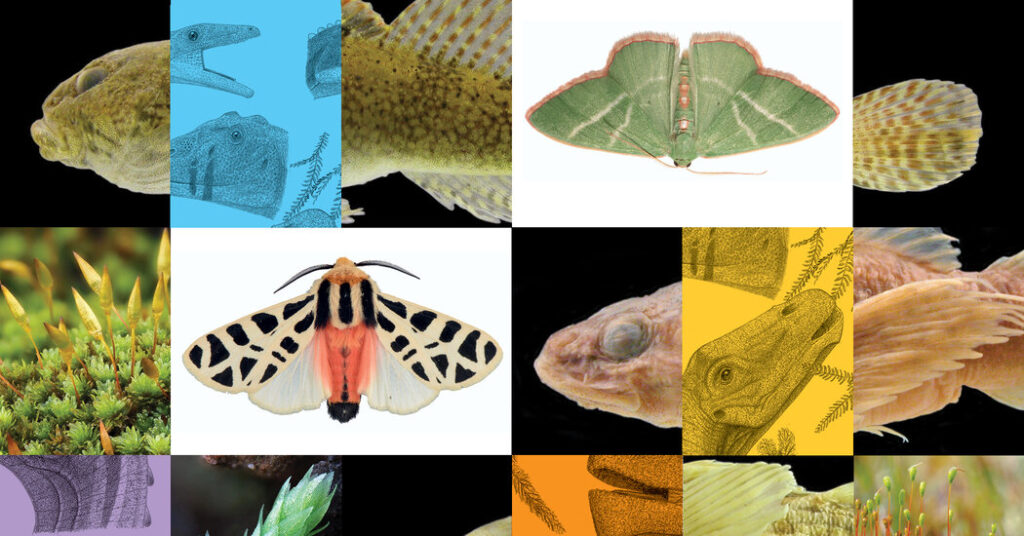
Many of the fish here are lovely, in their way, like the aqua and orange northern sunfish. Others are the stuff of nightmares (sea lampreys, with their circular maws ringed with rows of sharp teeth), while still others, like sturgeons, hail from the age of the dinosaurs, and look it. If many of the common names of the fish sound like hurled insults, the scientific names are even stranger, with Latin elements that roughly translate as “forgetting intestine,” “with large buttocks” and “odorous.”
California Lizards and How to Find Them
By Emily Taylor
This book is not a field guide, Taylor, a herpetologist and biology professor at Cal Poly, San Luis Obispo, writes, meaning that it doesn’t have detailed diagnostic information or range maps. But unlike many supposedly traditional field guides nowadays, “Lizards” is small and designed to be portable, with rounded edges that won’t snag in your cargo shorts. The book also focuses on a question often neglected in similar volumes: How do you find these little guys in the first place?
Taylor packs her book with beautiful photos of coast horned lizards (aka “horny toads,” who really can shoot blood out of their eye sockets) and fence lizards (the state’s ubiquitous “blue-bellies”), as well as compelling stories about sighting these creatures over her years taking students out into the field. For a more traditional field guide on lizards, Taylor recommends “California Amphibians and Reptiles,” a recent book by Robert W. Hansen and Jackson D. Shedd which she’s already using herself. “That’s the one that’s going to be the textbook for my herpetology class in the spring,” she said.
Mosses, Liverworts & Hornworts of the World
By Joanna Wilbraham
Collectively known as bryophytes, mosses, liverworts and hornworts can be found just about anywhere on the planet, in nearly every possible setting or clime.
Hikers and nature lovers tend to overlook these ubiquitous and diverse flora spreading over rocks or peeking out between sidewalk cracks. That’s a shame: as revealed in this book’s hundreds of color photos, bryophytes are amazingly diverse, many of them otherworldly and sci-fi-movie-worthy. Fun facts abound: The female liverwort Plagiochila exigua only lives in North America, while the males are found only in Europe (in lieu of sex, they clone themselves). And the Japanese love mosses so much that these ancient plants are even mentioned in “Kimigayo,” their national anthem.
Moths of Western North America
By Seabrooke Leckie
Most people have a generally lousy opinion of moths, Leckie writes, viewing them as ugly, drab-colored creatures that feast on your sweaters. But many members of the nearly 13,000 species that inhabit North America are actually quite lovely (and aren’t eating your sweaters), like the Western polyphemus, with their four iridescent eyespots staring out from striped wings, or the beautifully hued pink-banded glyph.
Coming in January, the book is billed as the first field guide to feature full-color photos of moths chilling in nature and very much alive, not pinned and spread in some museum collection. “I really wanted to portray the moths the way someone who is actually using the field guide is going to observe them,” Leckie said. An Ontarian and self-described “moth-er of two,” she tells readers how to attract these delicate creatures with lights and sugar baits, and explains why we should all be concerned about moth conservation (birds and bats feast on them, so fewer moths means fewer birds and bats).
The Princeton Field Guide to Sauropod and Prosauropod Dinosaurs
By Gregory S. Paul
When Laura Dern spies her first dinosaur in “Jurassic Park,” it’s a sauropod that makes her jaw go slack. It’s no wonder the filmmakers chose a sauropod (to be precise, a brachiosaurus) to open the show: They’re among the most popular dinosaurs, largely because of their enormous size. The tallest of them stood over five stories high, making them the largest land animals to have roamed the Earth.
Paul’s book features 275 species, with the latest size and mass estimates for each and amusing stories from the annals of paleontology. Dinosaur researchers will appreciate the side-view skeletons, while armchair dino-lovers will enjoy the illustrations of these beasts roaming through forests, sipping from streams, and getting their hindquarters chomped on by their meat-eating brethren.
The post Liverwort or Moss? Horny Toad or Fence Lizard? Niche Field Guides Can Tell You. appeared first on New York Times.