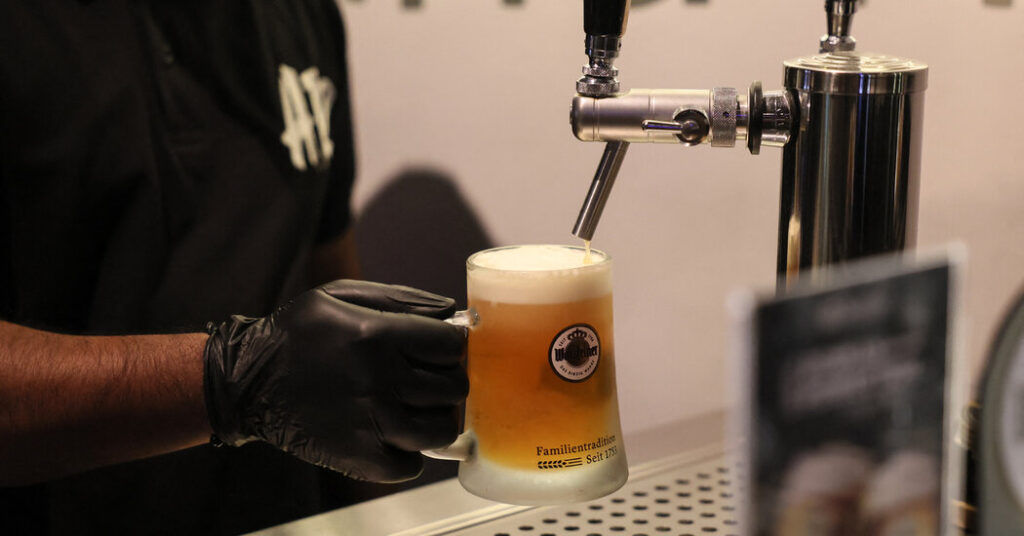
Saudi Arabia has banned alcohol for more than 70 years, so when whispers spread that an unmarked store in Riyadh, the capital, was quietly selling whiskey and champagne to wealthy foreign residents, it did not take long for a queue of cars to form outside.
In recent weeks, the liquor store — previously open only to diplomats, who are exempt from the prohibition — has been selling to non-Muslim foreigners who hold an expensive “premium residency” permit, according to five customers interviewed by The New York Times.
Premium residency is a limited status, generally conferred on wealthy or highly educated foreigners who work for government-owned entities, or in strategic sectors like health care.
The customers, a mix of premium residents and diplomats, spoke on the condition of anonymity because of local sensitivities around the topic, and in some cases because they feared disrupting their newfound access to alcohol.
No public announcement has been made about a change in the conservative Islamic kingdom’s alcohol policy. But on a sunny morning this past week, I camped outside the Riyadh store and saw that business was brisk.
The beige complex containing the store resembled dozens of others in the city’s Diplomatic Quarter, a secluded neighborhood filled with embassies. The store was distinguished only by an enigmatic sign that read, “VAT EXEMPT GOODS FOR DIPLOMATS ONLY,” referring to value-added tax, which is similar to a sales tax.
A succession of high-end SUVs approached a metal gate, where a security guard peered at drivers’ IDs, deciding if they could pass.
Shoppers who emerged from the store described a frenzied scene of eager new buyers crowding the aisles, purchasing thousands of dollars’ worth of booze. The loosening of entry procedures coincided with a new dual-pricing system: Diplomats were charged one set of marked-up prices, and premium residents paid an even higher set, several of the customers said. I saw a receipt that showed a middling bottle of white wine cost roughly $85, more than five times its price in the United States.
Though it is unclear who owns the store, several details about how it operates suggest the government is involved. Customers said they were allowed to buy a monthly quota that was linked to their government-issued ID number, and the smartphone app that diplomats use to gain access to the store was created by the tax and customs authority.
The Center for International Communication, a Saudi government media office, did not respond to a request for comment.
The system’s vagueness, and the official silence around it — not to mention the black bags that customers haul back to their cars — are in keeping with the rapid but sometimes nebulous ways in which Saudi Arabia has transformed under Crown Prince Mohammed bin Salman.
In the span of a decade, Prince Mohammed has remade the kingdom from top to bottom. Once infamous for its religious police, strict dress code and ban on women driving, Saudi Arabia now hosts mixed-gender raves, and Saudi women are free to drive, work and travel abroad as they please.
The path to greater social openness has been bewildering. Officials are often publicly ambiguous on policy changes that could prompt a backlash, leaving it unclear whether there was, in fact, a change.
“This is similar to how Saudi authorities approached a lot of social policies,” said Andrew Leber, an assistant professor at Tulane University in New Orleans and an expert in Saudi politics. “Allow relatively incremental changes under the surface without making a big announcement, giving them plausible deniability in case they want to pause or roll back the policy at some point.”
For instance, as recently as 2018, all commercial establishments across the kingdom closed several times a day to mark prayer times. They no longer do, but there was no formal announcement of this shift. Instead, business practices changed haltingly over several years — causing a great deal of confusion.
Just a few weeks ago, a senior adviser to the crown prince even told The Times that he was not aware of any plans to legalize alcohol.
“Nothing has changed so far,” the adviser, Ahmed al-Khateeb, who is the minister of tourism and head of the kingdom’s “Quality of Life” program, said in an interview last month. “We’ll see how things go in the future.”
Even finding the store is difficult. It does not appear on online maps, so friends discreetly share its GPS location.
New customers were also uncertain about the conditions to enter the store, and whether they could legally serve the alcohol to friends or resell it.
The Saudi government officially outlawed alcohol in the 1950s. At the time, a report in Time magazine said the prohibition came after a son of Saudi Arabia’s founding king killed a British diplomat during an alcohol-fueled dispute. The ban has its roots in religion, as the Quran advises Muslims to avoid alcohol.
As in the United States during Prohibition, the strict embargo belies a brisk black market. For decades, homemade spirits and high-end imported bottles have been poured at private parties, in gated residential compounds and in well-stocked Saudi homes.
Branded alcohol often entered the informal market through embassies, which were able to import an unlimited supply of alcohol in diplomatic shipments, until the government ended that system in January 2024.
The new Riyadh store opened as an official alternative but allowed only non-Muslim diplomats to enter, and limited them to a monthly quota of alcohol.
In local media, Saudi officials framed this as a crackdown on illicit trade. Even so, some embassies tried to carve out exceptions, seeking higher buying quotas in the store. Others, citing an informational security risk, resisted the requirement that diplomats download a Saudi government smartphone app to enter, according to three diplomats who spoke on the condition of anonymity because of the sensitivity of the matter.
At the time, some residents whispered that the new store was a pretext to broaden access to alcohol. Once the new system was in place, expanding the customer base would be relatively easy.
For the Saudi authorities, there are many motivations to allow alcohol sales.
The kingdom’s ostensibly sober social life has inhibited Prince Mohammed’s drive to attract more highly educated foreigners to work there. Saudi Arabia is hosting the men’s soccer World Cup in 2034, and many foreign attendees would expect to be able to buy alcohol.
Officials are also under pressure to expand tourism and increase the government’s non-oil revenue, both key parts of Prince Mohammed’s economic diversification plan.
The government “can’t have missed that alcohol sales and associated taxes are a huge moneymaker for neighboring Dubai,” said Mr. Leber, the expert in Saudi politics. In Dubai, the largest city in the United Arab Emirates, alcohol is widely available, including for Muslims.
Despite its vast oil wealth, Saudi Arabia is currently experiencing a budget crunch, and it is expected to face fiscal deficits in the coming years.
While officials appear to be moving cautiously to avoid pushback from Saudis who oppose the legalization of alcohol, a yearslong political crackdown has left few dissenters willing to speak out.
The recent expansion of alcohol sales has received no coverage in local media, and no comment from the grand mufti, the kingdom’s official religious leader, whom Prince Mohammed recently appointed.
Vivian Nereim is the lead reporter for The Times covering the countries of the Arabian Peninsula. She is based in Riyadh, Saudi Arabia.
The post Saudi Arabia Will Sell You Alcohol Now, if You’re Rich Enough appeared first on New York Times.