There hasn’t been a better architect for classical music than Frank Gehry, who died on Friday at 96. In designing halls and amphitheaters across the United States and abroad, he had a maverick’s aesthetic and the ear of a passionate fan, making sure his buildings consistently sounded as marvelous as they looked.
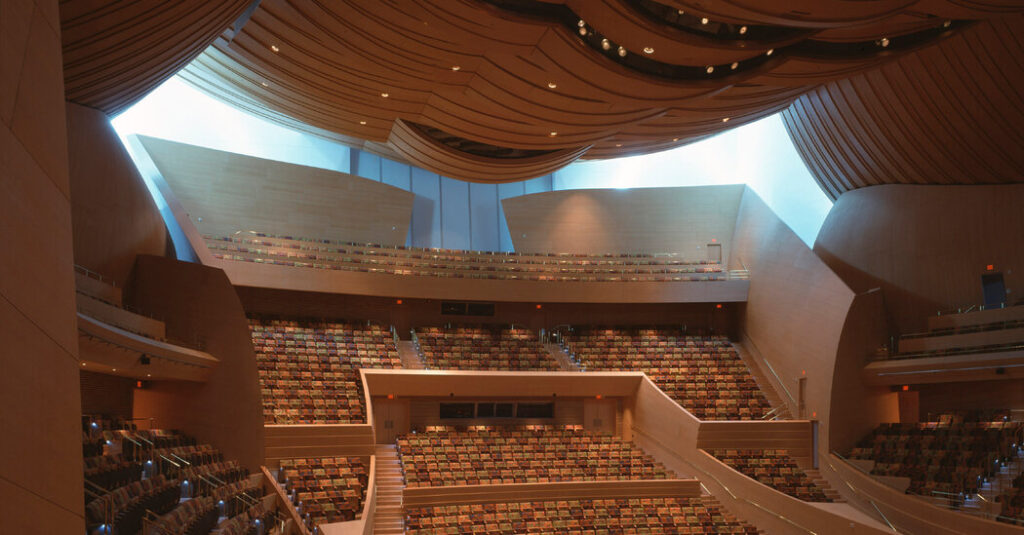
His masterpiece was Walt Disney Concert Hall, the home of the Los Angeles Philharmonic, which opened in 2003 and is one of the most instantly recognizable buildings in the city. Its facade is famous for its cluster of curved sails, coated in thousands of stainless steel plates. More of a wonder, though, is the auditorium. It’s a grand space that manages to make the musicians feel within reach from any seat. The audience wraps around the stage and surrounds the base of the organ, a towering instrument designed by Gehry that resembles a large order of fries from McDonald’s.
Disney is one of the finest concert halls in the country, an ideal place to hear music because of its thrilling look and nearly unmatched sound, which Gehry had a hand in shaping. He could have passed on his design to acoustic experts, but he insisted on working closely with Yasuhisa Toyota, his preferred acoustician. He also collaborated with Esa-Pekka Salonen, the Philharmonic’s music director at the time, who has said that to this day he uses the hall as his acoustic reference point when he composes.
Gehry wasn’t a musician. His ear could be trusted, however. He was both a dream and a nightmare as an audience member: enthusiastic but also perceptive. And in interviews he could be brutally honest, especially if he didn’t like something.
It’s a sensibility that was nurtured when Frank Gehry was still Frank Goldberg, a boy from Toronto whose mother, hoping to make him more cultured than she was, took him to hear classical music. It became one of his great loves.
Fittingly, perhaps, he liked to listen to Bach’s “Goldberg” Variations, in which an aria is put through transformations that gesture widely in all directions of style yet are held together in subtle, sublime balance. When he changed his last name to Gehry in 1954, he would jokingly refer to the “Goldbergs” as the “Gehry” Variations.
That was for laughs, but it suggested a connection to music that threaded through the rest of his life. One of his early triumphs was the Merriweather Post Pavilion in Columbia, Md. An outdoor stage made of simple materials and a large hood that fanned outward, it was battered by a heavy storm on its opening night in 1967, but nevertheless won over The New York Times’s classical music critic, who called it “better than most regulation concert halls.”
Gehry continued to impress artists and audiences alike. Or, rather, continues. Ground broke last year on a new, medium-size concert hall at the Colburn School in Los Angeles, adding to the artistic renaissance on South Grand Avenue that began with Disney Hall. And he had ambitions for the future, including as yet unrealized plans for a performance complex on Treasure Island in San Francisco. (He even designed ferries for it.)
He also dabbled in scenic design: chain link and industrial platforms for Lucinda Childs’s dance “Available Light”; icebergs of crumpled paper for Mozart’s “Don Giovanni”; an uncanny bleeding of auditorium into opera set for Wagner’s “Ring,” which continues at the Los Angeles Philharmonic in May.
Both inside and out, Gehry’s halls have the power to command your attention: arresting at first sight, then seductive on closer inspection. His expressive, affecting designs give a boost to the music onstage. There are strange phenomena involved in the psychology of acoustics, but it feels good to hear music in one of his buildings.
That was the case for his outdoor stages, too, like the Jay Pritzker Pavilion in Chicago, whose metallic curves resemble waves off Lake Michigan frozen in a cold snap. And Gehry was just as impressive on a small scale, like the gentle, handkerchief steel sheets atop the Fisher Center at Bard in the Hudson Valley, or the deceptive modesty of multipurpose surfaces at the New World Center in Miami and the open sunniness of the center for the Los Angeles Philharmonic’s youth orchestra. The inconspicuous exterior of the Pierre Boulez Saal in Berlin gives way inside to a graceful ring of seats that appears to float, turning a boxy room into a miracle of in-the-round intimacy.
Disney Hall had a pained gestation, with delays and budget worries, but it was transformational for the Philharmonic, redefining the orchestra’s relationship with its audience. Gehry was inspired by Hans Scharoun’s Philharmonie in Berlin, which democratizes the concert experience by placing the stage nearly at the center of the hall. Gehry similarly enveloped the orchestra, spreading listeners throughout the auditorium with no sense of hierarchy.
He could often be seen with his wife, Berta, at the hall in the decades after it opened. Thanks to his design, he was a local celebrity seated unremarkably alongside everyone else: just a guy who really loved classical music.
Joshua Barone is an editor for The Times covering classical music and dance. He also writes criticism about classical music and opera.
The post Frank Gehry’s Buildings Sound as Marvelous as They Look appeared first on New York Times.