NEW YORK — Cuban-born artist Wifredo Lam sometimes let other people title his paintings, as if their insight might detect ideas of which the artist was unconscious. His life follows a similar pattern, an ongoing discovery of himself as a slightly foreign object, rather like finding meaning in dreams that seem to come from outside ourselves.
It was almost inevitable that Lam, born in 1902 to a Chinese father and a multiracial mother, would seem to experience the self as a kind of foreign presence. Cuban society was a complex web of racial and economic hierarchies, just emerging from a colonial oppression founded on slavery and perpetuated by indentured labor. Caribbean artists and intellectuals who, like Lam, went back and forth between Europe and the islands wrote of a divided identity, of constant battle with an inculcated inferiority complex, and the pain of always being the other in both worlds they inhabited. He also came of age when psychoanalysis was in vogue and when European artists fetishized the idea of the primitive, as somehow providing an avenue to deeper states of consciousness and being.
The Museum of Modern Art’s “Wifredo Lam: When I Don’t Sleep, I Dream,” billed as the largest U.S. retrospective of the artist’s work, mostly skirts the emotional complexity of colonial life and the anti-colonialism with which Lam was allied through much of his life. It doesn’t focus much on his early life or his Chinese heritage, foregrounding instead his later interest in the Afro-Cuban movement, and his ties to major anti-colonial figures, especially the Martinique-born French author and politician Aimé Césaire.
But it does include a few early self-portraits that suggest an identity in flux, or undecided — as if one needed to decide such things. An intimate, sensitive image from around 1923, when the painter was in his early 20s, shows him in a shirt and tie, carefully coiffed, with a starched color, like a freshman about to matriculate at university. A few years later he appeared to foreground his Chinese heritage in a painting called “Sol,” probably a self-portrait, in which he appears with sharply accentuated features, dressed in intricately patterned flowing clothes. In a circa 1938 image he is shirtless, with light skin, while a 1926 graphite drawing, not included in the exhibition, shows him with more pronounced African features.
The exhibition feels a bit like an institutional confessional, a museum making amends for having neglected or condescended to Lam in the past. His most famous painting, “The Jungle” from 1942-1943, once hung in the museum’s lobby, where it was perceived by some to be excluded from or marginal to the main galleries while others felt it as uniquely accessible to the public, which could see it without paying admission. It was given more prestigious space within the galleries after the 1988 publication of a critical essay by the poet and critic John Yau, “Please Wait by the Coatroom: Wifredo Lam in the Museum of Modern Art.” A wave of appreciation for Lam in the 1980s made him a revered and influential figure to artists of that generation, and he remains a powerful force for younger artists who embrace decolonization not just as a political struggle, but as an analogue for a larger sense of mental and spiritual freedom from oppressive power.
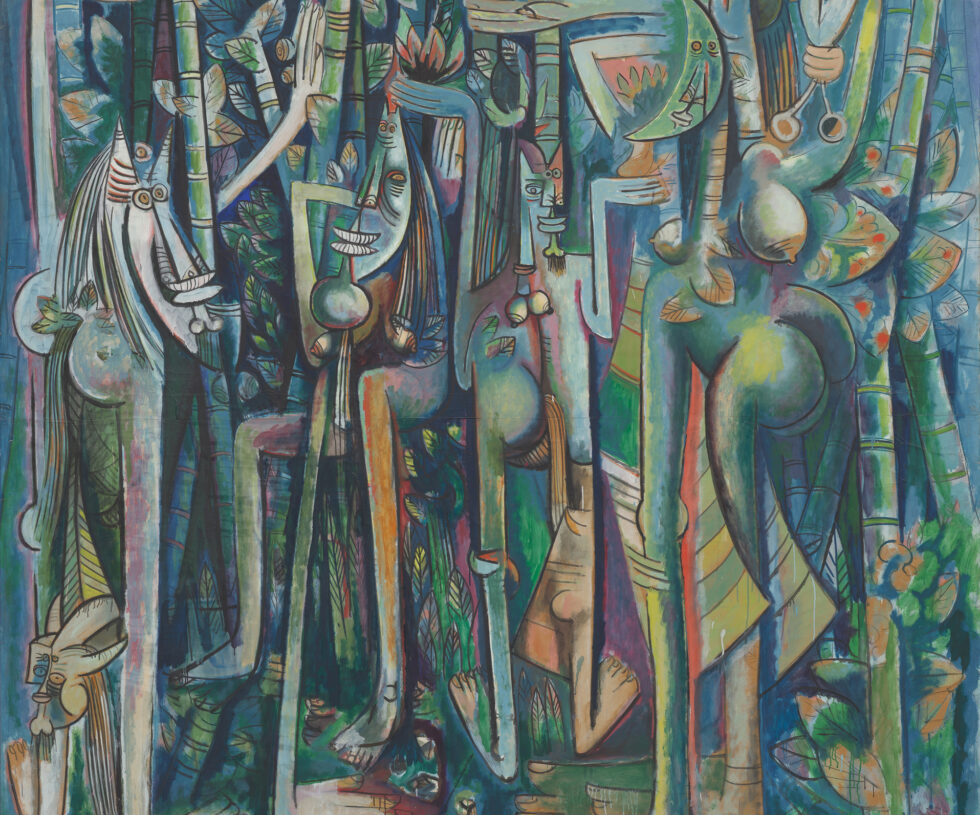
“The Jungle” is central to the exhibition. Lam had escaped Europe and fascism in 1941 and returned to Cuba, where he experienced mixed emotions back in a country where the old power structure, and its indignities, was still firmly in place. In “The Jungle,” figuration and forms derivative from Picasso become idiosyncratically his own, exuberant and animated, filling out the canvas to its edges. Faces inscribed into crescent moons, distended human forms with oversize feet and animal-human hybrids cavort in a field of brightly colored sugarcane stocks.
These figures weren’t new to Lam, nor was the allover treatment of the canvas, which he had previously used in a powerful 1937 indictment of fascism, “The Spanish Civil War.” But the energy is new, and vibrant, and while Lam never entirely broke free from the influence of Picasso, he gives these borrowed figures their own inflections and their own private language.
They are herbivorous, not predatory. Even in the darker and almost monochromatic 1949 “Large Composition,” a major, large-scale work on view for the first time in United States, the figures are animated more by playful, subversive and sexual energies than the darker, more violent fantasies of surrealism. Picasso’s “Guernica” has been domesticated, tamed and personalized.
The show, curated by Christophe Cherix and Beverly Adams, includes representative paintings from the various periods of Lam’s life, including drawings made before he moved to Europe in 1923, work made in Spain before and during the Civil War, work made upon his return to Cuba and large abstractions and ceramics made when he was a citizen of the world, with a studio in the picture-perfect Italian seaside town of Albissola Marina, in Liguria.
In 1951, Lam painted his first mural, for the giant Esso Standard Oil Company, in Havana. A year later, Fulgencio Batista seized power in a military coup and Lam fled for Paris. His work became increasingly and sometimes entirely abstract. The distended figures of “The Jungle” are put through geometric contortions and, in the 1955 work that gives the exhibition its title, “When I Don’t Sleep, I Dream,” a body (or composite of bodies) with a half-moon face and overlarge feet is laid out horizontally, like a living corpse. The fauna in Lam’s private menagerie retain their eyes, but often it seems they are looking only at themselves, or their nearest companions with profound estrangement.
The large, untitled abstractions he made in 1958 may have been an attempt to complete that estrangement, to free his work entirely from its self-consciousness and its indebtedness. But in the psychological drama of anti-colonialism one reads in the works of Césaire or Frantz Fanon, there is no easy or magical escape from the deep patterns and habits of colonial thinking. One struggles to get outside the vicious circle, only to be reinscribed. So, too, pure abstraction is as fully inscribed within the discourse of Western art as is surrealism. Lam’s pivot was an alignment with elite, art-world sensibilities, but his abstractions often feel like a blotting over or strapping down of the exuberant, decorative energies that made his earlier work feel distinctive.
Cherix detects a more triumphant narrative: “Lam’s visionary commitment to making his painting an ‘act of decolonization,’ as he put it, forever changed modern art,” he said in a news release. In 1980, two years before his death, Lam did indeed describe his work as “an act of decolonization.”
That describes an intention, an act of self-interpretation, perhaps another self-discovery. But what does anti-colonialism look like in artistic terms? Lam was too individual and too refined in his sensibility to do visual agitprop, and decolonization doesn’t have a stable meaning. In his drawings, one finds a restless invention that suggests a private, perpetual instability of thought, a yearning, or struggle perhaps. The straight, sharp, almost violent lines of his 1958 abstractions appear like thought bubbles in the figures he drew in a set of 1946 images on paper. Is that decolonization at work?
Despite Lam’s statement in 1980 and the frequent references to his friendship and allegiance with major figures in the struggle against colonialism, this framing of Lam seems more fashionable than comprehensive. There’s no doubt that Lam thought these thoughts and lived this struggle. He added generously to the canon of modern art, but it’s not clear that he “forever changed” it. Rather, he found in art what is often impossible to find for people caught within the cruel dialectics of colonial oppression: a home capacious enough for his imagination.
Wifredo Lam: When I Don’t Sleep, I Dream Through April 11 at the Museum of Modern Art, New York. www.moma.org.
The post The relentless creativity of an anti-colonial artist who was so much more appeared first on Washington Post.