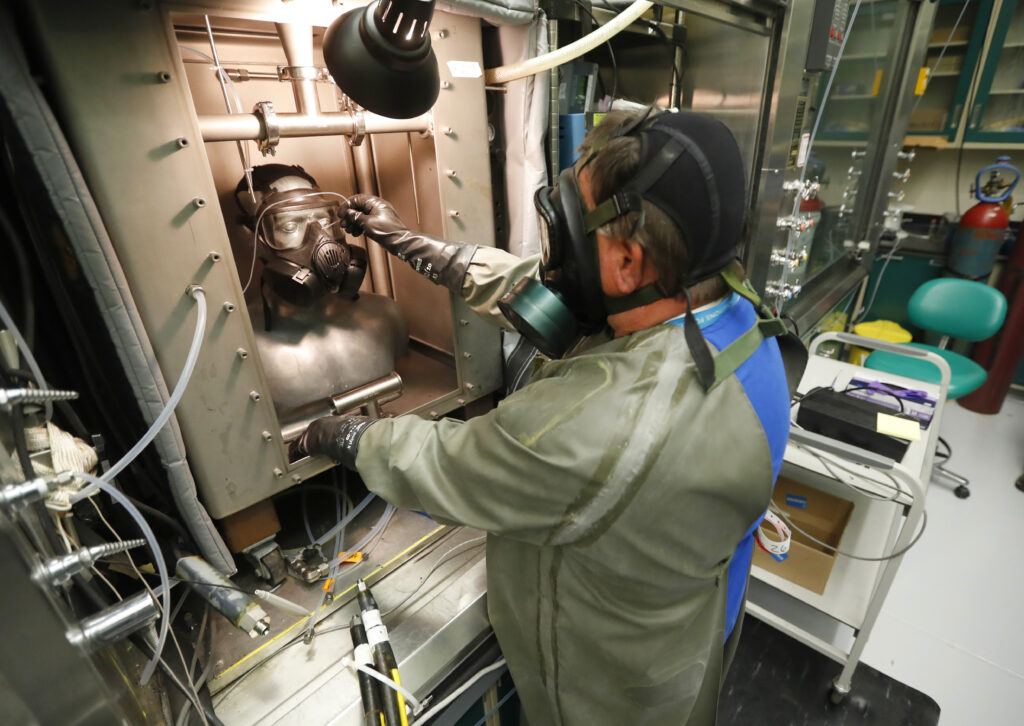
George F. Will’s July 30 column, “‘Biological War’ is a disturbing summons to seriousness,” which reviewed Annie Jacobsen’s “Biological War: A Scenario,” treated an existential risk with the seriousness it warrants and without the media’s usual theatrical embellishment. The central observation is exact: After 25 years of laboratory advances, the threshold for catastrophe has dropped so low that it is now “horrifyingly easy” to imagine an accident or a rogue actor tipping the human species into irreversible decline.
Will captured the asymmetry well. Nuclear weapons still require industrial-scale infrastructure, state-level organization and a certain bureaucratic visibility. A weaponized pathogen requires little more than competence, access and the absence of sufficient restraint. The same scientific progress that has given us mRNA vaccines has also lowered the barrier to extinction-level mischief. Jacobsen’s scenario simply follows that logic to its end.
One is left with an uncomfortable historical parallel. The 20th century taught us to fear the mushroom cloud; the 21st might teach us to fear the quiet laboratory. The difference is that the latter can begin with a single unlocked door or a single unexamined assumption. Seriousness, in this context, is not an attitude. It is the minimum condition for continued existence.
David Woodard, Tampere, Finland
Nurses’ skills don’t stop at state lines
Jarrett Skorup’s Aug. 7 op-ed, “When these licenses can’t cross state lines, consumers suffer,” rightly argued that state licensing barriers prevent qualified health professionals from practicing where they are most needed, leaving patients with fewer choices, longer waits and higher costs. But licensing portability is only part of the problem.
I am a nurse practitioner, so I know that what a clinician is permitted to do can also change at the state line. Currently, 27 states, D.C. and two U.S. territories grant nurse practitioners full practice authority. This allows us to evaluate and diagnose patients, order and interpret tests, prescribe medications, and initiate and manage treatment under the authority of the state board of nursing.
In states without full practice authority, nurse practitioners may be required to maintain physician supervision or enter costly collaborative agreements, even though they have met the same national education and certification standards as those practicing independently elsewhere. These restrictions can hinder the recruitment and retention of clinicians, particularly in rural communities that are already experiencing primary care shortages. A license that crosses state lines accomplishes little if the clinician’s ability to care for patients does not travel with it.
States should modernize both licensing portability and scope-of-practice laws so qualified clinicians can provide the care they were educated, certified and licensed to deliver.
Richard Ricciardi, Washington
The writer is the executive director for the Center for Health Policy and Media Engagement at George Washington University.
Standards can counter China’s AI advantage
Patrick Childress’s Aug. 5 online op-ed, “How China can corner the AI market with inferior technology,” was right to note that there are effective non-tariff trade policies the United States could implement to create alternatives to the adoption of low-cost Chinese artificial intelligence models.
Previous efforts to root out Chinese components from sensitive telecommunications infrastructure could provide a useful model. In President Donald Trump’s first term, the U.S. created the Clean Network with allied governments and the private sector to adopt standards for telecommunications equipment to ensure that it was secure. It led companies and governments to purchase equipment only from vendors that satisfied these standards. A similar standards network for governments and firms deploying AI models could ensure that trustworthy models are used in critical infrastructure systems internationally.
Ben Richmond, Pleasantville, New York
Keep illegally caught seafood off of plates
The July 28 editorial “How China’s illegal fishing fleet evades justice” noted that China’s vast distant-water fishing fleet is “allegedly subsidized by their government.” But there’s another source of support: unknowing American consumers.
Seafood linked to illegal, unreported and unregulated fishing enters the U.S. market due to gaps in traceability requirements and inadequate funding for enforcement. This means U.S. dollars are driving these destructive fishing practices, fueling forced labor and undercutting law-abiding American fishermen. The United States must do better.
The editorial rightly points out that transshipment — the transfer of catch, crew and supplies between vessels — can enable longer voyages, but it can also obscure where seafood was caught and by whom. Without stronger monitoring of transshipment at sea, illegally caught fish can be mixed with legitimate catch and enter U.S. supply chains.
The U.S. should invest in additional at-sea enforcement as well as seafood traceability and import monitoring. Better funding for transparency in the seafood supply chain is essential to block bad actors, prevent illegally harvested seafood from entering U.S. markets, and ensure American consumers are not subsidizing illegal fishing or forced labor.
Max Valentine, Washington
The writer is a campaign director and senior scientist at Oceana.
Letter submissions
Send letters to [email protected].
Submissions must be exclusive to The Post and should include the writer’s address and day and evening telephone numbers. Letters are subject to editing and abridgment. Please do not send letters as attachments. Because of the volume of material we receive, we are unable to acknowledge submissions; writers whose letters are under consideration for publication will be contacted.
The post ‘Extinction-level mischief’ is easier than ever appeared first on Washington Post.