BERLIN — In an address to commemorate Kristallnacht — the 1938 Nazi pogrom against Jews — German President Frank-Walter Steinmeier last month offered a solution for the resurgence of right-wing extremism: banning the nationalist, anti-immigrant Alternative for Germany (AfD) party.
Surveys show that the AfD, now the second-largest faction in the German parliament, is at least as popular as the Chancellor Friedrich Merz’s center-right Christian Democratic Union and attracting far more support than Steinmeier’s center-left Social Democratic Party.
Steinmeier’s comments further stoked a heated debate in Germany over whether to try to ban the AfD, which has been classified as an extremist group by German domestic intelligence.
To many Americans, the idea of banning a party that enjoys support from roughly a quarter of the voting-age population might seem undemocratic, something out of autocratic nations like Russia or China. But Germany, guided by its determination to avoid a repeat of Nazism, included a provision in its postwar constitution to allow banning parties that aim to subvert the constitutional order.
“We lost democracy once to a right-wing extremist party — foes of democracy that used the rules of democracy to abolish them,” Ralf Stegner, a social democrat and one of the German parliament’s leading advocates for banning the AfD, said referring to Adolf Hitler’s democratic election followed by his establishment of a dictatorship. “We cannot be unserious about preventing this kind of thing.”
Beatrix von Storch, a deputy AfD leader in parliament, argued that a party ban would be antidemocratic and open the door to prohibiting other conservative parties, such as Italian Prime Minister Giorgia Meloni’s Brothers of Italy and Nigel Farage’s Reform UK in Britain.
“If in Germany, the strongest party in opinion polls, the largest opposition party, can be banned, then Meloni can be banned,” von Storch said in an interview. “Then the Democrats can ban the Republicans. Then Keir Starmer can ban Nigel Farage.”
In May, Germany’s domestic intelligence agency labeled the AfD an “extremist endeavor,” citing its anti-Muslim and anti-immigrant stances and concluding that it “disregards human dignity.” The designation allowed for more state surveillance of party members and prompted calls for banning the party. It also drew the ire of some U.S. politicians — including Secretary of State Marco Rubio, who called it “tyranny in disguise” — and led a prominent far-right activist to seek asylum in the United States, alleging persecution.
Germany’s 1949 constitution, called its Basic Law, states that political parties are unconstitutional if they “seek to undermine or abolish the free democratic basic order or to endanger the existence of the Federal Republic of Germany.” Since then, two parties have been banned: a Nazi successor party in 1952 and a Communist party in 1956, when East Germany and West Germany were still separate countries.
More recently, efforts to ban the far-right National Democratic Party (NPD) failed — first, in 2003, because the party rolls were full of confidential state informants, and later, in 2017, because the party was so marginal that the constitutional court found it did not pose a real threat to take power.
That’s not the case with the AfD, which finished second in February’s federal elections and is now neck and neck with the governing CDU in most polls, often posting small leads within the margin of error. In state elections next year, polls suggest the AfD will receive by far the most votes in two eastern German states, though it’s unclear if it will secure an outright majority or if mainstream parties will consider entering into governing coalitions with it.
On a national level, the AfD and CDU each have about 25 percent support in Germany’s multiparty system — nowhere close to a majority.
The AfD has surged to dominance in the economically struggling states of the former Communist East Germany. In the past year, it has also made strong recent gains in the west, attracting voters who are unsettled by the wave of migration to Germany over the past decade, who are opposed to European political institutions, or are simply disaffected with mainstream parties and the status quo.
“Our constitution is clear: A party that embarks on the path of aggressive hostility toward the constitution must always reckon with the possibility of being banned,” Steinmeier said in his speech, without mentioning the AfD by name.
The German president holds a largely ceremonial role and is supposed to stay above the political fray, and the AfD responded angrily to his comments. “Never has a president abused his office in this way,” Bernd Baumann, a member of the AfD’s leadership in parliament, told the newspaper Handelsblatt.
The federal administration or either house of parliament can request to initiate court proceedings for a ban. But the CDU has been broadly wary of doing so, in contrast to many members of the center-left SPD, the junior partner in the governing coalition.
Merz said earlier this year that he was “very skeptical” of a ban, which would “smack too much of eliminating political rivals.”
Interior Minister Alexander Dobrindt, also from the center right, has said he wants to “govern [the AfD] away” by adopting policies that will peel off its voters, such as a tougher stance on immigration. But even as the administration’s crackdown has reduced the number of people crossing the border, the AfD’s standing in polls has only grown.
“The immigration issue is owned by the AfD,” said Kai Arzheimer, a political scientist at the University of Mainz whose research focuses on right-wing extremism. “The longer the mainstream parties keep immigration at the top of the agenda, the better for the AfD.”
Günther Krings, a CDU member of parliament who serves as the party’s legal policy spokesman, said he was open to a ban, but that the legal case must be rock-solid. He’s not persuaded that this one is.
“If you bring this to court, if you move for a party ban, you’d better win,” Krings said. “Because the negative outcome would be very problematic.”
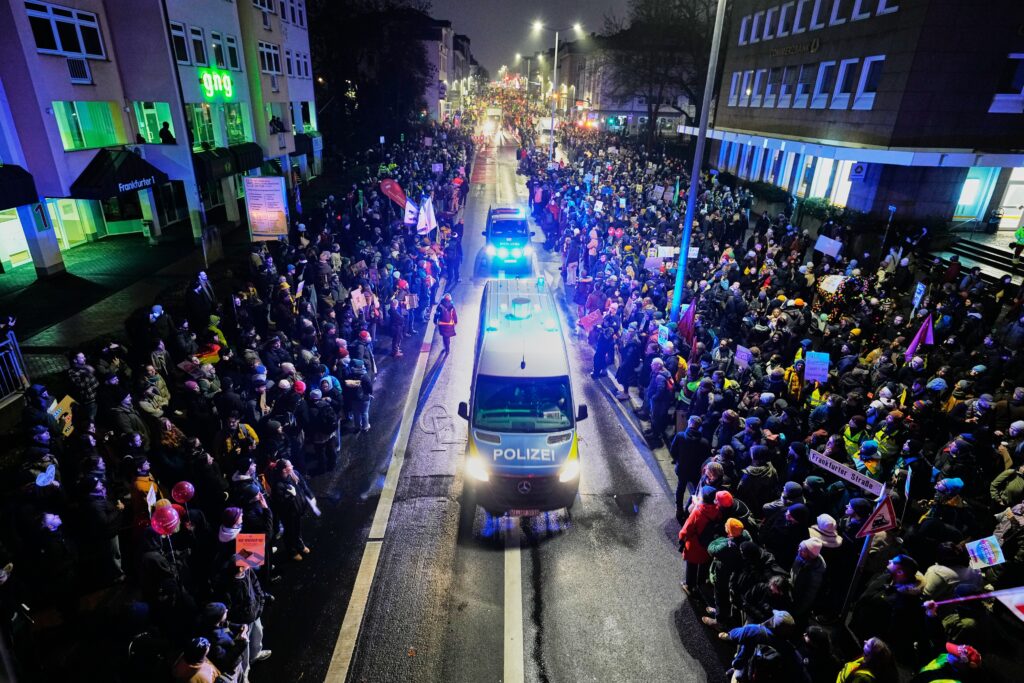
Part of the case for a ban rests on an explosive January report by the nonprofit investigative news organization Correctiv that senior AfD members had recently held a secret meeting in Potsdam, outside Berlin, where they discussed plans for mass deportations if they came to power, potentially including legal residents or citizens with “non-German backgrounds.” The report led to huge street protests, drawing an estimated 1.4 million people, and calls to ban the party.
But Krings said the party’s slippery position on migration could allow it to beat back charges that it’s planning to strip Germans of their citizenship, since some party leaders are pushing only for changes to limit future German citizenship.
A court ruling against the ban, Krings said, could be interpreted as a stamp of approval, affirming the AfD and its constitutional legitimacy, which would only bolster its standing.
Malte Engeler, a former judge who helps lead the campaign AfD Verbot Jetzt! (Ban the AfD Now!), disagrees, arguing that the legal case is strong, based on AfD proposals to redefine German legal residency along racial and ethnic lines. “The chances of succeeding are higher than not succeeding,” Engeler said. “The issue is gaining the political will to actually do that.”
Engeler said it is important to try to stop the party before it assumes power on a state or federal level, at which point a ban would become much harder. “The best time to do the banning procedure would, I guess, be five or 10 years ago,” he said. “The second-best time is now.”
The contentious debate over an AfD ban has scrambled alliances, bred confusion and led to unusual scenes, such as the SPD’s Berlin deputy state chairman recently displaying a “Ban the AfD now” sticker on his laptop as he voted against a motion to do exactly that, according to German media reports.
The country is deeply divided over a ban, polls show. A survey published in September found 42 percent of respondents in favor and 42 percent against; another poll a month later found public opinion tilting slightly against ban proceedings. Even many Germans who strongly oppose the AfD think a ban would be the wrong move.
“I’m completely against the ban,” said Rüdiger Becker, 69, as he drank coffee at a cafe in the Charlottenburg neighborhood of Berlin. “We live in a democracy.”
“I’m of the same opinion,” Cornelia Stark, 66, chimed in. “There’s a reason that so many people vote for them. Whether I agree with that opinion or not is irrelevant. But banning it simply isn’t an option.”
At a nearby cafe, Eckart Wurm, 73, said, “It’s already too late. The ban should have come earlier. They’re too powerful now. They’re already too strong and have too many followers.”
Asked if he supported the party, Wurm exclaimed, “For heaven’s sake, they’re the worst thing that could happen in Germany.”
Some members of the AfD have taken up the ban debate as a rallying cry. At a party event in the eastern German town of Senftenberg this summer, Hans-Christoph Berndt, the AfD leader in the Brandenburg state parliament, declared: “Within the next five years, we’ll either be banned and locked up in prison, or we’ll be in charge and fix this country!”
Stegner, the SPD member of parliament pushing for a ban, said he agreed that a failed attempt could strengthen the AfD. “It would be very bad if we lost this procedure and the supreme court decided against it,” he said. “But it’s worse if we don’t try it.”
He said that he views the debate less through a tactical lens than through an intergenerational moral one, guided by the fear that Germany might fail to learn from its terrible mistakes in the 1930s.
“What is the consequence if we don’t do this?” he asked. “That maybe our children and grandchildren would say, ‘You know what can happen and you failed in your responsibility to act.’”
The post Can Germany stop extremism by banning a far-right party? Some want to try. appeared first on Washington Post.