As a boy, I found myself in Huck Finn heaven after our family moved to a new tract house amid a ponderosa pine forest in Spokane, Wash. During the summer, we free-ranged out from our street, Indian Trail Road, swimming in an idle river and building tree forts from plywood leftovers at the suburban frontier.
Further out, on camping trips in nearby national forests, we came upon charred tree husks from an inferno of legend and epic ferocity — the Big Burn of 1910. It ravaged an area about the size of Connecticut, more than three million acres, in a weekend, and still stands as the biggest wildfire in American history.
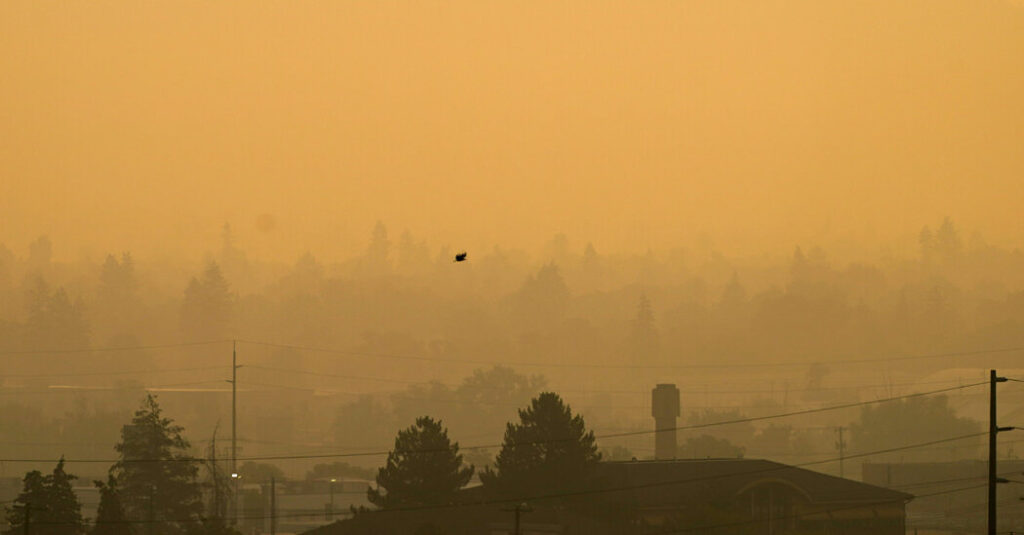
The blaze of 1910 spared Spokane, the largest city between Minneapolis and Seattle. But the fires of 2026 did not. I watched, heartbroken and sleepless, from a smoke-choked vacation retreat in eastern Washington as my old boyhood stomping ground fell to spikes of wind-driven flame last weekend.
Indian Trail Road was at the heart of a “war zone,” in the words of a National Guard general. Over 60,000 people, equal to one-fourth of the city’s population, were forced to evacuate. Mayor Lisa Brown called the Spokane Complex fires the “worst natural disaster” in the region’s civic history.
Nature on a rage was the main culprit. But an arsonist, allegedly, and conditions exacerbated by a global climate crisis were co-conspirators in the collapse of this formerly sylvan setting.
In an instant, a hot August Saturday was windblown into adrenal-surged panic. Friends and family members fled as lawns and shrubs caught fire, roofs went in a poof, bedrooms melted into fuel. They faced a giant plume of smoke, the pop-pop-pop from explosions, the smell of burned plastic. One of my childhood pals refused to go. He clambered atop his house, trying to set up a sprinkler to save his home. He slipped and fell, fracturing bones in three places. Hundreds, if not thousands, of people lost their homes, but miraculously no fatalities have been reported. The danger has yet to pass, as a new round of high winds and warm temperatures has left families in evacuation shelters wondering if their neighborhoods will make it through the coming days.
In a summer when France, Greece and Spain are burning, when southern England just recorded its driest month since records began almost 200 years ago, when New York and Chicago gagged on smoke from the faraway north, when the two largest reservoirs in the United States (on the Colorado River) shriveled to a combined record-low water level, it may seem provincial to dwell on a fire in your hometown.
But the lessons — some of them heeded, others ignored in the way of multigenerational hubris — from the Big Burn and this year’s tragedy are universal.
No one alive had ever seen anything like the flames that roared through parts of Washington, Idaho and Montana that Saturday night of August 1910. And no one had any idea how to contain them. For many people filling the new towns of the American West, fire was the last great fear. Wolves and grizzly bears had been nearly wiped out. Natives Americans were forced onto reservations, their populations crushed by disease and war. All that remained was fire.
Channeling a nation feeling its mid-adolescent invulnerability, Gifford Pinchot, the brilliant father of the Forest Service, made a prediction just before the woods blew up. “Today,” he stated, “we understand that forest fires are wholly within the control of men.”
He was asking for it.
Assembling an army of immigrants, convicts, loggers and Black troops known as Buffalo Soldiers, the fledgling Forest Service tried, for the first time, to attack a major wildfire. It failed miserably.
Some years later, the Forest Service adopted the 10 a.m. policy: Any wildfire spotted was to be snuffed by midmorning the next day. It suppressed many blazes, but put nature out of whack, allowing a huge fuel load of trees and brush to build up. Late in the 20th century, most foresters recognized that fire had a place. But they have since been alarmed by how big, how early, how hot, long and destructive the wildfires of the past 25 years have been. The new normal is catastrophe in places where people live, any month of the year, from Florida to Alaska.
The term of unpeaceful coexistence in the West was “wildland-urban interface.” In other words, we moved by the millions into the forests, the grasslands, the wilderness itself, and nature did what it always does. People throughout the region were told to clear safety buffers in the brush and trees around their houses, live under metal roofs, and expect to flee on any given summer day. That was the price.
I’d always assumed that in the cities a modern urban layout of tight, hard-surface grids and adequate fire departments would keep everyone safe.
As kids, we felt no fear. Those yellow-clad men and women jumping from low-flying planes into the maw of an inferno, our heroes, were dropped into neighboring public forests. Fire would never touch us.
The Spokane blaze, like the Southern California monsters that took down thousands of homes around Los Angeles in January of 2025, is forcing us to rethink the nature of the beast. Three major fires, one of them probably caused by an arsonist, roared through block after block, cul-de-sac after cul-de-sac, as if the human hand had never touched the landscape.
As Pinchot learned and lamented late in life, people can shape nature, but we cannot control it. If only President Trump had an ember of the founding forester’s insight. He blamed this summer’s fires in Canada’s vast and largely unpopulated boreal forests — the cause of bad air in many American cities — on poor management. He’s chosen negligent denial and willful ignorance over common sense, suggesting that “raking” forest floors in the West would prevent disasters.
Raking? In Spokane, some of the most manicured landscapes anywhere, in suburbia at its most refined, did not stand a chance against flames that jumped a river and stormed into backyards. In Washington, the Evergreen State, a drought emergency was declared in April. Driven by extreme heat and calcified land, fires have already consumed more than five million acres nationwide in 2026, well above the yearly average for this time of year. And the Pacific Northwest — known for peaks topped by millenniums-old glaciers, deep-green forests and clean mountain air — has been hit harder than any other region in the country.
Globally, nearly every year of late is hotter than the one before, and these changes make wildfires worse. Extreme infernos have more than doubled in frequency and intensity this century. I hesitate to say “duh” because that sounds like cynical surrender.
We are not powerless. “We shape our buildings,” said Churchill; “thereafter they shape us.” We need zoning and building codes for a hotter, drier world, which many cities have already put in place. For those who live in a fire zone, a sprinkler system on the roof, to match those in the ceiling of new buildings, might help.
The polling on human-caused climate change tells us that while most Americans believe it is happening, only about half think it will significantly threaten their way of life. It’s too often an academic debate, or a shouting match between pundits, or met with a shrug. The mournful site of my old neighborhood, the blackened playgrounds, the chimneys standing alone in the graveyards of homes that held three generations of memories, ashes and embers falling like snow in 90-degree heat, tell me something more personal. Loss. And grief. And a sense of urgency.
Timothy Egan is the author of “A Pilgrimage to Eternity: From Canterbury to Rome in Search of a Faith,” among other books, and a winner of the National Book Award for nonfiction.
The Times is committed to publishing a diversity of letters to the editor. We’d like to hear what you think about this or any of our articles. Here are some tips. And here’s our email: [email protected].
Follow the New York Times Opinion section on Facebook, Instagram, TikTok, Bluesky, WhatsApp and Threads.
The post A War Zone in Your Backyard appeared first on New York Times.