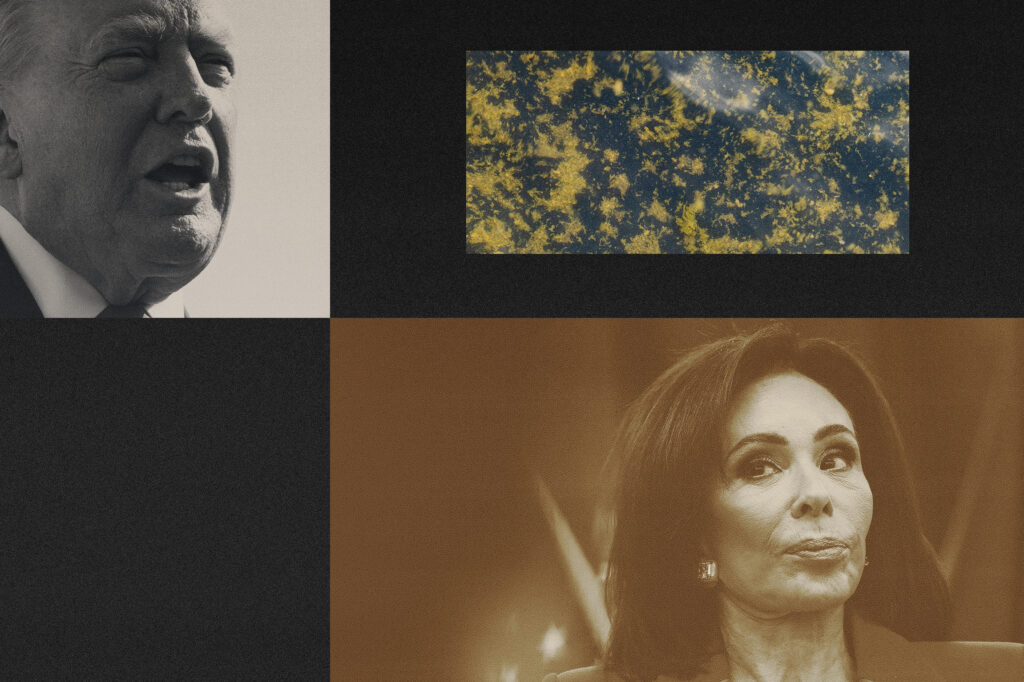
Jeanine Pirro swept into Washington last year as a camera-ready prosecutor and staunch ally of President Donald Trump. Suddenly she was everywhere: crime scenes and community forums, court hearings and TV interviews, TikTok-style videos and black-tie dinners.
But after more than a year in office as U.S. attorney in the nation’s capital, Pirro now finds herself at odds with Trump — with her job at risk — over scraps of blue liner that peeled off the Lincoln Memorial Reflecting Pool.
Pirro, who left her job as a Fox News host to become the top federal prosecutor in D.C., immediately began seeking the toughest charges possible for violent crimes. She launched criminal probes of more than a half-dozen public officials who had drawn Trump’s ire — then punted the blame to judges and juries when those efforts collapsed.
But her moves to drop several cases of alleged vandalism at the newly renovated pool contradicted Trump and blamed the administration’s handpicked contractor for botching a project the president had championed. And in the end, they exposed a crack in Pirro’s ability to balance Trump’s demands with her legal responsibilities.
“She thought she had covered all of her bases — that’s what she thought — and then, of course, things went south,” a person who has known Pirro for decades said of her current predicament with the president.
People who have followed Pirro’s trajectory as a judge, district attorney, conservative author and TV personality say she is a prosecutor at heart who has long been passionate about fighting crime and protecting victims, and who found a renewed sense of purpose when Trump tapped her to run one of the busiest U.S. attorney’s offices in the country.
Her detractors say few in the Justice Department have been as willing as Pirro to gin up prosecutions or test the boundaries of the system in pursuit of Trump’s fixations and antagonists.
This account of Pirro’s tumultuous time as U.S. attorney, and how she has handled being the prosecutor in Trump’s backyard, is based on court records and interviews with 11 people familiar with key events. Almost all spoke on the condition of anonymity to offer candid assessments of Pirro while her job is seemingly on the line. Pirro, through a spokesperson, declined an interview request.
Her troubles began after the Trump administration installed a coat of blue sealant at the Lincoln Memorial Reflecting Pool in anticipation of this year’s July Fourth festivities. Pieces of paint quickly started coming apart and floating to the surface, and some visitors who reached out to grab them were arrested, court records show.
Trump claimed vandals had torn up the pool’s “beautiful facade,” and Pirro initially filed criminal charges against four people, including a former Olympic canoeist who was indicted on a felony count of destruction of property. In her booming New York brogue, Pirro castigated that defendant at a news conference and said her office was “committed to protecting our national resources, our monuments, and our parks from vandals.”
But Pirro abruptly dropped all four cases weeks later, blamed the Interior Department for misleading prosecutors into filing unsupported criminal charges and was soon inside the Oval Office to explain herself.
A former judge and district attorney who served for decades in Westchester County, New York, Pirro arrived at the White House on Monday with boxes of evidence showing that the Interior Department had awarded a no-bid contract to a company that misapplied the liner, according to people familiar with the matter. That evidence is detailed in an explosive, 20-page court filing that the U.S. attorney’s office submitted last week, which stated that “the damage was the result of a botched installation and not vandalism.”
Pirro had personally reviewed and signed off on the filing, and it conveyed her frustration that the documents from Interior were not quickly turned over to prosecutors, as well as her view that they “demolished” any chance of building a winning case against the alleged vandals, according to people with knowledge of her thinking. Interior Secretary Doug Burgum pushed back, writing on X that the “evidence is clear” that vandalism was what damaged the pool.
One person familiar with Pirro’s thinking described her approach to the White House meeting as: “Stand her ground, be focused, make her case, and do the right thing.”
The rift between Trump and Pirro, over peeling bits of paint at a national monument, came after she had launched criminal probes into six Democratic lawmakers who criticized the administration’s military actions, as well as the Federal Reserve chair at the time, Jerome H. Powell, who refused Trump’s demands to resign or institute lower interest rates.
A federal judge rejected Pirro’s attempts to issue subpoenas in the Fed investigation, and she later closed that probe without seeking criminal charges, but Trump praised her doggedness in taking the case as far as she could. A grand jury declined to indict the Democratic lawmakers, and Trump soon moved on to other issues.
This time, Pirro’s office said in the Reflecting Pool court filing, prosecutors were voluntarily dismissing the charges. Trump said Pirro “folded like an umbrella.”
“I just think she was totally wrong,” Trump told reporters Wednesday, noting that National Park Service employees had told authorities they saw vandals in action. He described problems with the contractor as “a couple of little things” and said he hadn’t made a determination on whether to keep Pirro on the job.
Trump continued his criticism Friday, saying on social media that “U.S. Attorney Jeanine Pirro should revisit her hastily made decision.”
Pirro had befriended Trump decades ago in New York’s social circles, but they had never worked together, and one dynamic underlying their rare public break is that both are more comfortable calling the shots than deferring to others, said the longtime friend, who has seen them together.
“She has a lot of respect for the president,” this person said, adding, “They have a relationship that for the first time has now transformed into a professional subordinate situation.”
Pirro, 75, leads the only U.S. attorney’s office in the country with the dual mandate to prosecute local crimes and complex federal cases. Trump named her interim U.S. attorney in May 2025. She was later confirmed by the Senate, earning support from Republicans that Trump’s first pick for the job, Ed Martin, couldn’t muster.
She came into a deep-blue city where only 6.5 percent of D.C. voters cast ballots for Trump in the 2024 election. Protests flared when immigration raids and street arrests swept up hundreds of people after Trump declared a crime emergency in D.C. last year, bringing in teams of federal officers and National Guard troops to patrol city streets. Pirro has often been the one absorbing the blowback from heated community meetings and in court, where juries have voted down felony charges for some defendants and acquitted others of assaulting federal officers.
“The truth is that with the federal surge — whether you like it or you don’t like it — crime is down,” Pirro told the dozens of community members in the D.C. police’s Fifth District office in Northeast Washington after a tense weekend last October in which 12 people were shot.
Homicides last year declined by roughly one-third, totaling 127, according to D.C. police statistics. They have dropped another 32 percent this year, and stood at 66 as of Thursday. Robberies and property crimes also have declined, but assaults with dangerous weapons have risen 42 percent this year, to 758 instances, according to the police data.
“President Trump said, ‘I’m going to make D.C. safe and beautiful,’” Pirro added at the October meeting. “And you know what? He’s going to do it. … Every day we’re pushing. Pushing against juries, pushing against judges.”
On social media, she frequently repeats a similar message, crediting the president with making the city safer.
Those who have worked with Pirro describe her as a decisive boss, quick to grasp legal nuances and less abrasive than her brash TV persona. She has taken a particular interest in a new task force to disrupt international cryptocurrency scams, and she has called on the D.C. Council to toughen sentencing laws for juvenile crimes and partnered with Mayor Muriel E. Bowser (D) on efforts to strengthen domestic violence legislation. Pirro, according to those who know her, is meticulous about her fashion choices, known for her sweet tooth and on friendly terms with some of her staff, attending trivia night at a brewery-slash-pizzeria this year.
Pirro has attempted to rebuild the U.S. attorney office’s ranks, which were decimated by staff departures and Martin’s purge of prosecutors who had investigated the Jan. 6, 2021, attack on the U.S. Capitol. The Justice Department is now offering $25,000 bonuses to lawyers who sign a commitment to stay at the office for two years, according to two people familiar with the matter, who spoke on the condition of anonymity because they were not authorized to discuss it.
“I think that U.S. Attorney Pirro, over the past year and a half that she’s been there, has led an unprecedented effort to literally turn this city on its head to be a safe place for all of us to live and eat,” acting attorney general Todd Blanche said at a news conference Wednesday, a notable show of support that buoyed Pirro’s allies. Blanche added that Trump was allowed to dismiss any U.S. attorney.
Although Pirro’s office has had a mixed record with jury trials in U.S. district court over the past year, there have been no major setbacks in the office’s biggest cases. Those include the prosecutions in the killing of a 21-year-old congressional intern; the fatal shooting of a young couple outside the Capital Jewish Museum last year; the ambush-style attack in which one National Guard member was killed and another wounded; and the case of Cole Tomas Allen, who has been charged with attempting to assassinate Trump at the White House correspondents’ dinner this year. The trial of an alleged terrorist behind the infamous bombing of Pan Am Flight 103 over Lockerbie, Scotland, is scheduled for this year in D.C., with Pirro’s office running the prosecution.
But critics say Pirro has curtailed prosecutors’ autonomy and jacked up their workloads by ordering them to seek the maximum possible charges in every case. Judges and public defenders have criticized Pirro’s office for bringing cases during Trump’s federal law enforcement surge that were based on incomplete or shoddy investigations, leading to multiple instances in which the U.S. attorney’s office dismissed charges after the defendants spent time in jail.
“I think many Americans have a sense that in Trump 2.0, prosecutions are being brought for reasons other than public safety,” Paul Butler, a Georgetown University law professor, said in an email assessing Pirro’s record as U.S. attorney. “We are now seeing many jurors more carefully scrutinizing cases, and that’s a good thing in terms of how the system is supposed to work.”
Longtime defense attorney Joe Flood, who practices in the D.C. area, recalled that he first encountered Pirro in the 1990s when she was the Westchester County district attorney and he was defending people facing the death penalty in New York. She made death-penalty cases central to her political ambitions, he said, as she geared up for a potential run for state attorney general or governor, but she never got a defendant sentenced to death and eventually left elected office for her television career.
In Trump’s second term, Flood said, some U.S. attorneys in key offices have discovered that being a responsible prosecutor is sometimes a fireable offense. He noted that Erik S. Siebert, whom Trump had appointed as the interim U.S. attorney for the Eastern District of Virginia, was forced out last year after declining to seek criminal charges against former FBI director James B. Comey and New York Attorney General Letitia James. Career prosecutors in both cases had said the evidence was too flimsy to take to court.
“The reality is if you’re an ethical U.S. attorney and you won’t be bent to Trump’s will, you’re gone,” Flood said. Of Pirro’s decision to drop the Reflecting Pool cases, he added: “She gets some credit for standing up to Trump.”
Judges have also called out Pirro’s office for wiping out the most serious convictions from the Jan. 6 riot — the seditious conspiracy cases against the far-right Proud Boys and Oath Keepers.
Members of the extremist groups stockpiled firearms and led the charge into the Capitol, according to the evidence presented at their trials. Pirro this year signed on to key court filings to clear those charges as a matter of loyalty to Trump, according to people familiar with the matter. But she declines to take questions about those moves, even as federal judges bemoan the historical consequences of undoing convictions for crimes against the country.
Perry Stein, Jeremy Roebuck and Rachel Kurzius contributed to this report.
The post Pirro, Trump’s longtime champion, is on the outs over Reflecting Pool move appeared first on Washington Post.