What is it about American and global politics that feels so destabilizing right now? Perhaps this is what it feels like to live through revolutionary times.
That is what Ivan Krastev, a political theorist who lived through a post-Communist revolution in his home country, Bulgaria, has been thinking. He has been reflecting on European and American politics and how we ended up here. He tried to make sense of this moment in politics in a written conversation with John Guida, an editor in Times Opinion. It has been edited for length and clarity.
John Guida: You were asked recently how you feel the world — not understand it, but feel it — and you said, “It’s very much like a vertigo.” How so?
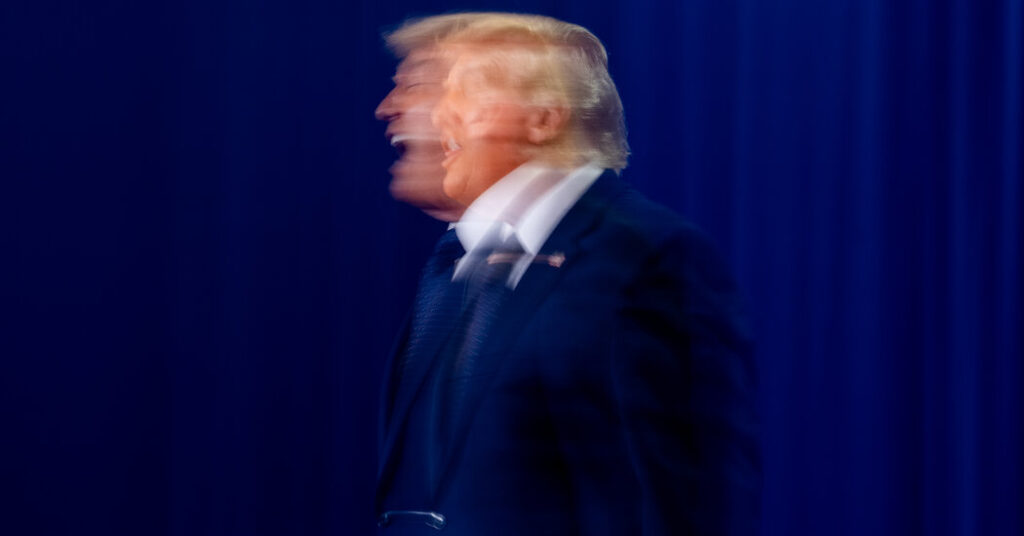
Ivan Krastev: The great Czech-French writer Milan Kundera has observed that vertigo is “something other than the fear of falling” — “it is the desire to fall, against which, terrified, we defend ourselves.” This is what I feel when we talk about political time in both Europe and America. Politics has become very fast. It reminds me of the early 1990s in Eastern Europe. On Friday you cannot believe what you were thinking on Monday. The speed of change is mind-blowing. It feels you are living in revolutionary time — but if this is a revolution, it is a revolution without a project.
Normally revolutions are obsessed with the future, while one of the distinctive characteristics of our time is the negation of the future as something we are ready to make sacrifices for. In the Cold War, America and the Soviet Union had very different visions of the future, but they shared political time. Not anymore. President Trump shrinks time, thinking in terms of weeks. President Vladimir Putin extends it, thinking in terms of centuries.
There is a joke that before Putin invaded Ukraine the people he consulted were Peter the Great, Catherine the Great and Ivan the Terrible. On the other hand, Trump will quickly reverse a decision he just made — it is a stream of constant choosing at the cost of making an actual decision. So in Europe, we have a war in Ukraine that is now longer than World War I, while in Iran, you need to check the news every hour to know if the war has stopped or restarted.
Guida: What do you think explains Trump’s capacity to avoid the grip of political time? You’ve described a Trump “time zone.”
Krastev: In the first year of his return to the White House, Trump’s political speed helped him to take the initiative. He was doing things so fast that he left others living in a state of total disorientation. But now — and this is very clear in the case of war with Iran — Trump has become the victim of his own time zone. It’s almost as if he can take two contradictory positions at the same time — a quantum revolution in politics. But the magic of his words is starting to fade away.
The constant reversal of position results in political impotence. The markets, but also Trump’s allies and his enemies, started to dismiss what the president is saying. Political time is reduced to a moment without history or future. Trump does not wait for others to name buildings after him; he does this himself, and this creates some sense of apocalyptic time.
Guida: Do you think that narrowing of time has affected the posture of the United States? America has traditionally been seen as a country leading the way into or certainly open to the future. Now we are torn in ways that call back to the past: on the one side, MAGA; on the other, socialism. What happened to the future?
Krastev: The future has vanished. The only future we talk about are different dystopian scenarios involving climate, demography, artificial intelligence. The disappearance of the future is a major contrast with America’s history and America’s self-understanding.
America first defined itself in opposition to old aristocratic Europe; it was the New World, setting itself apart in categories like tolerance and freedom. In the Cold War, it defined itself in opposition to the Soviet Union, and because the Soviet project was obsessed with the future, the American project was also universalist and very much future-oriented. Now America, or at least MAGA, wants to replace the future with the past. Europeans have done it before, but America is not a European nation-state, so going back to the golden past is not easy.
Guida: You have noted that you look around and see a lot of people — not just in the United States, I assume you think this is true of Europe as well — who are defending something they are afraid of losing. The future, as you said, “becomes something we fear.” Is this attitude an aberration, or a new normal that is being revealed to us and that we better get used to, if there is any getting used to it?
Krastev: Shared fear of the future cannot bring the world together, because there is one thing that is more terrifying than that we all will die, and that is that some will die and others will be immortal. It is interesting to compare student protests in the 1960s to today’s. We will be shocked to realize that back then, young people protested because they did not want to live the lives of their parents; they wanted better lives. Today they protest because they fear — and for good reasons — that they will have lives worse than those of their parents. They demand to have something like the same quality of life that their parents did.
Nostalgia has become the popular form of dreaming about the future. One of the neglected aspects of the current demographic crisis is that young people are among the angriest minorities in Western societies — they do not have the numbers to win elections, and they do not have the resources to achieve their aspirations.
Guida: In Democratic Party primaries this past year, we have had a group on the progressive left, the Democratic Socialists of America — Zohran Mamdani of New York City is perhaps the best-known member — winning elections and highlighting some of the issues you refer to here. The demographic crisis has plagued Europe as well as America. Do you think America is still exceptional? Or has it become exceptionally dysfunctional?
Krastev: While yesterday America’s exceptionalism was defined by “it never happened here,” with “it” being fascism or Communism, today the only future America can imagine for itself is to become a Communist country, if you talk to the right, or to become a fascist dictatorship, if you talk to the left.
Mamdani, if we use the terminology of the 20th century, is a moderate social democrat. He is inspirational rather than visionary. He supports redistributive policies on taxation, for example, but not to nationalize the means of production nor to remake society. He is radical, in some ways, but he would not qualify as Leon Trotsky’s nephew. The paradox of the terms of “socialism” and “fascism” is that most of the people who use them — either to identify with them or to attack their opponent — are using them as a shortcut for signaling radicalism. The truth is that both America and Europe are poisonously polarized but in the absence of real radical goals.
Both Communist and fascist nations were pedagogical dictatorships. They were built by ex-soldiers who had lived for years with violence. They wanted to build a new society and a new man. Today in Western democratic politics what we see is a lot of hysteria but not radical visions for the future. Now what people care about is punishing those whom they blame for the lost future.
When people do not believe in the future, destruction and self-destruction are the same thing. It reminds me of a story: In the 1990s, during the civil war in Somalia, armed gangs would strip X-ray machines and other hospital equipment, knowing perfectly well that if they themselves were wounded, they would not have the benefit of those tools to get treated. Freed from a vision for better future, radicalism has a suicidal face.
Guida: How have American politics become Europeanized? And how have European politics become Americanized?
Krastev: Framing the choices of American politics as a choice between socialism and fascism is Europeanization. At the same time, migration is becoming the center of European politics. The percentage of nonnative-born Austrian, German or Swedish residents is higher than the percentage of nonnative-born residents in the United States, so integration of foreign-born citizens is central for European politics. This is what we call Americanization of European politics.
The problem in Europe is that suddenly nobody feels at home, neither migrants coming in nor the voters of the far right who would like to travel back in time to an imagined, more appealing past.
Guida: We’ve now seen several varieties of anti-establishment or anti-system parties, in Europe and the United States. Have any developed effective ways of governing or producing answers to the problems or challenges of our day (for instance, the development of A.I., inequality, inflation, the sense of unfairness, affordability, issues around social order)?
Krastev: No. Anti-system parties have learned to win elections, but for the moment they are failing to demonstrate any workable governing model. The dramatic defeat of Viktor Orban in Hungary is the most powerful demonstration of this. He was the model. And people decisively turned against his rule.
But politically 2027 will be a long year in Europe. It will start with the regional elections in eastern Germany this autumn that can topple the current German government. They will continue with elections in France, Italy, Poland and Spain. It will be a long and cruel year.
What we see is not simply the rise of the far right but the fragmentation of the far right and the emergence of new, more radical projects. This is true in Poland and Italy. We do not know how Europe will look in 2028. We see a similar trend in the United States: The anti-establishment sentiment is strong on both the right and left, but when it comes to governing, it is not clear what the alternatives are. In a way, the revolutionary sentiment is present, but this is the revolution of the passengers who have pulled the emergency brakes, to paraphrase Walter Benjamin.
Guida: Is part of the problem an issue with unsuitable governing units? In the Cold War, it was a world of blocs. In the post-Cold War, it was a globalized economy. Now we are in between global networks, which are often stressed or being demolished, and retreats to hard borders in response to China shock(s) and migration (among other things). How important is the establishment of a redefined, reset global order to the politics of these various nations?
Krastev: We are living in a world very different from the world of the Cold War. Probably our very idea of governance will change. Some of the changes we witness are really radical. Imagine for a moment that some of our most fundamental assumptions have been challenged. We disagree on many things, but we have tended to believe that the future will be better than today and that individuals are mortals but nations are immortals, and we continue living through our children, our sacrifices for the nation, our books.
Now some individuals — particularly in Silicon Valley, but also including people like Putin — are starting to genuinely hope that they will not die, some nations are starting to genuinely believe that they will die, and many young people for different reasons have decided not to have children. This political world cannot be understood or explained in the language of the 20th century. This is why neither awakening the utopian energies nor simply defending institutions will be enough to deal with the current crisis.
This is where this sense of vertigo comes from. In politics vertigo is when you see the abyss, but you are not sure: Is this the past or the future?
Ivan Krastev is chairman of the Center for Liberal Strategies in Sofia, Bulgaria, a permanent fellow at the Institute for Human Sciences in Vienna and a Financial Times contributing editor. John Guida is an editor in Times Opinion.
The Times is committed to publishing a diversity of letters to the editor. We’d like to hear what you think about this or any of our articles. Here are some tips. And here’s our email: [email protected].
Follow the New York Times Opinion section on Facebook, Instagram, TikTok, Bluesky, WhatsApp and Threads.
The post The Vertigo Theory of Trump 2.0 appeared first on New York Times.