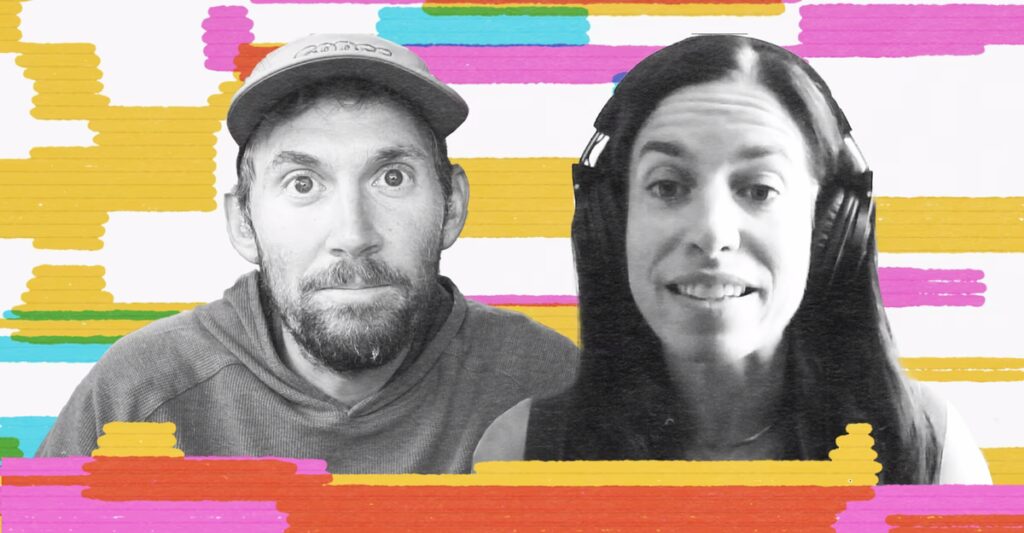
Most people spend more time than you think agonizing over their social-media posts. Kathryn Jezer-Morton wanted to understand their thinking—and when she dug deeper, she learned that redemption and optimization narratives are what the algorithm rewards, and therefore what drive the stories we tell. What does that mean for how we all think about ourselves? Charlie Warzel talks to Jezer-Morton about how authentic has become something different from true, and how people’s arcs on social media tend to point only upward.
The following is a transcript of the episode:
Kathryn Jezer-Morton: No one’s interested in scientific data as much as they’re interested in a really compelling anecdote. And this is just attention-economy stuff. This is because a really compelling anecdote is going to perform better for a number of reasons, whereas a big, longitudinal study is gonna have some interesting findings but it’s also gonna have some contradictory findings. Science is often much less, kind of, explosive than, like, this one dude who’s like, I took this supplement, and six months later, I am freaking jacked. You know, that’s cool.
Charlie Warzel: I’m Charlie Warzel, and this is Galaxy Brain, a show where, today, we’re going to answer a seemingly unanswerable question: How is social media changing the way we understand ourselves and even humanity as a whole?
By any account, I’ve been a somewhat prolific poster for at least two decades. Like most Millennials, I was a kid and high schooler in the pre-social-media days and went to college just as Facebook was taking off. This is partially why, as I’ve long argued, Millennials like myself are often uniquely tortured about social media: We’ve experienced it profoundly shaping our social lives, our culture, our politics, and ourselves, but we can also remember just enough of a time before it that we can see this process as something that was emergent. In other words, it’s not a given that our lives had to be mediated this way, by these massive platforms for viral advertising.
And so a few years ago, I was talking to another writer who is roughly around my age about what it’s meant to come of age in the attention economy. We talked about how fun and experimental all of this was at first, how exciting it was to be connected to everyone all at once. It was both intimate and incredibly public. But also about how quickly all the experimentation turned into something different; how we, without really even noticing it, began writing, posting, and performing—all for this imagined audience. And how we started imagining how that imagined audience would respond. How we’d see people get mocked or shamed or lavished with praise and internalize all of that in the back of our minds. How the way we spoke changed on specific platforms as the result of in-jokes, memes, and a shared culture that everyone was building at once.
This wasn’t necessarily a bad thing, though there are countless examples of the way that social media curdles people or pushes us to be the most neurotic, reactive, and uncharitable versions of ourselves. All these versions once felt separate from our actual selves, but over time they’ve become harder to untangle.
This is the subject of a new book by the writer Kathryn Jezer-Morton, titled The Story of Your Life: How Social Media Shapes the Way We Experience Everything. Jezer-Morton, argues that social media’s greatest influence might be how we understand ourselves as humans and not, as many critics have argued, its impact on attention spans or our politics. Humans are storytellers and always have been. And those stories help us understand the world and our place in it. I was drawn to Jezer Morton’s book in part because of her framing of social media: as a place where all of us who post are telling a collective story about what it means to be a person in today’s world.
In some sense, this is all obvious enough. But what’s less clear is what these platforms and stories are doing to all of us, whether you share your life on social media or you just lurk there. Are they making us more unique or more the same? What is highlighted in a culture that is mediated by algorithms, and what lived experiences are excluded? If social media is the lens through which we capture the story of our lives, is the aperture being widened or narrowed? Jezer-Morton brings a nuance to this polarizing topic, and she joins me now to talk about it all.
Warzel: Kathryn, welcome to Galaxy Brain.
Kathryn Jezer-Morton: Thank you, Charlie.
Warzel: So your book is about social media, but it’s really about how we make sense of ourselves and the world through personal stories. And so I wanted to start with you telling me just a bit about your own personal story growing up on a commune in Vermont and specifically how you feel that shaped your understanding of personal and communal narratives and how it’s sort of a foundation for some of your work in this book, but also on social media in general.
Jezer-Morton: Yeah, so I spent a lot of my childhood on a commune that my dad was part of the founding group of in southern Vermont, and I lived there on and off for a number of years. And I think that, for me, I was always really aware that it was a story. The whole place was a story. I knew that people lived together who weren’t family and that the place had this kind of rich history and that also like we were, kind of—we were hippies, and it was messy, and it was very, kind of, it was a bit of a chaotic vibe some of the time. And so I was being told these stories from when I was very young. And I think that it gave me this really rich understanding that a lot of what life is is storytelling. So when I got to college and we started using social media, I was like, This rules. This is so fun. I am like, I’m a natural. This is like, I was born to do this. And I really just took to it like a fish to water. And I think it was because I was like, No, this is what we do. We narrate ourselves. We bring ourselves to life through pictures and stories. And you know, it’s like a fun creative project. We’re basically narrating ourselves into being, and we get to do it however we want. But I think that as soon as I started using it, I was like, What are we all doing, though? Like, what are we actually up to? And from the very beginning—like I think I joined Facebook in 2007—I was like, This feels like there’s something going on here, and I think we’re doing something and we don’t even really know what we’re doing.
Warzel: Let’s go back a little, though, to you loving social media. I mean, one thing that’s very clear from your work is that genuine affection and also that, like, I’m not trying to tell you that posting is bad or that you know your screens are destroying you just because they’re there all the time. But I wanna go back to this. I have a very similar relationship to social media. It’s tortured, but it’s also, especially in the beginning, I was like, Wow, you made this thing for me. This is like—all I want to do is perform for different people and create this persona. What was part of the story you were crafting? What were you trying to do very early on in those, like the halcyon days?
Jezer-Morton: So I was freshly graduated from college. I was living in New Orleans. I was married. I was living this little professional life. And I think it was an opportunity to show the world, like, Check it out, guys. Like this is me and my little life. And it was very Millennial. There’s something very deeply cringe about it, looking back, like, Here’s my house, and Check it out. We made gumbo. It was so fun.
And you know, Here’s Mardi Gras. Here are our costumes. And it was also—I was living very far away from my family, and so there was a practical aspect where I was like, Look at my life in New Orleans, guys. And New Orleans is a cool place, and it photographs well. So it was easy. But I think I was just honestly becoming an adult and becoming independent and telling everyone that I was happy about that. And I think I was doing a little bit of nascent personal branding in that I wanted to seem fun but also like an adult, like I was independent.
Warzel: You devoted your academic career in part to understanding how these feeds shape us, and this led you to do anthropological work of interviewing normal people about their social-media use. And you say that you’ve been fascinated by how little people want to discuss what they do in their feeds. And I found that really, really interesting. Why do you think that is, that people kind of balk at examining what it is they’re doing? ’Cause we’re spending so much time on these platforms.
Jezer-Morton: Yeah, to me that was what got me started writing this book. I was like, No one wants to talk about it. And yet we’re doing it for a public audience. So, right, what’s going on when you choose this picture instead of that picture and post it? I know it’s not just automatic behavior because I’m thinking about it. I mean that’s really where it started. I was like, If I’m thinking about this, if I’m being careful with my messaging, then everyone else is too. And we never talk about that. And it’s also very, I think, in a kind of puritanical sense or something, like it’s embarrassing to admit that we are really kind of working hard to project a certain image.
No one really wants to admit that. And everyone accuses other people of doing that. And no one self-implicates. So that was really the starting point of like, I want to sit with someone and be like, talk to me about your feed. Tell me what you’re doing. It’s okay. It’s just you and me. Just tell me what you have going on. And what I found was a lot of people were like, “No one’s ever asked me this before.” And if I could gain their trust, they were like, Yeah, man, let’s get into it. I actually have a lot—I think about this a lot.
Warzel: So okay, broadly speaking, what is it that you think we’re all doing when we post?
Jezer-Morton: So I just want to begin by saying that, obviously, if this is—it is the world, social media. So it is enormously diverse and there are gonna be exceptions always. So I can’t say everyone’s doing the same thing. I think that what we’re doing is we’re maintaining a brand that we have built over time. Each of us has one.
It’s an identity. There’s a sort of consistency that we’re seeking to maintain. And we’re just working in the service of maintaining it. And I think, for some of us, it might be something that we’re a bit tired of. Maybe we kind of started working with this brand at the beginning of our social-media time and we’re kind of stuck with it. And maybe we’re not posting anymore because we’re like, I just like, I don’t want to keep doing that thing anymore. That shtick is old. Like, I can’t.
Warzel: Mm-hmm.
Jezer-Morton: But a lot of us are just like, Yeah, I’ll just keep doing it, basically. And it’s to do with demonstrating that you have your life under control, that you have a certain degree of fitness in your life, whether that’s economic or physical—just, like, you’re really with it; you understand the world; you can kind of handle the world as it’s coming at you. I think it’s about capacity. You’re basically proving your capacity to survive, day after day or however often you’re posting. And yeah, I think that’s what people are doing. And I don’t think that’s how it started, and I think that’s how it is now.
Warzel: How would you describe that evolution? Because the way that I think about it, from my own perspective, I think from what you were just saying about stumbling onto these platforms and figuring out is: It was so light. It was so experimental, right? It was, Okay, I’m gonna do this. I’m gonna try on this piece of my persona. It all felt like it had no consequences, right? Just like very intimate stuff that’s happening, very public, but also ephemeral and light and like, This is my Facebook persona, right? This is how I am on Twitter at, like, being a young journalist—I’m speaking very personally—like, on the town in New York City doing fun stuff, working for this company, BuzzFeed. It was all very low-stakes, I guess I would say. And then something happened. But how would you describe the evolution of what happened as these platforms became more mature?
Jezer-Morton: I think that the movement away from the chronological newsfeed was really huge. I think that once an algorithm was starting to feed us stuff based on its performance, it changed. I think users clocked to that really quickly. And I think that we just started to learn that some stuff got seen and other stuff didn’t. And we did start, I think—not everybody—but I think a lot of people started to change ever so slightly the way that they posted.
People came to understand that selfies or pictures of themselves performed better. I think that just the idea of being visible in this huge population changed the dynamic. Remember, when we started using these things at the beginning, it was just people that we knew. And I think for most people it still is. Like, you know, you’re a journalist, so you have people who are following you just for your work.
But it’s also like, over years and years, you go through different jobs, you move. So you have these people now who are following you and seeing your stuff who you’ll never see again and who you haven’t seen in years. So they’re effectively strangers. And I think that that changes it too, where you’re like, Okay, so there’s my friends, but then there’s all these random people that are looking at me. And I think even if you’re a person who has no professional business on social media, you’re not selling anything, you’re not maintaining anything, whatever—you’re still talking to strangers. And I think that forces a certain formality, a certain kind of concern for your reputation that was not present at the beginning at all.
Warzel: I wrote this story in 2020 about boomers on Facebook, right? It was all about, like, these boomers are being radicalized on Facebook. And I talked to a lot of them, and one of the things that they described to me that I thought was so fascinating is, especially for boomers—like, for us who are relatively around the age of college while we were on it or whatever, it was like we were meeting people at parties and adding them on Facebook, right? Or something like that. But for the boomers, it was like, Oh my gosh, that was the kid who lived down the street from me 50 years ago, and I can reconnect with them. And there was a magic to that, and it was great.
But once the newsfeed shifted less away from the personal updates into the political updates, you would see stuff like, Oh god, my next-door neighbor from 50 years ago is an incredible bigot, and now I need to argue with them. Right? And so all these people were just exposed to essentially strangers because the relationship was so tenuous to begin with, even though it was so exciting to uncover. And so much of this conflict had happened because, really, you weren’t supposed to be hanging out with that person, right? Or like having that person then comment on a photo of your grandchild. Where you’re like, What gives you the right, man? There’s all this conflict.
Jezer-Morton: Yeah, these are not people that you have any business being in contact with. There’s no utility to these points of contact. They’re unprecedented socially. And so now we’re having to deal with it. And I would say, yeah, younger people have the same thing where it’s like, even really younger people like Gen Z, they’re meeting, churning through tons of new connections. You know, 15-year-olds will have 1,000 people on Snapchat. And it’s like, How do you know that many people at your young age? That’s how it works now. And it just creates this totally nonsensical social environment. Yeah.
Warzel: So you mentioned the phrase personal branding earlier, talking about what people are doing and how social media has pushed people into really thinking like a brand. I think of branding obviously as a way to sell something. What do you think people are selling, and why are they forced into that specific behavior of posting the way that, you know, Wendy’s posts on Facebook, or whatever. Why did people sort of become more like the brands instead of—I mean, I guess the brands have become more like people too—but why do you think that that fusing has happened?
Jezer-Morton: Yeah, it’s true that the brands have become more like people. The people have become more like brands. And now we’re all kind of in this weird middle place.
Warzel: It’s great.
Jezer-Morton: I think that, first of all, it’s just the affordances of the platform. I think the platform, the designs, the interfaces encouraged us to do certain things. I think that when we started to have the “likes” and then cascading comments, you’re suddenly in this kind of market-research environment where people can give you feedback. And I think that just the very fact of likes and comments kind of puts a person in a position to be like, Okay, well, now I’m looking for your approval. Now I want to see how—I want to do this because I want you guys to like it. So there’s that, just very simply, the interface kind of puts us in that position. I think if we didn’t have those features we would behave differently. And I think that’s true on interfaces where there aren’t these kinds of interactive features, people do behave differently. If you think about like Flickr or whatever, these photo-sharing sites, people just put photos and it’s different. We have been over the last 20 years in this period of precarity becoming a larger and larger part of the economic environment, the workplace environment. People are having to kind of try to promote themselves, even if they’re not really trying to sell anything. They are kind of like, I need to look my best. I want to try to maintain a certain reputation. You’re competing in the job market. You feel more and more that you’re competing in the social environment, like in the world of dating.
When I try to explain to the college students that I teach, There’s other ways of telling a story about yourself or presenting yourself to the world than this branded self where you’re trying to demonstrate a certain kind of fitness and you want to always look a certain way, they don’t understand what I mean at all. Because to them, it’s like, Why wouldn’t I want to have people think that I’m the best version of myself? That’s my purpose, is to get better and better at something, become a better version of myself, get more fit, whatever the case may be. I’m working on myself. I’m trying to get better. I want people to see that. I want people to see that I’m trying and that I’m succeeding. And they can’t comprehend that there’s a different narrative structure around selfhood that could possibly exist. And the fact is there was, before social media, that everyone lived in: that you were a person, you had your hobbies, you had your goals, you had your the things that you were up to, but your self might have been somewhat separate from this, these sets of work concerns or creative concerns. And it really wasn’t all one thing that you were trying to convince people of. I think that we accepted that there was something about each of us that was a little bit uncontainable or like, you know, just ourselves.
Warzel: Mm-hmm. Or worth protecting, yeah.
Jezer-Morton: Yeah, worth protecting. And I think that that idea has just completely faded into a kind of obsolescence.
Warzel: The precarity part is really fascinating to me, especially in the way that it is a behavior that obviously benefits the platforms. If you don’t post with a certain type of frequency now, it’s less at-bats, right? Less chances for the algorithm to reward you or to be seen, or to whatever, or to make money off of whatever thing, or have a brand deal. But it’s also just to exist, right? You disappear in these things if you don’t continue to feed them. There’s just too much to drown you out if you’re not also doing the constant connection and posting, and whether that’s in the dating space, or just on Instagram or Twitter sharing stories and articles—whatever it is, TikTok, you name it, YouTube.
Jezer-Morton: This is what happens, I think, when people go through a really difficult time. You’ll see they’ll disappear because they can’t narrate, like a divorce, illness, tragedy. Sometimes people will narrate through it. You’ll see that. And it’s very interesting. But a lot of the time, people don’t, because they’re like, I don’t know how to accommodate this complexity of feeling. I can’t narrate it. So I’m just out of here. And then if they want to come back, it’s like, then you have to make some kind of statement, like, Hey, I’m back. I think that this is where we hit the limitations of the medium. It doesn’t welcome us back in a way that feels full of possibility. It feels like you have to kind of engage within the constraints of this brand environment. And to me, I think it’s very inhibiting for people who are going through complex, deeply ambivalent life chapters. And so—and I say this in the book—we don’t have that many examples of telling stories that have to do with struggle and ambivalence and pain because people just don’t know how to do it. And so the longer we don’t do it, the longer we’re not going to do it because we just don’t have examples to look to like, Oh, well, that person narrated their really painful divorce in a way that really made sense to me. And so I can kind of build on that. You just don’t see these stories. You see people having bounced back.
Warzel: Well, this is what I wanted to go to next too, which is the idea of what you call “master narratives” in the, sort of, architecture a lot of these platforms build towards, right? One of them being things like redemption—redemption being a very important one of those, or just progress in general as a kind of master narrative. But what are some of the other master narratives that these platforms favor?
Jezer-Morton: I mean, I think redemption is the No. 1, which is just, you know, I’m getting better and better. I’m overcoming. I think just the idea of, even within suffering, battling an illness, overcoming, being a warrior—all of this kind of military sort of metaphors around illness and recovery.
I think that’s the main one. I think it’s to do with just being someone who is going to overcome it, gonna kill it, gonna be awesome in the end. And I think there are certainly exceptions to this rule. And I think especially among younger people, you’re seeing people talk about suffering in new ways to me, that I’m kind of impressed with. But I would say among Millennials and older people, even like a GoFundMe, for example—which, you know, a GoFundMe is about suffering. People don’t usually make their own GoFundMe pages. They’re made on behalf of someone. And you accept the charity of your friend who kindly sets up a GoFundMe on your behalf. People don’t do it for themselves. And I really do think that’s just like a bit of—it’s like a value system at work. People are like, I can’t. I don’t want to be seen asking for help. I want someone to ask for help for me. And I think that’s part of the same master narrative. Like, If I’m asking for help, I’m asking for pity. I’m asking for—it feels very wrong, very uncomfortable for most people to do that. Which is really interesting because asking for help is extremely human, and any therapist will tell you that it’s really good to do it. And it’s good to get comfortable doing it. But I think it’s something that people have a very hard time with.
Warzel: So with the idea of demonstrating growth or progress or redemption, you also say that social-media structure penalizes what you call “flat stories.” So what are flat stories?
Jezer-Morton: So a flat story is a story that doesn’t have an upward-trending arc. So it’s like, Yeah, I got a divorce and I’m not sure if it was a good idea or not. And honestly, I’m very confused, but life goes on. It’s like, I’m having a really hard time in this job, and I don’t feel like I’m doing a good job, but I’m gonna try to hang on for as long as possible because I need the money. Right?
And for me, the novel is the technology of the flat story. My favorite novels are novels that kind of end with this feeling where you’re like, Dang, you know, Oof. Life. Ain’t it just like that? You know, like The Age of Innocence by Edith Wharton, where he’s like, Yep, I’m just gonna be with someone who I’m not in love with. And as a reader, you’re like, Oh God, devastating. But like—and I think this is why people love novels—it puts you in someone else’s subject position, it introduces a whole other reality, and then it kind of forces you to account for how being a human is complex and hard. And, I mean, it’s the best, right?
So, okay, that’s novels. Social media: not the same thing. The technology affords different stories. And for me, like the way I started thinking about flat stories was the commune of my childhood. It’s still around; it’s been around for 50 years. There’s only a couple people living there now, but it keeps on somehow. But it’s not a triumphant story. Like, 100 percent, the golden age was in the past. But if you go up there, you’re like, Man, this place is kind of cool. This is different. These people are cool and getting old, and they’re here. And it’s hard to place it within a narrative framework that I think many of us are familiar with.
Warzel: What I can’t stop thinking about as you’re talking about this is the idea, similar to the commune, that so much of business pre–social media and the internet—like family businesses, right? Like, it’s the hardware store that just kind of is around for 75 years, and like, is it going well? Yeah, we have some good months and some good years, and then there’s some bad years. And yeah, we had to replace the roof and took out a loan, whatever. Versus the narrative around business, finance, the economy now, which is just like, it can’t be a flat narrative, right? In order to raise venture capital money to do whatever, it’s growth at all costs. It’s scale. “Number go up,” right? All these things just have to increase and increase and increase, and it’s better and better. And the story has to be algorithmically enticing. But just the way that this all bleeds into everything.
Now it’s a weird thing. You can find a way to post about, like, “My store endured,” right? “My hardware store endured forever.” But it’s not an interesting cultural narrative anymore to exist and to persist in that way. It has to be this growth. I think that’s really fascinating, that it seems to be bleeding in very much to just the general concept of what success is and can be.
Jezer-Morton: Exactly. No, it’s this idea that you have to 10X your story or you’re dead. It’s crazy that this has become kind of a narrative, any kind of concern that we have. But if you talk to a teenager—like, I have a 15-year-old son. He’s almost 16, and he doesn’t really use social media, but like a lot of teens, boys in particular—I don’t really know that much about what girls are up to, but—they’re into fitness. They go to the gym. That’s cool. Go to the gym, sure. What can I say? Fine. And he’s not taking supplements, but it’s just, it’s an activity that allows you to think in terms of getting better and better and better. It just has that built in. And so I don’t even know how much he likes going to the gym. I really can’t tell. But it allows him to participate in the discourse of I was here (Gestures lower.) and now I’m here (Gestures higher.), and in a year I’ll be here (Gestures even higher.).
And I think it’s like socially, especially if you’re young, it just makes sense. It’s easy. You plug yourself in, and now you have something to talk about with tons and tons of people. And I’m convinced it’s part of the same thing. Listen, human beings are interested in the body. It’s not like this is unprecedented. But I think that wherever you can get your growth narrative is where you’re gonna try to get it. And the gym is one such place. There’s a reason why optimization culture is what everyone is part of. It’s not just because we’re obsessed with being better. It’s because it’s a very convenient way of telling your story as a person in a way that other people can understand. And I really think that social media has given us all the training to participate in this.
Warzel: And it’s safe too, right? It’s very safe to be like, I’m just trying to get better, you know? Who’s gonna be like, Get rid of this guy?
Jezer-Morton: Yeah, what a loser. Yikes.
Warzel: He’s trying to be healthy. So okay, so we’ve established that social media teaches us to sell a story of ourselves as this product; that we’re locked into these master narratives improvement, redemption, resilience. And the algorithms then also reward the most legible, the most emotionally salient and intense versions of all of this.
Warzel: And then what you were right about in the book is how our lives start to reorganize themselves around this. And I’d love to kind of go through a couple of those examples. And the first one is vacations. So what have you learned from studying posts about vacations from influencers but also just from regular people?
Jezer-Morton: Yeah, so I went to Scottsdale, Arizona, and I hung out with some moms there. And this one mom said this amazing thing to me. She was like, Oh yeah, like when I’m posting, especially on trips, activities out and about with my family, I just want people to see that we do shit. We do shit. We are a family that does shit. We’re not boring, and we’re active, and we’re really good at making the best of it. We’re out in the world. And so I think a vacation is a great opportunity to kind of stage a really successful, kind of engaged, spirit of We know how to make the most of our time together. We’re not stuck inside. We’re not ruminating. We’re not grumping at each other. We’re at the Eiffel Tower; we’re grinning; we got here; we’re having the time of our lives. And so it creates this kind of affective container almost, like travel does, vacations do, and then just creating these really legible scenes around big landmarks that everyone recognizes—you know, like Positano, whatever it is, a place that everyone’s like, “Beautiful, yes, you made it.”
Vacations were not always an opportunity to show people your economic and emotional fitness. It used to be about other things too.
Warzel: Something that that you note, though, that I think is really interesting to this this broader idea is that it kind of makes us—because there’s these conventions in this in this way of doing something even that we’ve done forever, like vacations—there’s this small-c conservatism to it, right? Can you say a little more about how it pushes people to be more conservative, not ideologically or politically, but just in what they do?
Jezer-Morton: Yeah, so small-c conservatism, meaning just like the desire to replicate things as they have previously been done. Like tradition. It’s usually done like this, so I wanna do it that way. I want to replicate the photo that I’ve seen. And by doing it successfully, I will have succeeded. As opposed to like, for example, in other eras, people might have been like, When I go on vacation, I want to have a transcendent experience where I feel maybe like I’m transformed or like the place gets under my skin and I feel like a different version of myself altogether that I may take home with me or I may not. But it’s very, kind of, you could call it woo-woo, you can call it whatever you want, but it’s to do with the mysteries of the self. It has nothing to do with proving or re-creating anything that you’ve seen other people do. You’re like, No, I’m gonna do it in a completely new way, getting loose. So yeah, this conservatism has to do with like, I just want it to look the way that you know the pictures look when the influencers do it.
And I see this in a lot of young people. For them, the enjoyment of having gotten just the right shot, making something look really “aesthetic,” as they say, it’s a deep enjoyment for them. It’s a source of real satisfaction that I can’t relate to. I’m too old, but I see they’re like, Ooh, this, this is fun. We’re having fun now because we got just the right frame. We got everything in it just right.
Warzel: Yeah, and I think it’s important, what I notice in your work and in this conversation is not like belittling that, right? It’s not passing judgment on that, just noting that that has actually happened. I think it’s very similar with phones at concerts and things like that, where there are some people who see it and go, like, Great, so you’re not even doing the thing. You’re not even engaged with this, you’re just so consumed with capturing it. And you’ll hear a lot of people say, like, I’m having a great time. This is what I’m here to do. I’m here to capture this in this way.
Jezer-Morton: No, totally. And I say this in the book—and I would actually like to spend more time thinking about this because I didn’t really have time to develop it—I think that when people feel the emotion of, like, I’m having fun. This feels so great. Here we are at the concert. I think that taking out your phone and capturing it has now become part of expressing that emotion. Emotions are partly in our bodies, but they’re also partly culturally expressed, like people express emotions differently in other parts of the world. And I think that the taking out of the phone and being like, We’re gonna get this capture, it’s part and parcel of this feeling of like, This is so awesome. I am loving this. And I don’t think that it’s the same thing as, you know, erasing yourself from the moment or failing to experience it. I think it’s part of experiencing it for a lot of people.
Warzel: Let’s move into politics, specifically the way that the internet is shaping political identities. How have you seen social media changing the way that we express and perform our politics in this way?
Jezer-Morton: Fundamentally, we’re performing as brands. We are compelled to act this way, but in fact, being a person is a very terrible fit for branding. We’re constantly in violation of our own brand guidelines. We’re constantly failing to be consistent. That’s what being a person is. It’s a mess. It’s like square peg in a round hole, personal branding and being a person. And I think that really comes up, it shows in politics because I think we assume that when someone is posting about politics, they’re coming from a place of cool-headed, like I’m making a statement on the events, when often, and I found this in my research, it’s very emotional and it’s very irrational. And maybe there’s like a couple people out there in the audience that you’re trying to get through to, and you really don’t care what anyone else thinks, but these are the people that you’re in communication with—or whatever, you’re working through something, you’re compensating for something—whatever it is, you have ulterior motives and you’re expressing them through your posts, the things that you’re sharing about politics.
And I think it’s very easy to misinterpret that and to think that, you know, Oh, this person is just stating their political views, when in fact there’s so many other things going on.
Warzel: A corollary to the politics part of this is how the platforms, and all of our collective behaviors on the platforms, change our relationships to facts and truth. And you have an observation here that I think is—I spent a lot of time just thinking about it, so I’d love for you to explain this out even more for me, which is the idea that truth in some ways has been replaced by the idea of authenticity. Can you tease that out a little more for me and for everyone listening?
Jezer-Morton: Yeah. So authenticity being that someone is willing to kind of put themselves out there or seem really real, seem unfiltered, seem sort of unpracticed. And I think it is a little bit of a maybe we have a sort of a fatigue or we’re getting wary of the whole personal brand polish and we want people who kind of violate the rules of personal branding.
Donald Trump: perfect example, right? He’s not a very consistent persona. He does all kinds of stuff that is very contradictory. And for that reason, he’s considered very authentic. Like, He says what he means, even if it contradicts what he just said. You always know that he’s coming from someplace that is real within him, or whatever. I mean, authentic doesn’t mean “true” anymore. It has a different meaning.
And I think we see this—so the example that I gave, and I see so many examples of this now all over Instagram, is: No one’s interested in scientific data as much as they’re interested in a really compelling anecdote. And this is just attention-economy stuff. This is because a really compelling anecdote is going to perform better for a number of reasons, whereas a big, longitudinal study is gonna have some interesting findings but it’s also gonna have some contradictory findings, or it’s not always gonna—science is often much less explosive than this one dude who’s like, I took this supplement, and six months later I am freaking jacked. You know, that’s cool. I can see the results. These charts, like, Ugh, it involved like 50,000 people, subjects—there’s some real conclusive evidence here, but it’s way less fun. The results are just much more ambiguous.
We’re living in the age of the anecdote. The anecdote is so much better than the data. Because the anecdote comes from someone’s passion. It involves this affective kind of loadedness that we get to appreciate.
Warzel: I’ve talked about this with certain influencers before, and it’s so interesting because in my professional career, like we’re here at The Atlantic, this is an institution that’s been around for a long time. There’s a lot of credibility that is supposed to come with that and through the processes of, whether it’s The Atlantic or The New York Times or any media institution or any university or place that has been around and has norms and standards and has built up a trust around that. And what you see in the current attention economy, as you say, is the truth being replaced by the authentic-feeling anecdote. But also too is the feeling of, with the authenticity that comes from the influencer and not the institution, is the forgiveness that comes from that, right? Like, an influencer screws up and it’s like, Hey man, it’s just one guy. He’s out, she’s out there. They’re just hustling. They’re making a million videos. They’re posting all the time. What do you expect? They’re gonna get some stuff wrong, man. But they’re trying, and they’re real, and they’re not corporate. Versus, you know, The New York Times or The Washington Post or The Atlantic or whoever makes a mistake, and it’s like, no forgiveness.
Jezer-Morton: Yeah. How dare you?
Warzel: Yeah, the person who feels authentic is given so much rope in these situations.
Jezer-Morton: Yeah, I think that when someone is like, I’m gonna stream my life, and I’m gonna show you my whole my whole vibe, people are like, I honestly don’t care what they say. I love that they’re showing me their whole vibe. And I think that people—again, I think this is maybe a little bit of a response to a fatigue of this kind of perfect brand itself—people are like, No, I want to watch someone just be in front of the camera for eight hours talking about any old thing, and I’ll listen to them, and I’m into it because it feels really real. I’ll listen to their anecdotes. I’ll just catch their vibe. And it feels satisfying in a way that, you know, when people are pretending to be perfect, we’re losing maybe some of the satisfaction of that.
Warzel: I wanna zoom out a little because you argue that stories—humans are storytellers—historically expand our understanding of human beings, who we are, what we can do, and they invite really big open-ended questions, but that social media and its stories are kind of shrinking. Instead of the open-ended questions, it’s like the aperture is narrower.
Is social media and these platforms that we’re telling our stories on, are they shrinking our idea of what the world can be?
Jezer-Morton: I think so. I think we’re always trying to fit our experience into these very limiting narratives that social media gives us. And I think that has an effect of shrinking our capacity. And I do think that ultimately so much of human life, it’s an imaginative activity. Like everyone’s talking about The Odyssey right now. The Odyssey before it was written down was many, many versions of the same story that had many possible endings. And people who heard the story of Odysseus had heard it told in a number of different ways. And they accepted the fact that this story had infinite possible endings. And that was cognitively normal for them. They were like: a given story, who knows how it’s gonna end? And I do think that that gives people a capacity to understand life in a different way than people who are mostly hearing their narratives from social media, or they’re really just hearing about how people are doing awesome and they’re growing and they’re improving and they’re overcoming. And it feels pretty unidirectional and it just feels limited. And I just think that the stories that you hear help you to then tell your own story. And the stories that we hear are not as capacious as they could be.
Warzel: Well, and I think there’s something too of the relentless growth and resilience and positivity as the master narratives, as you call them, as they sandwich up against the reality, the precarity that we also talked about that you’re experiencing, right, when you’re looking at whether it’s climate change or economic insecurity or “AI’s coming for whatever” or political unrest.
You see all that and it’s like, No, but the story has to be this way, and it’s hard to reckon the two of them. And I think that kind of makes a person feel a little insane.
You wrote something I felt very, very deeply, as a fellow person who’s spent the last two decades on social media, and I’m gonna quote you to yourself here: “It is humiliating to try to account for our experiences on platforms that are obviously hostile towards their users. It’s degrading. We’re being treated like shit, and not surprisingly, it’s getting to us. After enough years of this degradation, we may start to believe we are shit. Is it any surprise that contempt and self-loathing animates so much of what’s left of posting culture?”
And personally, I feel like less and less attached to the story of myself as a result of all this, the story I’m telling on these platforms. It is work now. It’s not fun. It’s begun to feel like work. And without a viable alternative—we’re probably not gonna get off these platforms or just have a wholesale change of our behaviors—but I do wonder if you think there’s gonna be something of a wake-up. Like we’ll stop posting on the platforms as terms, maybe, or that we’ll begin to treat them very differently and almost in a kind of protest to what they want us to be. Do you see that happening, or do you think that it’s just so entwined with our lives and identities that we’re just gonna continue to be living in this abusive relationship?
Jezer-Morton: I really see this book as like my farewell to the posting era. I do think that people are posting less. I think they’re going to be posting less and less. I think more social media is going to be populated by AI anyway. And I think the humans are going to have less and less of a role to play. And I do think we’re going to come up with something different. It’s not going to be like a new social-media platform. I don’t believe that that’s imminent. But I think we do come up with creative solutions. We have workarounds. We do find a way to kind of escape capture in our storytelling. We manage that. Memes are one such way, I think. I don’t know about a wake-up call. That feels a little major. I think it’s gonna be slow. I think it’s gonna be very gradual. But I think that people already are like, This narrative tool is no longer working for me. And I don’t know what we’re gonna replace it with, but I know that the desire, the need to tell our stories to each other and to ourselves is gonna find a new container somehow. I fully believe that.
Warzel: I hope that it is something that is not owned by Mark Zuckerberg, whatever it is.
Jezer-Morton: Me too.
Warzel: Kathryn, thank you so much for coming on Galaxy Brain and and talking through these perfectly galaxy-brained concepts with us.
Jezer-Morton: Thanks so much for having me.
Warzel: That’s it for us here. Thank you to my guest, Kathryn Jezer-Morton. Just a quick show note: We are going on a little bit of a hiatus for a portion of this summer to spend some time thinking about what we’re going to do for the new episodes. But we will be back very soon, I promise you that.
And if you want to support this work and the work of my fellow colleagues, you can subscribe to the publication at TheAtlantic.com/Listener. That’s TheAtlantic.com/Listener. And as a little Easter egg for all of those of you who have made it here through the credits: You may have noticed something wispy and strange behind me. I lost a bet to a bunch of my friends on a golf trip and had to get a mullet. So if you stuck around, this one’s for you. Thanks so much, and I’ll see you on the internet.
The post How Social Media Makes Our Lives Smaller appeared first on The Atlantic.