In a recent season of “Clarkson’s Farm,” the British TV personality and back-to-the-lander Jeremy Clarkson buys a pub in rural England. Under Clarkson’s shambling yet enthusiastic guidance, the battered old boozer emerges with a new name (the Farmer’s Dog) and a menu of thoughtfully updated British classics made from seasonal, locally sourced ingredients: Lancashire hotpot, gammon steak with bubble and squeak, and pressed ham with piccalilli. And then, amid this abundance of signals that the Farmer’s Dog is a serious dining destination devoted to the highest ideas of ham, comes the exclamation point. Clarkson hangs a kind of house manifesto on the wall:
“Eat at a local restaurant tonight. Get the cream sauce. Have a cold pint at 4 o’clock in a mostly empty bar. Go somewhere you’ve never been. Listen to someone you think may have nothing in common with you. Order the steak rare. Eat an oyster. Have a Negroni. Have two. Be open to a world where you may not understand or agree with the person next to you, but have a drink with them anyways. Eat slowly. Tip your server. Check in on your friends. Check in on yourself. Enjoy the ride.”
Appended to this passage is the name of its author, the god of dining himself: Anthony Bourdain.
More than eight years after he took his own life in a hotel in France, Bourdain is ragingly alive, and his legend — or, rather, his cult — only grows stronger with time, across multiple fronts. There are the TV shows; there are the books; the anniversary editions of the books, the posthumous travel guides; the photographic anthologies and the documentaries; the memoirs of the assistants; the biographies both authorized and unauthorized; the slop anthologies collecting his vital insights into snackable form.
Now comes the biopic “Tony,” which confers on its subject modern America’s ultimate honor — the right to be known by a single name — and presents his late-adulthood celebrity as the stuff of misty, almost biblical, origins: If Bourdain had not tasted a freshly caught striped bass on Cape Cod in the summer of 1974, would history have ever been the same? Would the 18-year-old Tony have become Anthony Bourdain, chef, writer, traveler and eater extraordinaire? The collective rage to know this man shows no sign of abating; the dark prince of kitchen gonzo has become for the present generation what James Dean and Jim Morrison were in earlier times, the essence of acceptable rebellion.
Virtually every place Bourdain visited and endorsed still bears the trace of his memory. Before it closed last year, Chez Francis — the most recent successor to Les Halles, the Park Avenue bistro at which Bourdain served as executive chef before he found fame with his hit 2000 memoir, “Kitchen Confidential” — had a small glass display case paying homage to Bourdain. At Bun Cha Huong Lien, a plexiglass cube still encloses the table and stools where Bourdain dined with Barack Obama for an episode of his CNN show “Parts Unknown.” Today visitors to this modest, and now mobbed, Hanoi noodle house can marvel at the table, still set, that hosted this encounter of the high-liberal megafauna: the chopsticks that serviced the Bourdainian mouth, the box of tissues that brought succor to the presidential nose, the spoons that touched their lips.
June 25, the day he was born in 1956, is now Bourdain Day online, an opportunity for his acolytes to remember him with extracts from his books and shows, photos of tribute Negronis, descriptions of memorial dinners and hand-drawn sketches of his likeness. The real power of the Bourdain cult is felt in the outpourings of his followers and imitators. It’s felt in the excitement that the hit gastro-drama “The Bear” aired the first episode of its final season on Bourdain Day; in the perpetual re-creation and celebration across social media of the “Anthony Bourdain sandwich,” a stack of fried mortadella and provolone on a roll that was among his most cherished meals. The phantasmal Bourdain has become mightier than the real Bourdain ever was, in part because the flesh-and-blood original is no longer around to take issue with the way his words and ideas are chopped and shopped throughout culture. Death is canonizing and bastardizing at the same time.
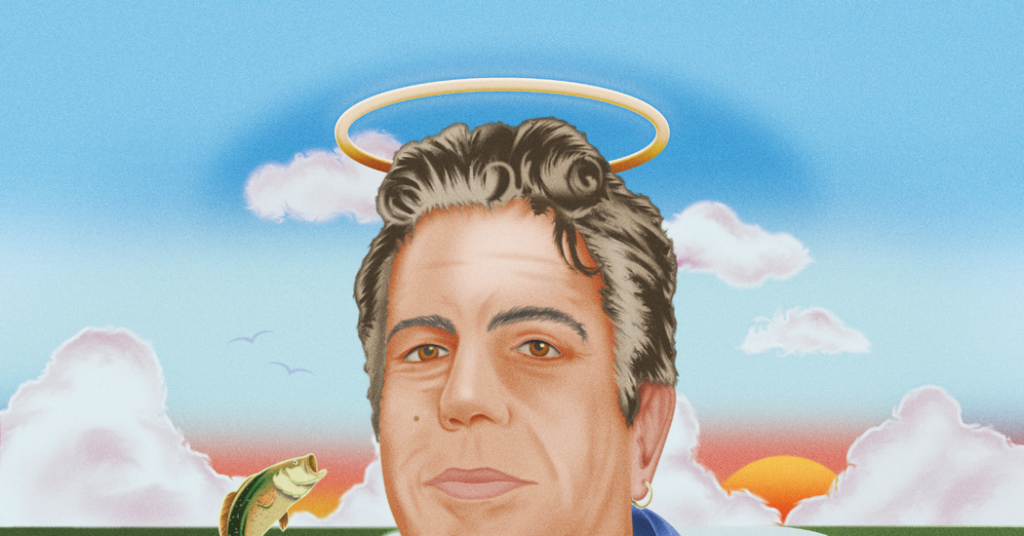
Across the internet, innumerable fan accounts reproduce Bourdain’s aperçus and injunctions over pictures of him in various settings drawn from his TV shows — his mouth forever pursed into that inscrutable squiggle. Here he is, staring into the distance through a pair of sunglasses: “Knowing how to cook an omelet, wipe your own ass and roll a decent joint — these are the basic life skills every self-respecting adult should master.” Here he is in Paris, before a cafe table set with a baguette and a cup of milky coffee: “Most of us are lucky to see Paris once in a lifetime. Please, make the most of it by doing as little as possible. Walk a little. Get lost a bit. Eat. Catch a breakfast buzz. Have a nap. Try and have sex if you can, just not with a mime.” Now he’s topless, now he’s deep in conversation with a Black man draped in tribal robes, now he’s laughing at lunch. “Life is [expletive] good.”
And then, of course, there’s the chunk of text that Clarkson nailed to the wall of his pub. The cult that Bourdain has spawned is now so exotic and fertile that the quotation with which he’s most often associated and memed online is not even something he said; in fact, a fan claims to have made up the passage in 2021 to sound like a classic burst of Bourdainiana, and it has spread to all corners of the internet in the years since.
That Bourdain never uttered these words makes them only more interesting. In this collection of fictional commands, you can see the contours of the nascent Bourdainian cult, its constant exhortation to betterment through discovery, open-mindedness, slowing down and hedonic self-care. Every cultural phantasm is by definition bound to float, but in the years since Bourdain’s death, his legend has detached from the ordinary rules of attribution and gained an eerie kind of auto-generative velocity. This is now a cult of authenticity so powerful it does not even need to hold itself to its own defining standard, a cult that can accommodate both fact and fiction. No longer simply a mourned chef, writer and bon vivant, Bourdain has become an ideology.
Though it arrives at a relatively mature stage of its subject’s posthumous legend, the new biopic offers clues as to why. The film liberally adapts two chapters of “Kitchen Confidential” to tell the story of various awakenings — sexual, culinary, cultural — that Bourdain underwent over the course of a single summer working in the kitchen of a Provincetown restaurant in the early 1970s.
The story is also, surreptitiously, about the man he became once his kitchen days were behind him: not a slave to the line but a sensualist of the table. Indeed, the most revealing and true-to-life scenes revolve around Bourdain’s discovery of his own palate. “Tony” is as much about the joy of developing an appreciation for fresh seafood as it is about discovering the thrills and dangers of kitchen work.
Bourdain was cool, yes; good-looking, without doubt; tall, all the medical records agree. He embodied both liberal virtue and unfiltered authenticity: He was a “good guy” who took the time to listen to refugees and victims of war, but he was also honest about his shortcomings as a husband and father and human. The tats, the alcoholic whiff of punk rock, the kicked addictions and the never-defeated demons: These were all part of the package, too. “I’m Anthony Bourdain, I write, I travel, I eat, and I’m hungry for more” was the line he spoke over the opening credits to every episode of his TV series “No Reservations,” and in many ways that captures the essence of his allure. Bourdain came along at a time when Americans were uniquely primed to transform food from a simple source of nourishment into a cultural totem, to make eating a marker of social and individual progress rather than a simple necessity.
But there’s something deeper driving Tonymania, and the new biopic helps shed light on what that might be. People are obsessed with Bourdain because of what he became, because he managed the transition from a life of work to a life of play.
This is a man, let’s not forget, who spent almost three decades as a non-famous cook before he hit it big. Time and time again, in his books and TV shows, Bourdain returns to the moment he finally quit his job at Les Halles to become our full-time food daddy, reveling in his new “career” — “roaming the globe in search of nothing more than food and kicks,” as he described it in “Medium Raw,” his sequel to “Kitchen Confidential” — as some giant, hilarious con: “This couldn’t last, I thought. It was surely a fluke.”
And yet it did last: He decamped definitively from the kitchen to the dining room. He overcame the bondage of labor to pursue his passion. Yes, that passion was still “a job” in the strict sense, but it had none of the drudgery of work as most people experience it.
Around the turn of the century, just as “Kitchen Confidential” was hitting the shelves, the macho chef became an archetype of rugged masculinity, and the television spectacle of white-shirted virtuosos taming the flames in their cramped and unforgiving kitchens conveyed a faintly reassuring sense that America’s old vigor — its gift for production — was not completely extinguished. Bourdain was part of this “foodie” turn in culture, but he also spoke to a widespread anxiety over deindustrialization and the broader direction of economic life. He was a celebrity cook first, and then became a celebrity eater — a textbook reskilling for the services and knowledge economy. In an era of mass layoffs and collective worry that America was not making things anymore, Bourdain offered a kind of solution. Actually, he showed us, you don’t need to make anything. You can just eat.
But eating, alone, would not have been enough to cement the legend. What mattered is not that Bourdain gave up the life of work to embrace a life of pleasure, but how he did it: He consumed with style, ideas, a sense of discrimination between good and bad, worthy and unworthy. More than a simple vessel of experiences and sensations, Bourdain wielded the power of criticism; he had taste. For a society at sea, Bourdain offered, if only in our imagination, a kind of rescuing wisdom: eat local, be open to a world where you may not agree with the person next to you, get the cream sauce. There was empathy in these words, but they were delivered with a reassuring masculine swagger. A sinner and a saint, Bourdain married aesthetics to ethics in a way that few in popular culture had managed before, and no one has managed since. And he did it all, it seemed at least, while respecting the highest calling of the consumer economy: He enjoyed himself.
Bourdain was, in many ways, the first food influencer of the digital age, and even spectrally he still exerts the authority of primacy. The power of his symbolic transition has only increased in the years since his death: Across Instagram and TikTok, the committed eater is now a “creator,” and the collapse in the distinction between consumption and production is complete. Eating has become work. There are little Bourdains everywhere.
Of course, that’s part of the problem. Like everything else, Bourdain’s vision of the good life has now been swallowed by the infinite scroll. To succumb to the scroll is, paradoxically, the opposite of what the man himself preached: It’s isolating, riskless, anhedonic. The internet’s endless feed of Bourdainian ephemera and pastiche is pure kitsch — in some cases, even, pure fabrication.
Does it matter that the high priest of adventure has been reduced to another figure in our phones, that his gospel of taste survives as more slop in the trough of online, that the discernment and style he personified are largely absent from the cult he spawned? Probably not. Like all faiths, the religion of Bourdain is about belief rather than truth; the deluded, the hypocritical and the confused are all of the flock. Eating, in the world Tony helped create, is not just work; it’s also a form of hope. Get the cream sauce.
Aaron Timms is a writer in New York. He is working on a book about modern food culture.
The post The Gospel According to Anthony Bourdain appeared first on New York Times.