Colombia’s new president campaigned on promises to crush his country’s powerful drug traffickers with the help of the United States.
He takes office Friday, but his plans to partner with U.S. forces are already underway and could make Colombia a centerpiece of the Trump administration’s efforts to militarize the fight against drug trafficking across the region.
After Colombian officials from the incoming administration traveled to Washington last month, a senior U.S. defense official announced a new military partnership with Colombia that he said would take a historically strong alliance “to new levels.”
And the president-elect, Abelardo De La Espriella, has named Medellín the hub of President Trump’s new regional anti-trafficking alliance, the Shield of the Americas.
The Trump administration has made targeting traffickers in Latin America a priority. Blaming cartels and drug gangs for America’s overdose crisis and for fueling violent crime, his administration has designated two dozen groups in the region as terrorist organizations and has authorized using lethal force against them.
U.S. officials have created a regional anti-cartel coalition and military task force including 18 other nations, and have compared their push to U.S. military campaigns against Al Qaeda and the Islamic State.
The Trump administration has also pressed Latin American leaders to allow U.S. forces to conduct joint strikes within their territory, and Mr. Trump has touted U.S.-involved operations that killed the leaders of a major cartel in Mexico and a transnational gang in Venezuela.
Previous U.S. crackdowns on drug trafficking in Latin America have had limited success — and the latest push has raised concerns that military operations could threaten countries’ sovereignty and endanger civilians.
Before Mr. De La Espriella’s election in June, the Trump administration had made little headway with Colombia, the world’s largest cocaine producer and traditionally Washington’s closest ally in the region.
The outgoing president, Gustavo Petro, a leftist, criticized Mr. Trump’s anti-trafficking strategy and denounced as murder the U.S. military strikes on boats that the Trump administration has claimed, without evidence, are carrying drugs off the coast of South America. The strikes have now killed at least 221 people.
The U.S. authorities imposed sanctions on Mr. Petro, decertified Colombia as a counternarcotics partner and threatened to cut off aid.
Mr. De La Espriella, a staunch conservative who had never held office, is poised to be a far more willing ally. On the campaign trail, he praised Mr. Trump’s boat strikes and won over many Colombians with vows to come down on armed traffickers “with the wrath of God.”
The two governments have wasted no time. After meeting with defense officials in Washington, Colombia’s incoming defense minister, Gen. Jorge Eduardo Mora, said that the recently announced strategy, called Plan Patriot 2.0, marks “a new stage of cooperation, integration and joint action.”
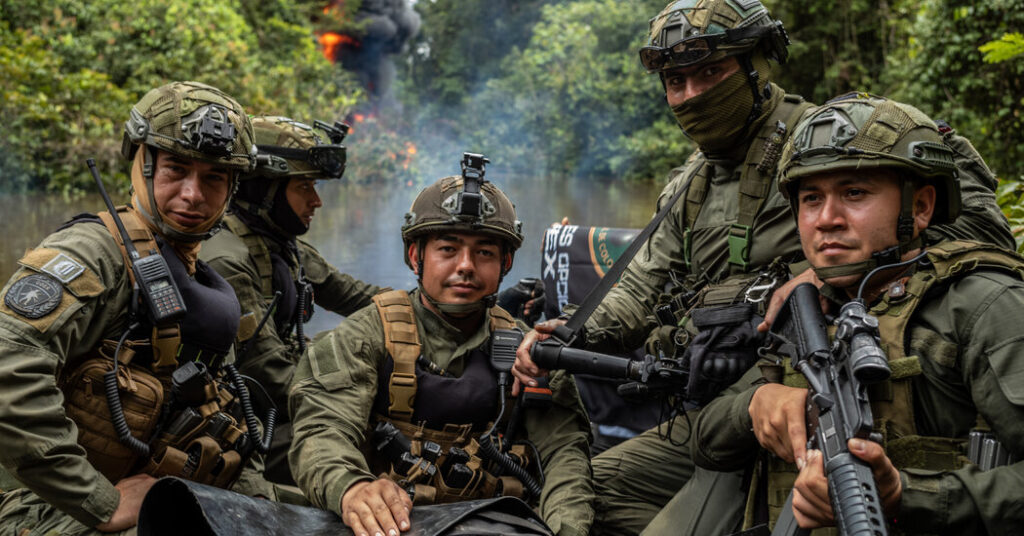
The two countries have discussed plans to provide U.S. intelligence and support to Colombia’s military for counternarcotics missions, to extradite captured traffickers and to restart the aerial eradication of coca plants, according to U.S. officials.
The officials spoke on condition of anonymity because they were not authorized to speak publicly about the plans.
The timeline for joint operations is not clear. One former senior Trump administration official said there was pressure from the White House and senior Pentagon leaders to show results immediately after Mr. De La Espriella took office, but noted that U.S. military commanders were counseling more planning.
The Department of Defense declined to comment beyond a statement from last month. The White House referred questions to the State Department, which said in a statement, “We stand ready to support Colombia’s efforts to strengthen its security forces, defeat narcoterrorists and criminal organizations and end illegal immigration flows.”
Colombia’s armed groups, which include former leftist rebel armies and right-wing paramilitaries, have long been involved in drug trafficking, but have expanded significantly in recent years amid soaring global demand for cocaine.
The groups have multiplied and spread into more of the country, and the number of combatants has increased from around 13,000 in 2022 to nearly 27,000 last year, according to conflict researchers.
Military operations were largely halted for much of Mr. Petro’s term, as his government pursued peace talks with armed groups, a move critics say allowed the groups to expand.
“Is this the right moment for a more kinetic approach?” said Kevin Whitaker, the U.S. ambassador to Colombia from 2014 to 2019. “My answer is ‘yes, and.’”
Even as armed drug trafficking has surged, Mr. Whitaker said, Colombia’s military has been hobbled by funding cuts, and scores of generals were purged under Mr. Petro.
Planning and executing operations is a cycle that improves with repetition, he said, “and this is an armed force which just hasn’t been doing it for the last four years at the same level that it had done before.”
He added: “You can’t just snap your fingers.”
Restarting the aerial eradication of coca, the plant used to make cocaine, also requires planning, experts say. Eradication using glyphosate, an herbicide, was banned by Colombia in 2015 in response to World Health Organization warnings about the health effects on humans.
Both governments will be eager for an early show of force, said Gimena Sánchez, the Andes director at the Washington Office on Latin America.
The U.S. government, which has promoted dramatic footage of military operations against alleged traffickers, may be looking for more such imagery in the run-up to November’s midterm elections. For his part, Mr. De La Espriella is likely to “go big,” Ms. Sánchez said, kicking off his term with “showy actions.”
Targeting the leaders of trafficking groups has been shown to have little long-term effect on the drug trade, she said.
Mr. De La Espriella’s presidential office did not respond to a request for comment.
The original Plan Patriot was a U.S.-backed military offensive in the 2000s that deployed thousands of Colombian soldiers against leftist rebel groups like the Revolutionary Armed Forces of Colombia, or FARC. It was part of Plan Colombia, a multibillion dollar U.S. program to provide military aid and other assistance.
It dealt significant blows to the FARC, which eventually agreed to disband, signing a landmark peace accord in 2016. But a truth commission found that Plan Patriot also resulted in extreme violence by state forces, including extrajudicial killings.
Quashing traffickers has long been a challenge for Colombia’s military. The groups operate in rugged terrain and sometimes live among civilian populations. Adding to the challenge, they have now spilled across Colombia’s borders into Venezuela and Ecuador.
Another obstacle, conflict experts say, is that many minors have been recruited by trafficking groups, in part to ward off airstrikes.
It is not clear how much aid could now flow to Colombia. In the past, Colombia was the region’s largest recipient of U.S. security assistance, but during the first year of Mr. Trump’s second term, that assistance was cut by more than half, to around $187 million from $400 million, according to a report to Congress by the Trump administration.
With Mr. De La Espriella now in office, experts say, the spigot could reopen.
Mr. Mora, the incoming defense minister, has said Plan Patriot 2.0 would help restore Colombia’s military capabilities. According to the Colombian newspaper El Tiempo, the partnership is expected to bolster Colombia’s helicopter fleet and provide drone protection technology as armed groups are increasingly turning to drone warfare.
The plan has drawn criticism from the left. Senator Iván Cepeda, whom Mr. De La Espriella narrowly defeated in June’s election, told an interviewer: “What’s being discussed is a strategy to subject Colombia to another sovereignty and convert it into a kind of protectorate.”
Mr. De La Espriella had originally planned to hold his inauguration at a military base in a conflict zone, instead of the capital. Lawmakers ultimately approved moving the event to Cali, a city near the zone.
This week, the Colombian authorities reported that they had intercepted a bus carrying 1,000 pounds of explosives meant to target military and police facilities during the inauguration. The police said the attack had been planned by a FARC dissident group.
The post Trump Administration Fast-Tracks Military Cooperation With Colombia appeared first on New York Times.