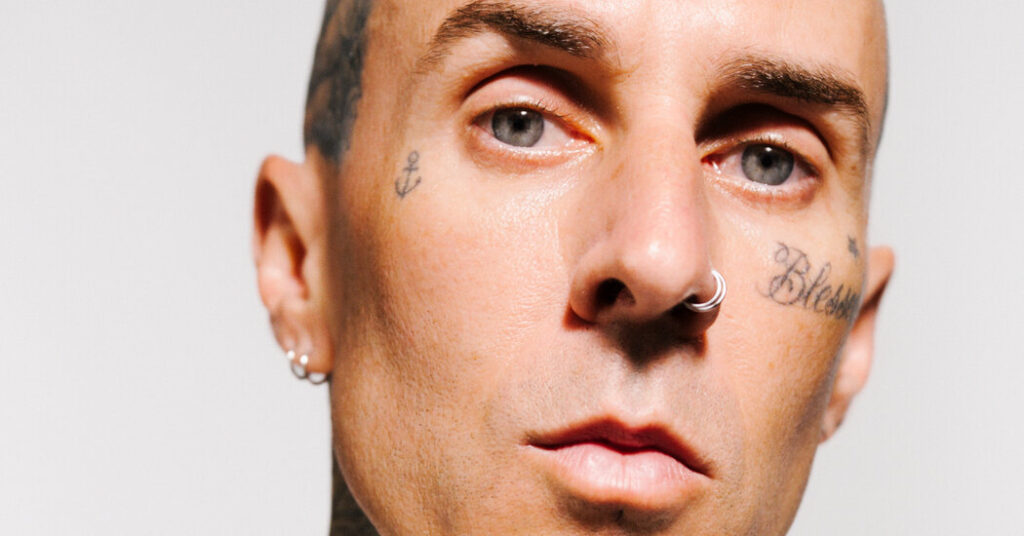
The drummer Travis Barker is a pop-punk star who’s also been an in-demand hip-hop collaborator and go-to anchor for an award-show extravaganza. A bashful, relatively low-profile celebrity who married into reality TV’s royal family. A former hard-living rocker who has matured into a life of long runs, breath work and parenting a blended brood of seven.
The one constant throughout a career of multiplatinum albums, near-tragedy and a streetwear line has been percussion. Barker is one of the signature drummers of the modern era, a ferocious pounder with a versatile ear. Trained in jazz and marching bands during his teenage skater years in Fontana, Calif., he’s brought that skilled dynamism to bands across multiple genres: ska, country, and of course, the generational pop-punk heroes Blink-182 and the rap-rock outfit Transplants. (He even played a little soca before becoming famous.)
A Barker fill is immediately recognizable, and over a three-decade career, he’s generally preferred speaking through the kit — loudly, quickly and with maximum physical force. “I think scars are cool,” Barker said recently in an interview on Popcast, The New York Times pop culture chat show. “I’ve never left a show where I’m a bloody mess, or my hands are a mess, and been like, I wish I didn’t play the way I did or I wish I would have went not as hard tonight.”
But in middle age, Barker, 50, is finding other ways to share what he’s been through. On Aug. 13, Hulu will release the documentary “Travis Barker: Louder Than Fear,” a decade-in-the-making biography, from his strict upbringing and the rebellion it inspired to the highs of MTV fame with Blink, through the aftermath of the 2008 plane crash that killed four of the six people onboard, including some of his closest friends. Barker barely survived and underwent years of physical and psychological recovery in the years since.
Ending on a note of rebirth, including his marriage to Kourtney Kardashian and first flight in nearly 20 years, the documentary is an uncommonly intimate and engagingly direct look at a celebrity who has rarely welcomed close scrutiny, but found himself under microscopes all the same.
In conversation with Popcast’s Jon Caramanica and Joe Coscarelli, Barker spoke about drumming as discipline; remaining just to the side of the spotlight around his famous bandmates and family members; which parts of his life he’s willing to surrender to the cameras; and the life changes he’s chosen to make over the years in order to protect his devotion to music.
“That’s why I train and that’s why I run and that’s why I box and that is why I do the things I do,” Barker said. “Because I want to be able to play the way I want play.”
JOE COSCARELLI When did you decide to make this film and why? There is very intense footage from your plane crash, your 20-plus surgeries afterward, your recovery and sobriety journey, intimate moments with your family …
TRAVIS BARKER After my book [ “Can I Say: Living Large, Cheating Death, and Drums, Drums, Drums,” 2015] the conversations started. The book, the wounds were so fresh — that was really difficult. But both the book and the film are therapeutic, right?
It was maybe like 2017, the documentary was supposed to be done. And the directors and the producer, their goal for the end was, can you please go to an airport and we end there? They just wanted to have me walk on a plane, maybe insinuating maybe one day I’ll fly again. And I was like, absolutely not. There’s no [expletive] way I’m going near a plane. At that time, I wouldn’t even stay at hotels near airports. I didn’t go to an airport for almost 20 years.
I was like, just put this out one day when I’m gone, whatever. I don’t want to deal with it anymore. So it just sat there stagnant. Next thing you know, I fall in love, get into this relationship, just self-work, doing breath work — very long story short, I fly again.
COSCARELLI You’re alluding to this, but the other thing that happened in between 2017 and 2026 is you married into the reality TV family. You’re on “The Kardashians” now, I assume learning to share more about your personal life in that format. How did that prepare you to tell the end of that story in this film?
BARKER I kind of don’t even realize I’m on the show. I think the best way for me to deal with stuff like that or to be a part of things like that is to not really acknowledge that I’m being filmed or anything different is happening. I love my wife and her family and the girls and everyone. And sometimes she’s filming and I’m there. But I never even approve episodes or watch them.
CARAMANICA Really — you don’t do any approvals?
BARKER Nah, I’m not on the show as a main character where I have interviews. I’m an accessory. But the show wasn’t really a learning curve to opening up. What helped me release the documentary was being able to overcome the big things that had power over me.
CARAMANICA I was really struck by how your children spoke in the film about fear, trauma and anxiety related to flying. When you finally said, “Me and Kourtney are going to get on a plane and go on this trip,” your children were saying, “Please don’t.” I wonder if you can talk about your conversations with them to get them comfortable with where you were?
BARKER Well, my journey getting there was I had this massage therapist and I remember her telling me, you gotta do breath work. And I’m like, what are you talking about? She’s like, you have so much trauma, I can feel it in your body. I didn’t know exactly how to navigate after my accident — talked to a post-traumatic doctor, got sober, would run, would exercise, do all this stuff that I just felt was calling me.
A fan that was really, really cool and very persistent would always reach out to me and be like, hey, do breath work. But the guy, he looked like me — he had tattoos on his head. And I was like, man, I feel so weird — I don’t know this person. I’m going to be very closed off. Dude, 10 minutes into it, I’m bawling my eyes out. I’m like, a mess. And it’s like that the next five sessions. But I also feel like I’m making progress, you know? I just felt different. So ultimately that led to me telling my wife, if you’re ever gonna take me anywhere, don’t tell me about it. Just tell me the night before. So she did, I did breath work the night before, ended up flying. Luckily I had a great experience.
But my kids were very, very protective of me and very scared, to the point where they were begging me not to go on the plane. So I had to show them to break the cycle to where they would try. Unfortunately, my kids were around three and five when my accident happened and they never flew after that. It’s sad, but they were basically brought up to think that’s how people die.
COSCARELLI In the climax of the documentary, as they’re going through the story of your crash, you’re essentially doing an interpretive drum solo set to the most horrible thing that’s ever happened in your life. How was that directed?
BARKER The producer of the film said, hey, there’s this scene in the film where we’re gonna go to some of the footage of your plane crash and I want you to do a drum solo that kind of mirrors that feeling. I showed up to this warehouse that’s lit and there’s fire everywhere. And I didn’t say much, honestly, I just got behind the kit and started talking.
COSCARELLI With your hands and your feet. When you were done, did you feel like you had released something?
BARKER Yeah. It’s so raw, it’s so cathartic and intense. I think I did two solos, which were just completely off the dome, just improv. You know when you see an M.M.A. fight and they know they knocked him out — they don’t even need to watch him fall, they just walk off? I just did a walk-off. I was like, I know that’s it. That was hard. Harder than I communicated. But I just thought the best thing was to just put the energy through the drums.
COSCARELLI Your fertility journey with your wife, Kourtney, is documented on “The Kardashians,” but not entirely. In “Louder Than Fear,” you two share the harrowing story of a miscarriage that she had before you had your son Rocky, who’s now 2. How did you guys decide that this was the right forum to share that part of your journey together?
BARKER I think when there’s things that can benefit people or help people relate to something, that’s always a green light. She’s always trying to do something like that. So our journey of miscarriages and then I.V.F., which failed, resulting in us having a baby naturally — I feel like that’s a story that so many people can relate to.
CARAMANICA Your older kids, especially Landon and Alabama, are very popular online. You have this history in reality television and being a star yourself. How do you communicate with them about navigating that part of growing up?
BARKER It’s so hard. I mean, my son called me the other day and he’s like, hey, they offered me to go on “The Voice.” And I was like, dude, you’re way too cool for that. I have to tell him — because you could think I’m contradicting myself because you’ve seen me play drums on “American Idol” with Mary J. Blige — whatever, I’m different. You gotta think about your idols. If your idol’s Kurt Cobain, would Kurt Cobain do “The Voice?”
CARAMANICA Do you feel protective over how they present themselves on the internet? Every now and then you see one of them get into some kind of scrap online.
BARKER I lead by example. I used to almost get in fights with paparazzi. I’m not proud of any of that stuff. I used have a temper when it came to people following us or just dumb stuff, I might be quick to react or be confrontational. But I’m like, that ain’t it, babe. It’s just all noise. Stay running in the direction you’re running in.
Credits
Popcast is hosted by Jon Caramanica and Joe Coscarelli and produced by Sophie Erickson, Kate LoPresti and Felice Leon. This episode was filmed by Bernardo Garcia Elguezabal, Srdjan Stojiljkovic and Pat Gunther and edited by Amy Marino with help from Rebecca Blandon. Our theme music is by Elisheba Ittoop. Nick Pitman is our audio engineer and Amanda Webster is our photo editor. Brooke Minters is our executive producer. Header video cinematography is by Avery Munson Clark.
Special thanks to Sarah Bonn, Dahlia Haddad, Mike Cordero, Nicole Huber, Aaron Byrd, Carl Mazurek, Zach Caldwell, Maddy Masiello, Brad Kimbrough, Craig Hettich, Andrew Wilcox, David Malitz, Elena Bergeron, Sia Michel, Nina Lassam and Sam Dolnick.
The post Travis Barker Survived a Plane Crash, Married a Kardashian and Drummed Through It All appeared first on New York Times.