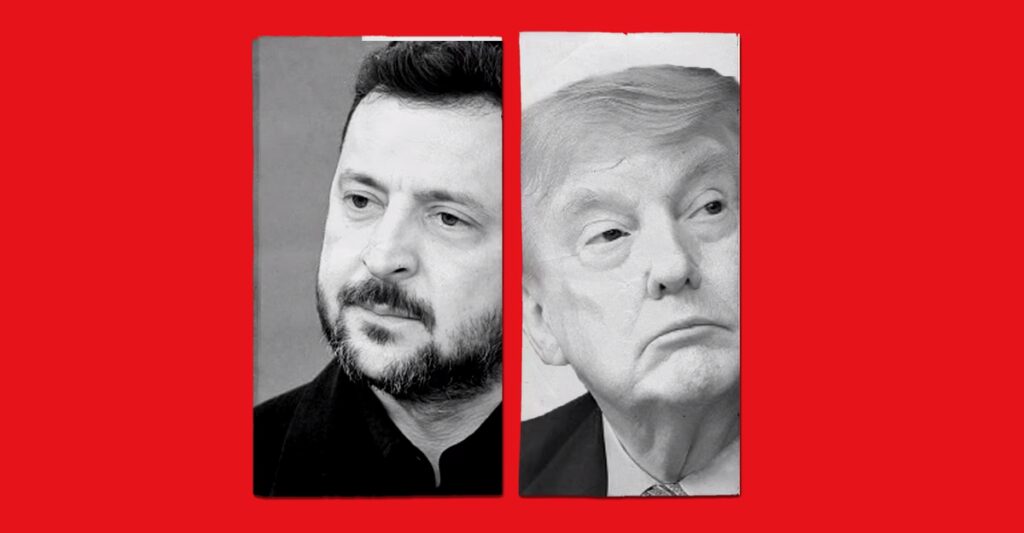
Earlier this summer, Ukraine had finally seized the initiative in its punishing four-year war. President Volodymyr Zelensky had plenty of dramatic victories and technological advances to tout to his Western backers as he made the case that Russia can be defeated. His clash with Donald Trump in the Oval Office last year had been eclipsed by more recent encounters in which the U.S. president seemed open to helping Ukraine prevail. After closed-door talks with Zelensky in Turkey last month, Trump offered to meet Kyiv’s desperate need for air defenses and told reporters during a briefing about the two leaders’ promising vibe: “There was a lot of love in that room, a lot of unity.”
In Washington, Zelensky also had a well-connected ambassador in place. Olha Stefanishyna, a former deputy prime minister, was constantly describing Ukraine’s battlefield successes to officials and lawmakers. Her goal was to move beyond those sympathetic to Kyiv’s plight to build “reliable, economic, interest-based relations across America,” she told us in an interview.
That momentum, built up since the start of the year, fizzled in a matter of days. At his meeting with Zelensky last week, Trump did not agree to send more of the Patriot air-defense systems that Ukraine needs to stop Russian ballistic missiles. He also backtracked on his pledge to let Ukrainian companies make these systems themselves. Back in Kyiv, long-festering issues related to wartime corruption weakened Zelensky’s team, leading to the ouster of Defense Minister Mykhailo Fedorov last month and the resignation of Stefanishyna earlier this week. (She returned to Kyiv to address corruption allegations, which she denies.)
In a rare show of public dissent, protesters have rallied for weeks in Kyiv to demand that Zelensky reinstate the defense minister. His reengagement may be vital to Zelensky’s plan for Ukraine to survive the winter. Zelensky had asked Trump during their meeting to call in a favor from Elon Musk, The Atlantic first reported last week; Musk’s SpaceX operates the Starlink satellite system. Zelensky wants to use the system to guide strikes against the missile batteries that Russia uses to hammer Kyiv and other cities. Trump was noncommittal about that proposal too. Since he was dismissed, Fedorov has been working through back channels to appeal to Musk, who so far has refused to relent, two of Fedorov’s close allies in Kyiv told us.
“As of this moment, there is no positive decision,” one of those allies said on Wednesday. Musk continues to argue with Fedorov over the risk of further Russian escalation in the war. “Elon keeps saying it’s time to make a deal,” the Fedorov ally said. (Musk and SpaceX did not respond to requests for comment.)
After the Oval Office meeting with Zelensky, Trump said that his trusted envoys Steve Witkoff and Jared Kushner would make their first visit to wartime Kyiv in the coming days. But there are no other signs indicating that the pair will make the trip, despite Witkoff’s eight visits to Moscow as Trump’s envoy. Ukrainian officials are skeptical that the real-estate tycoons, who would have to make the long train ride to Kyiv from Poland, will show up anytime soon.
[Read: Zelensky asked Trump for a favor from Elon Musk]
All of these developments have been as unwelcome as they are painfully familiar for Ukraine’s leadership: Throughout the war, they have seen the resolve of their most important ally falter in the moments when it has mattered most—and when a real breakthrough seemed within reach. The White House, fearful of Kremlin retaliation and worried about a shortage of munitions during its war with Iran, has left Kyiv to face another winter of Russian bombardment, just weeks after things finally appeared to be looking up.
A senior administration official, speaking on condition of anonymity to address internal deliberations, told us that the United States was exploring options for defense-industry cooperation with Ukraine but suggested, as Trump has publicly in recent weeks, that following through with his promise to grant Ukraine the ability to manufacture Patriot systems could endanger America’s military edge. “We must prioritize protecting these exquisite systems and expanding overall production of critical weapons systems for the U.S. warfighter and for our partners and allies,” the official said in a statement.
At a meeting of his war council on Wednesday, Zelensky mused that his foreign partners might have darker motives for withholding the air defenses that his country needs. “Maybe these are political steps aimed at making Ukraine more, let’s call it, compliant,” he said in televised remarks. “In my view, that’s also part of it.”
Perhaps the Ukrainians should have seen this coming. After Trump won the election in 2024, many of Zelensky’s allies in Kyiv clung to naive expectations for his second term. They had grown deeply frustrated with what they viewed as the Biden administration’s lack of urgency in providing Ukraine with high-powered weapons. A common refrain in Kyiv held that Joe Biden, due to his fear of escalation, gave them enough to survive the war but not enough to win.
Officials in Kyiv had hoped that Trump might jump-start negotiations with the Kremlin after he repeatedly promised to end the war quickly. “We needed to show that we were not the obstacle to peace,” a senior Ukrainian official told us about that period. “The obstacle is Russia, and we need to overcome it together.”
[Anne Applebaum: Putin’s human safari is the dystopian future of war]
This became the central message of Ukrainian diplomacy during the U.S. presidential transition, and Zelensky delivered it to Trump at every opportunity. But Trump wanted to see some tangible benefit for the United States in supporting Ukraine. Senator Lindsey Graham, a confidant of both Trump and Zelensky, came up with a plan for the U.S. to profit from its role in the war through the extraction of Ukraine’s natural resources, especially rare earth minerals. Zelensky balked at the plan’s most onerous provisions, which seemed to turn Ukraine from an American ally into an economic vassal. He rejected drafts presented to him by J. D. Vance and Treasury Secretary Scott Bessent, among others.
Stefanishyna, then serving as both the deputy prime minister and the justice minister, helped design a compromise that both sides could accept. She hoped the signing ceremony at the White House, which she attended, would be a brief, cordial affair. The now-famous encounter last February instead devolved into a televised fracas, in which Trump and Vance accused Zelensky of ingratitude and disrespect. Trump’s aides asked the Ukrainian delegation to leave the White House. “Complete and utter disaster,” Graham fumed to reporters gathered outside the West Wing.
Looking back, Stefanishyna told us, Zelensky and his aides hadn’t come prepared to make Ukraine’s case in a way that would resonate with Trump. They didn’t realize the extent to which Trump and his aides viewed Ukraine’s suffering—at least 16,000 civilian deaths have been documented, in addition to nearly half a million soldiers killed or wounded—as a Democratic cause. Biden had spearheaded the Western coalition in support of Ukraine and sought to make his defense of Ukraine’s sovereignty a defining issue of his presidency. With Trump back in power, this all worked in Russia’s favor. “We came with all this pain to the White House,” she said, “and it became very obvious that this was our pain” and not something shared by the Trump administration. Although Trump may have empathized on some level, she added, “as president of the United States, he has a very different perspective. This was a wake-up.”
The administration official said that Trump and his team remain committed to contributing to the war’s end. “We are the only country in the world that can play that role,” the official said.
[Read: Zelensky makes his pitch to Trump]
In July of last year, Stefanishyna arrived in the U.S. to represent Ukraine in Washington. Soon after, Trump hosted Vladimir Putin in Anchorage, Alaska. Stefanishyna was horrified to see the Russian president get a much warmer reception than Zelensky had in February. The summit ended Putin’s long global isolation without Trump demanding a single concession. The moment generated a “very physical fear,” Stefanishyna said. “To wake up in the morning in a reality where the United States is coming back to friendly relations with Russia,” she said, was “like Ukraine never existed.” The rapprochement “was much more terrifying than living in Ukraine under bombs.”
Through the bitterly cold winter that followed, in which temperatures fell below zero Fahrenheit, Russian missiles hammered Ukraine’s power grid and heating infrastructure, leaving millions of civilians to freeze in darkened homes or bomb shelters. Many saw this as the low point for Kyiv in the war.
Ukraine survived. But by the middle of winter, Russia had figured out a potent new way to attack. Russian troops were guiding their drones in Ukraine with the help of Starlink. “This could have been a real catastrophe,” Fedorov told us. The technology allowed the Russians to circumvent Ukraine’s air defenses and bombard any target they wanted, including the government district in Kyiv. To stop them, Fedorov reached out to Musk with an urgent appeal for help.
The billionaire called him back at the end of January, when Fedorov happened to be at his daughter’s birthday party, and the minister stepped out to chat with Musk, whose face appeared on the screen of his phone. That conversation led to a plan to cut off Russian access to Starlink terminals. Ukrainian forces continued to fly their drones with Starlink inside Ukrainian territory, including in Crimea and other Russian-occupied regions.
The technological imbalance allowed Ukraine to shift the momentum at the front, where its troops reclaimed a few hundred square kilometers of occupied territory by the middle of February. Around the same time, Ukraine began a campaign of long-range strikes targeting Russian oil refineries. It also used drones early this summer to cut off Russian supply lines to Crimea. Moscow and other cities soon faced fuel shortages, and Kremlin-backed authorities in Crimea declared a state of emergency. For the first time in years, Ukraine appeared to have Russia on the back foot.
[Read: Building tanks while the Ukrainians master drones]
The White House noticed. “The real factor that has changed the U.S. attitude, including President Trump, is success on the battlefield by the Ukrainians,” William Taylor, a former U.S. ambassador to Ukraine, told us regarding its recent battlefield gains. He noted Russia’s staggering casualty rate, far higher than Ukraine’s. After all, Taylor added: “Trump likes to back a winner.”
The start of the war in Iran at the end of February—as it happens, one year to the day after Zelensky’s clash with Trump in the Oval Office—gave Stefanishyna another chance to make Ukraine’s case around Washington. Ukraine had invented a way to shoot down the cheap drones that Iran was using to target Persian Gulf nations and U.S. bases in the Middle East. The Ukrainian interceptor drones cost as little as $1,000 to produce, compared with millions for sophisticated U.S. interceptor missiles. “We discovered that we are the only country on the whole planet who’s able to provide effective means of defense in that regard,” Stefanishyna told us. The innovation gave Ukraine the opportunity to engage with the United States not as a supplicant asking for aid but as a partner.
Zelensky offered to share the technology with the U.S. and its allies in the Middle East. Trump did not seem interested. “We don’t need their help in drone defense,” he told Fox News in March, days after a deadly drone attack on the U.S. base in Kuwait. “We know more about drones than anybody.”
Others in his administration saw it differently. In congressional testimony in May, U.S. Army Secretary Dan Driscoll said that he had learned a lot from the Ukrainians. Their military operating system, known as Delta, “is absolutely incredible,” Driscoll said. “It fully integrates every single drone, every sensor, and every shooting platform into just one single network. Ours does not.”
Ukrainian strikes against Russian oil refineries and other infrastructure also bolstered the impression of momentum shifting in Ukraine’s favor. “Now everybody in Washington thinks Ukraine is going to win,” one Republican strategist told us last week. “They have all these drones, and we want all these drones.”
Following what Trump called a “very good meeting” with Zelensky on the sidelines of a G7 summit in June, the U.S. president piled pressure on Putin, saying that “Russia should make a deal.” Then came Trump and Zelensky’s talks at the NATO conference in Ankara, Turkey, last month, where Trump dangled the Patriot-production license as an answer to Kyiv’s long-term air-defense needs.
[Read: What’s eating ‘Putin’s brain’?]
When Zelensky and Stefanishyna met again with Trump last week, ahead of Graham’s funeral in Washington, the tensions of the previous year’s encounter were absent. Rather than arguing for support on moral and legal grounds, Zelensky touted Ukraine’s battlefield advantage and the expertise that Kyiv could offer in waging war in the 21st century. The message was that “Ukraine is no longer a charity case” but rather a valuable partner holding its own on the battlefield, a former Zelensky adviser told us after the meeting. “It was a much more realistic approach, given the administration’s ‘America First’ policy. And if you look at the results, it’s night and day.” Now it was Putin, not Zelensky, whom U.S. officials viewed as the obstacle to peace. Even Laura Loomer, an informal Trump adviser and erstwhile supporter of the Kremlin, returned from Kyiv gushing about how Ukraine deserved American backing to figure out how to win.
That was last week, shortly before we visited the Ukrainian embassy, which occupies a historic brick structure in Georgetown, north of the Potomac River. In 1791, President George Washington met with a group of local landholders in the building to discuss acquiring terrain for the American capital. Today, a hallway in the building holds a Ukrainian bomber drone called a Vampire, which Stefanishyna used to showcase her country’s wartime innovations.
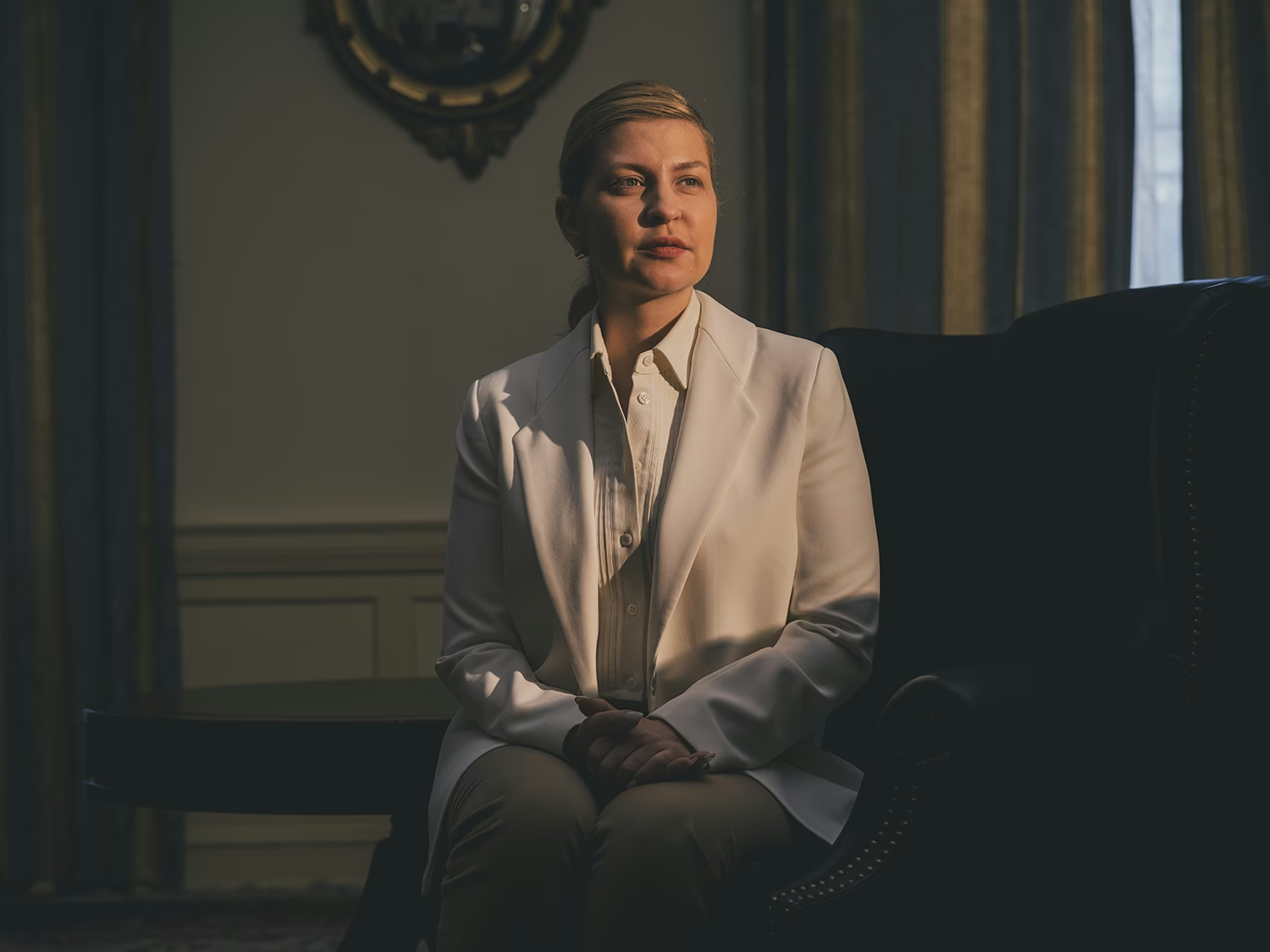
On the day of our interview, however, Stefanishyna was preparing to leave after less than a year on the job. Investigative journalists in Kyiv had scrutinized her property deals and her record in government going back to 2013, when she served as a junior official in the justice ministry. The price her family had paid for an apartment in Kyiv nearly a decade later also raised suspicion in the press. Anti-corruption investigators began looking into her financial records, questioning her friends and relatives. She denied all of the claims of wrongdoing but decided that the allegations were too distracting for her to remain the ambassador to the U.S. “I cannot really pretend like I’m doing a great job here, having fun, while my family is under threat,” she said, tears welling in her eyes.
A week after we spoke with Stefanishyna, anti-corruption authorities in Kyiv charged her with “illicit enrichment,” and a court set her bail at 6 million hryvnia, worth roughly $130,000. “The mission has been successfully completed, and I am in Ukraine to answer here,” she wrote in response on social media. “The burden of proof lies with the one making the accusation. As for me, I will do all I can: calmly defend my position in accordance with the law.”
Her departure was part of a government reshuffle that also cost Fedorov, the defense minister, his job. Speaking last week to Ukrainian journalists, he said that his firing was also related to problems with corruption. In his role as the defense minister, he had pushed for reforms that angered a long list of arms manufacturers and their allies in the military high command, and they had teamed up to undermine Fedorov’s position. His allies told us that he has continued to try to persuade Musk to relent on Starlink, but to no avail.
In a matter of days, the optimism that for months had been building around Ukraine’s prospects seemed to fade. At one point earlier this summer, Zelensky could look ahead to an influx of new U.S. missiles to defend Kyiv, the right to make even more in Ukraine, and the potential ability to strike inside Russia thanks to Fedorov’s overtures to Musk. He enjoyed greater respect from Trump for Ukraine’s innovations and battlefield momentum, and better relations across Washington thanks to a well-regarded young ambassador.
[Read: Putin is slipping into delusion]
Instead, Trump appears to have turned lukewarm and is stalling on previous commitments on Patriot missiles. Entreaties to Musk have so far failed. Zelensky’s firing of his popular defense minister has prompted protests at home. And Ukraine has no ambassador to make the case for continued U.S. support, because the previous one returned home to face charges of corruption.
As if to emphasize the turnaround, Russia has intensified its missile strikes on Kyiv, taking advantage of Ukraine’s depleted air defenses. Earlier this week, the city and its suburbs faced a barrage of at least two dozen ballistic missiles in a single night. Ukraine was unable to shoot any of them down. Seventeen civilians died, and at least 44 others were wounded.
The post Ukraine’s Fleeting Turnaround appeared first on The Atlantic.