The hamlet of Morristown, N.Y., on the St. Lawrence Seaway, has a windmill from 1825 and a one-room schoolhouse from 1824. It has a village historian, a weathered Main Street and a museum exhibit chronicling the patent medicine, Dr. Morse’s Indian Root Pills, that essentially built the town.
And for most of the past two centuries, Morristown and the small towns around it near the Canadian border have been home to members of a family named Putman.
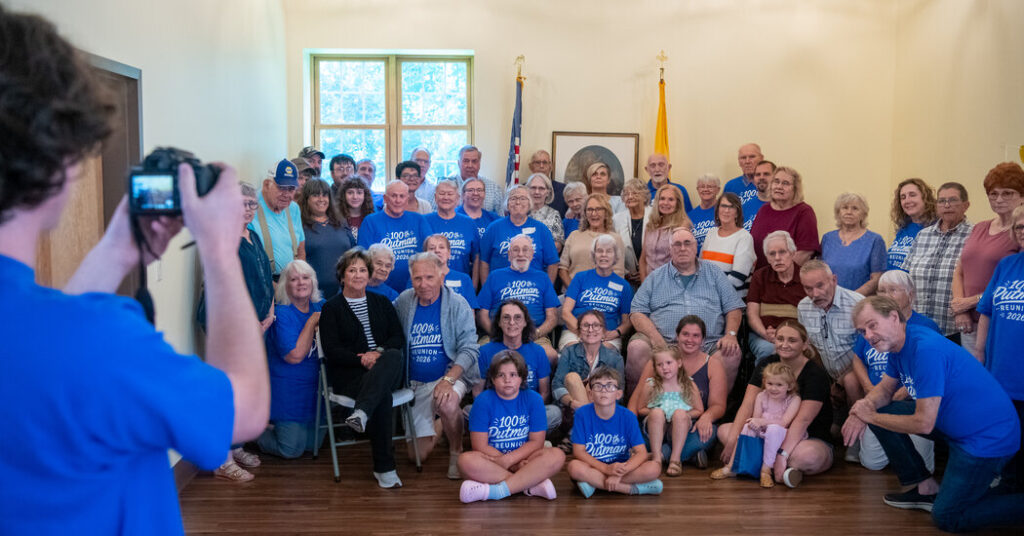
On a splendid Sunday afternoon in July, about 50 members of the family gathered at the Saint John the Evangelist Parish Hall, across from the windmill, for their 100th family reunion. Most were in their 70s and 80s. They brought brownies and cookies and starches of all varieties. They brought family photographs and handwritten family trees.
Lots of families hold reunions. The Putmans make theirs a serious business, with a president, a secretary, a budget, multiple prizes and a written ledger with notes from every year, starting with the second reunion.
“Our ice cream men got lost from the crowd and my what a time we did have,” ran the note from that 1925 gathering, in neat cursive lettering that eschewed commas, Oxford or otherwise. “But after a time it all turned out for the best. We had a very nice dinner as we always do. We all eat our share I guess.”
For the 100th (the family missed a year during World War II, and another during Covid, so 102 years have passed since the first), the organizers had a budget of about $200, from the raffle of a quilt at last year’s gathering.
“And we’ve already spent it all,” said Janet P. Newtown, 84, the village historian and one of the organizers, back in June.
The Putman family reunions in many ways reflect the story of this swath of upstate New York in the last century, and of rural America more broadly.
It is a story of younger people leaving their family farms for job opportunities elsewhere, of farm consolidation and loosening family connections.
Willard Putman, born in 1847, and his wife, Olive, had a dairy farm where they raised six sons and two daughters. These children, in turn, became dairy farmers or cheese makers and raised big families of their own.
It was a way of life, said James Putman, 74, who still runs a dairy farm in the area with 50 cattle, down from a high of 250.
“Back when I was a kid we’d have the reunion down to Gramp Putman’s camp,” he said, referring to Frank Putman, a son of Willard, who owned a parcel of land on the river that he used as a family retreat. “All of his brothers were cheese makers or farmers, and all his children were farmers. And we’d come after we got through chores in the morning, and we’d all have a big time until it was time to go home and milk at night. And it was great.”
But as they got older, James Putman’s peers went in different directions.
“I knew I didn’t want to milk cows seven days a week,” said Michael Putman, 86, a cousin of James. Michael was one of 10 siblings, and none of them wanted to take over the family farm after their father died.
“The dairy industry was a tough business, and they weren’t making any money,” he said. “Now the little farms are gone, and it’s mostly big farms. People assume they’re corporate farms, but they really aren’t. They’re still a family farm, it’s just a lot of cows.”
In Jane Smiley’s novel “Some Luck,” about an Iowa farm family, she relates a joke about a farmer who wins the lottery. People ask what he plans to do with the million dollars. “Well,” he says, “I guess I’ll just farm till it’s gone.”
At the Putman family reunion, this got a knowing laugh from farmers, ex-farmers and children of farmers.
As in other parts of rural America, without the farm to hold them, the younger generations tended to leave the area.
“Nobody stays,” Ms. Newtown, the village historian, said. “We’re friendly, but there’s nothing to do here, like you can do in a bigger area.”
With fewer Putmans in the area, the reunions got smaller. Last year, only 26 people attended, down from highs of over 100.
Kim Gudmondson, 71, one of Michael Putman’s sisters, left for Cornell after high school, and later for Silicon Valley. “I didn’t want to be a high school teacher, which almost everyone here is — teachers or farmers,” she said. “I mean, there really isn’t that much. I wanted more.”
Ms. Gudmondson started attending the reunions about four years ago. But few among the younger generations come, said Trishia Bacon McCoy, 46, who flew up from Arkansas with her two children, ages 8 and 9.
For people her age and younger, she said, “I think family reunions have gone by the wayside. Once those older matriarchal people pass away, it’s like, well, we’re just going to go do our own thing. I don’t like that.”
Ms. Newtown said grace. People lined up to get food, then took their seats at a table the length of the room. The reunion was, as ever, alcohol-free.
And, as ever, there were prizes to give away.
“Who’s the oldest gentleman?” Julie Johnson, 69, asked the crowd. “I hear 84. Anyone older than 84?”
Indeed there was. Donald Putman, 86, was there with his wife of 68 years, Shirley, and their daughter Melissa. He had grown up on the family farm. “I wanted nothing more to do with farming,” he said.
“Now let’s do the women,” Ms. Johnson called. “Anyone older than 82?” It was a bittersweet moment. The prize in recent years went to Doris Putman, James Putman’s mother, who is 101 and has attended most reunions since 1949, when she married into the family. But this year, she declined the invitation. “My vision is terrible, and consequently my balance is terrible,” she said in an interview. “I can’t go over there and stumble around, fall down.”
So Shirley Putman, 86, won the prize.
There was a prize for the youngest and for the relative who traveled the farthest and a raffle of this year’s quilt, which showed scenes of farm life.
Then a new wrinkle: a second drawing to pick a president for next year’s reunion. “I’m saying please,” Ms. Johnson said, as Ms. Newtown read the first name drawn. No response.
Another name, another demurral.
“How do you get a Putman to shut up?” Ms. Johnson asked. “Tell him he’s president of the reunion next year.”
Finally, on the fifth drawing, James Putman accepted the mantle. “Oh, I was just lucky,” he said dryly.
People began to pack up and say their long goodbyes. Maybe it would be another year before they saw one another again. Or maybe longer, even much longer. After 100, who knew who would show up for future reunions? “When it gets to 150,” said Sylvia Bounds, 78, “maybe that’ll be a big one.”
The post ‘Nobody Stays’: What a 100th Family Reunion Says About Rural New York appeared first on New York Times.