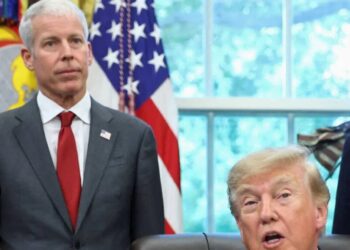
Kevin Warsh, the new chairman of the Federal Reserve, has made clear that he intends to change the way monetary policy works. After five years of inflation running above the Fed’s target rate of 2 percent and sustained criticism of the institution by the president who appointed him, that purpose has some logic. Why then have financial markets reacted with seeming skepticism, and what are the prospects for success?
In a little more than two months in office, Mr. Warsh has focused on how the Fed communicates and his desire to modernize both the data infrastructure on which the Fed relies and the models it uses to interpret those data. On communication, Mr. Warsh’s vow of relative silence rests on a misguided foundation and should end soon. On data and models, his critique has more bite, especially in view of the latest economic research.
However, the success of his chairmanship may hinge on an issue that has so far received little attention and sits outside the traditional purview of monetary policy: the nation’s ongoing fiscal deficits.
Start with communication. Mr. Warsh has taken to the mantra that markets should “play the ball, not the referee.” In this sports metaphor, the ball represents economic fundamentals such as prospects for economic growth or inflation, while the referee is the Fed. The implication is that the Fed should remain quiet about its intentions, forcing markets to pay attention to fundamentals. The problem with this metaphor is that when it comes to interest rates, the fundamentals are the Fed.
This statement is obviously true for the overnight interest rate that the Fed directly controls. But medium-term rates are largely just averages of expected short-term rates. To see why, consider setting aside $100 for one year. This can be done by buying a Treasury bill or certificate of deposit with a maturity of one year. Alternatively, an investor can buy a Treasury bill with a maturity of 28 days, earning interest at the Fed’s target rate, then reinvest the payoff at maturity in another 28-day bill, and so forth 10 more times. Both strategies turn $100 today into a larger sum in one year, linking the interest rate on the one-year Treasury bill to the average of expected 28-day bill rates over the year. In addition, if the market fears future inflation, longer-term rates will go up immediately to compensate investors for the risk that the purchasing power of their $100 principal could fall.
No wonder then that traders in Treasury bills and bonds focus closely on expected Fed policy. But this doesn’t mean that other parts of the financial system also pay undue attention to the Fed. For example, recent swings in the stock market mostly reflect changing views on A.I. and concerns about the closing of the Strait of Hormuz. In the bond market, however, Mr. Warsh’s unwillingness to discuss future rates leaves prospective holders of longer-term bonds to wonder whether the Fed really will act if required to bring inflation down.
Those doubts explain the rise in longer-term yields during Mr. Warsh’s news conference last week, after the decision to leave short-term rates unchanged. Resolving those doubts doesn’t require that the Fed commit to a specific path of rates, which would be imprudent given the uncertainty over the economy’s other fundamentals. Rather, Mr. Warsh should make clear statements about what developments would incline him to favor a rate change.
The Warsh reassessment of central banking orthodoxy goes far beyond communication. In his first news conference in June, he announced five task forces, each headed by luminaries of economics, business or finance, with topics including the Fed’s data analysis and the causes of inflation. Their creation may leave the impression that economists have neglected key issues facing monetary policymakers. In fact, the opposite is true. The task forces will succeed by drawing on the best current economics research.
Consider the call for better data. Mr. Warsh correctly notes that the nation’s existing data architecture could be improved. What stands today relies largely on household and business surveys that face declining response rates and take time to collect and process.
The economics profession has also taken notice. For example, in 2025 the National Bureau of Economic Research opened the Economic Measurement Research Institute, with the objective of basing the gathering, assembling and distributing of data “on 21st-century information technology to effectively measure the 21st-century economy.” Other institutions have similar initiatives.
In practice, this means much more use of anonymized transaction accounts, payroll records and other administrative data that will allow for more granular and timely analysis of the economy’s trajectory. Economists at the Federal Reserve are heavily involved in this effort. It would be a very good outcome if these initiatives — and support for the resources they require — gain the powerful imprimatur of the Fed chair.
On inflation, Mr. Warsh is correct to insist on a reassessment of the models used before the inflation surge. The research community has already trained its attention on several areas, including the frequency with which companies update their prices, what happens when they reach their production capacity, what drives their costs, and the role of supply chains. Other economists put more emphasis on supply shocks and expectations. An honest assessment of the past five years will find a healthy debate that resists a clear, unambiguous takeaway for policymakers but that also better reflects the complexity of the real world.
A final issue not directly the subject of a Warsh task force may prove the most pivotal of his tenure: the interaction of monetary policy, fiscal deficits and inflation. In one extreme view, budget deficits are the ultimate source of inflation, as any gap between spending and taxes will ultimately be filled by the central bank’s printing money. Even if one believes that Congress will eventually address the nation’s chronic deficits, the accumulated debt may constrict the Fed’s room to maneuver by raising the fiscal cost of higher interest rates.
This conflict between monetary and fiscal policy was at the core of the last major debate over Fed independence, after World War II. In addition to drawing on the latest academic research, Mr. Warsh will need all of his political talents to secure Congress’s help in meeting the Fed’s ultimate objectives.
Gabriel Chodorow-Reich is a member of the Dallas Fed Academic Advisory Council.
The Times is committed to publishing a diversity of letters to the editor. We’d like to hear what you think about this or any of our articles. Here are some tips. And here’s our email: [email protected].
Follow the New York Times Opinion section on Facebook, Instagram, TikTok, Bluesky, WhatsApp and Threads.
The post Kevin Warsh Wants a New Fed. The Markets Are Not Sure. appeared first on New York Times.