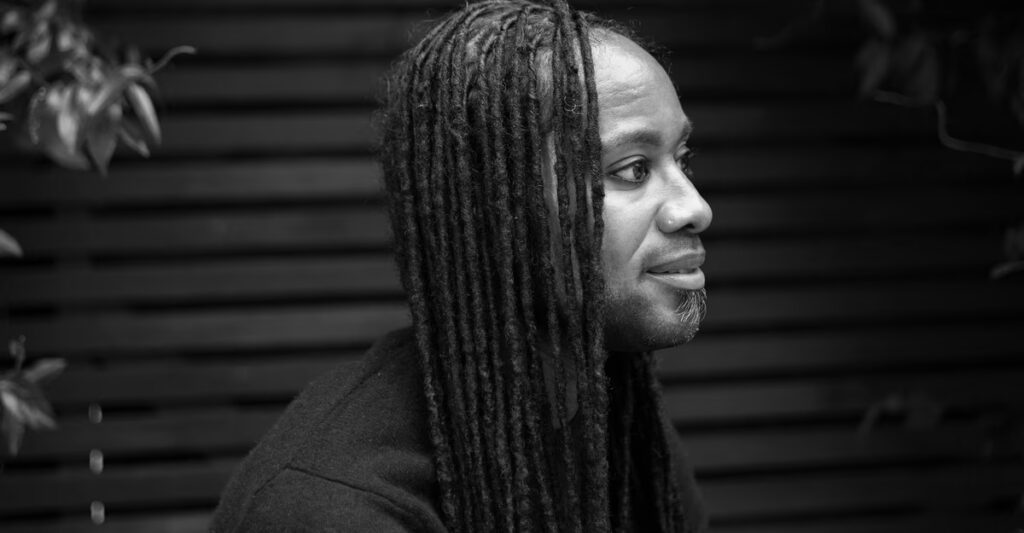
Even before the push alert about his resignation from the University of Cambridge this week, Jason Arday might well have been the world’s most famous living sociologist. In early 2023, Arday received a professorship at Cambridge; at 37, he was the youngest Black scholar ever to have done so, and his appointment made international headlines. A year later, he set out to sell his memoir. According to a cover letter that his agent sent to publishers at the time, Arday’s book, to be titled Great and Unfortunate Things, would be “an awe-inspiring tale of near mythic proportions.”
That now appears to be an understatement. Arday’s story was indeed astonishing: As a toddler, he was diagnosed with autism and developmental delays; he didn’t fully speak until the age of 11; he learned to read and write only as an adult. Arday’s parents are Ghanaian immigrants; he grew up wearing homemade clothes and hustling for cash by playing snooker. Yet in spite of all these obstacles and many, many others he has recounted over the years, Arday found a way to go to university and then to graduate school. Eventually, he got his Ph.D., and then he became a star. “We are so lucky to have you,” Cambridge’s head of faculty for education, Hilary Cremin, told him in a clip shown on BBC shortly after his hiring was announced. “You are the best in the world in terms of the research that you do.”
But in the past two weeks, Arday’s near-mythic (or perhaps purely mythic) tale has disintegrated. In July, a philosopher named Nathan Cofnas published a long Substack post reviewing apparent evidence of plagiarism in Arday’s academic work. Cofnas posted 36 passages from Arday’s 2015 dissertation, about student teaching, which reproduce or closely track text found in a 2009 dissertation from another scholar in the field, Paula Zwozdiak-Myers. Arday looks to have even copied from and rearranged Zwozdiak-Myers’s title, and in doing so to have misused an apostrophe.
Arday’s grad-school alma mater, Liverpool John Moores University, which first received direct complaints about the dissertation last fall, did its own investigation and cleared Arday of wrongdoing. “A confidential procedure was conducted,” the university told me in a statement. “Professor Arday’s PhD still stands.” But some of Arday’s other academic papers had potential problems too—and they seemed much worse than the mere borrowing of language. Quotes from structured interviews that Arday claimed to have performed closely resembled those used by other researchers; parts of some interview responses also reappeared across different studies under Arday’s name, attributed to different people. This duplication, if deliberate, would be something other than plagiarism—it would be academic fraud. (The website Retraction Watch reports that two of Arday’s papers were quietly corrected.)
Yesterday, Cambridge announced that it had “begun an investigation following new information about Professor Arday’s academic qualifications and honorary appointments.” By the end of the day, Arday had resigned. “I want to reclaim some peace, some privacy and some semblance of an ordinary life,” he said in a statement. “I no longer wish to feel as though I am living under a constant spotlight, where every aspect of my life is subject to public examination and judgement.”
[Read: The multibillion-dollar foundation that controls the humanities]
Arday did not respond to questions from The Atlantic, but he told The Times last week that he is not a “liar” or a “fantasist” and that he’d been given insufficient supervision as a graduate student, especially in light of his learning disabilities: “It’s more likely that I’ve made a mistake, there’s a clerical error. It’s not that I’ve fabricated.” He also seemed to address such allegations at a conference in April for the British Sociological Association, where he gave a talk about pervasive efforts to discredit Black scholars including himself. “These people are brilliant, perversely brilliant,” he told his colleagues. “There are times when you look at what they’re doing and you say to yourself, Well done, well played, very good. You’ve caught me [in] a thousand knots—how do I get myself out of this situation?”
This much is true: Some of the people who were going after Arday had a political agenda. Cofnas, the philosopher who put Arday’s dissertation through a plagiarism checker last month, argues for a “hereditarian revolution” based on the idea that innate differences in intelligence and other traits exist across racial groups. (He also claims that “the humanities and much of the social sciences have been slain on the altar of DEI.”) But the challenges to Arday’s credibility quickly went beyond the realm of Cofnas and his fellow white reactionaries, and beyond familiar arguments about diversity hiring. Taken all together, they exposed a broader, self-destructive tendency that has long been present in our universities, and also in the media and publishing: Any failing can be forgiven, as long as it’s packaged in a story that people want to hear.
Great and Unfortunate Things, which Arday co-wrote with Eve Claxton, is still scheduled to come out next week from Simon & Schuster. The story that it tells should not be taken at face value; it differs notably from other versions of his life that Arday has shared in public and in private, including in the original proposal he sent out with his agent. But the book is also, in a way, very honest and quite telling: It provides a vivid portrait of a man who was always manifestly ill-equipped for academia yet found a way to reach its upper levels. This is not someone else’s cruel assessment of Arday’s tragic and improbable career. It’s his own.
The memoir begins with a prophecy. It’s 2006, and Jason Arday, then 21 years old, is installing water pumps in the favelas of Brazil and showing children how to use them. A local aid worker—“a woman in her thirties with dark hair and eyes and a gentle, steady way about her”—touches his arm and softly tells him that he is destined to suffer in his life but also to do great things. “After the trip was over, I never saw the woman again, but her words stayed with me,” Arday writes, “and, you might say, her prediction came true.”
The rest of the book is an elaboration on this moment: Arday suffers; Arday overcomes. The doctors who assessed him as a toddler told his mother that “there’s no one in there” and that he was “no better than a vegetable.” Even his speech therapist wasn’t optimistic that he’d ever learn to talk. (At one point, she also physically abused him, the memoir says.) As a boy, Arday rocked and hummed and banged his head until he bled; he slammed cupboard doors and smeared his feces on the walls. Yet still, eventually, he started to verbalize. Still, eventually, he made his way through school.
[Read: Higher Ed is very sorry]
Tribulations piled up throughout his life. Arday is nearly deaf in one ear; he’s dyslexic; he finds simple math befuddling; he has “marked difficulties” with memory, reading, and processing skills. As a teen, he was beaten so severely by a group of kids his age that he became an epileptic. To make his way through secondary school while—by his own account—illiterate, he needed ample help: support assistants who sat beside him in class and took notes on his behalf.
When Arday applied to university, his girlfriend, Debs—who had been teaching him to read—“wrote out” the application on his behalf, including the personal statement. In university, a friend who took the same courses sat beside him, sharing notes. (She’s “the only reason I survived” university, he says.) By the time Arday started on his master’s degree, he writes, he was reading at about the same level as his 3-year-old daughter. Still, he pressed onward. Still, somehow, he got a teaching job.
His obstacles were only multiplying, though. Money was tight, so after each day of teaching, Arday writes, he had to work an overnight shift in a supermarket, from 11 p.m. to 5 a.m., and then a morning shift as a cleaner from 5:30 to 7:30. The only time he had left to write his dissertation was when he was commuting between London, where he lived, and Liverpool, where he taught. On those semiweekly five-hour rides, the book explains, he would open up his laptop on the plastic seat-back table and start typing out his thesis, hunt-and-peck style.
As his dissertation deadline approached, Arday started having blurry vision; medical scans revealed a brain tumor. After it was removed, he had a ministroke and lost his short-term memory. “I’d worked on my thesis for over thirty months, and now I was reading it as if for the first time,” he writes. As one might expect, his thesis defense did not go smoothly. One examiner was suspicious of his work: “I am struggling to see that there is any original contribution here,” she said, according to the book. But Arday, who often likens himself to Rocky Balboa, managed to fight back, and in the end, he passed. (The memoir brings up the fictional boxer in about a dozen different contexts.)
More troubles follow in the years ahead: Arday’s brain tumor returns; he splits up with his wife; he suffers autistic burnout during the coronavirus pandemic and can’t get out of bed. He decides to kill himself by jumping off a bridge, but at the very last minute, he listens to his favorite song, “Take It to the Limit”—delaying his attempt just long enough for a member of his family to rescue him. “In the end,” he writes, “my decision to listen to the Eagles likely saved my life.”
[Read: The publishing mystery that no one wants to talk about]
The book sticks mostly to this frantic register, and coincidence abounds. Arday claims, for instance, that when the kids who beat him up at the bus stop were arrested, he told the judge that they shouldn’t go to prison. Then, years later, when he took a brief teaching job at an unnamed London university, two of the muggers turned out to be his students. They’d been so moved by his act of mercy that they’d turned their lives around, and now they were coaching other at-risk youths. “Both of them gave me a huge hug, which I returned,” he writes. One asked Arday to be the godfather of his child.
Is that really true? I reached out to the book’s fact-checker to ask whether this and several other stories from the book had been verified, but she did not respond. Even asking that question places me on the wrong side of Arday’s moral ledger. Again and again, the book acknowledges his “impossible” success, yet his indignation at anyone who ever doubted him remains a running theme throughout the book. These are Arday’s villains—the Ivan Dragos and the Clubber Langs of academia, who dared to wonder whether his work was really so original, or questioned whether he did it on his own. He swallowed his “feelings of offense,” he says in reference to one lecturer who insisted on drilling him about subject material in person, “but I have never forgotten them.”
When you succeed against pretty much insurmountable odds,” Arday writes in the book, “it weirdly makes people question your credibility.” Is it weird? I don’t think it’s weird. When you keep succeeding against insurmountable odds, the facts of your surmounting will be bound to get a second look.
Arday’s record of public statements includes plenty that would seem to be exaggerated, if not completely false. He said repeatedly, for instance, that he’d once run 300 miles in three days for a charity event, and that on another occasion he’d run 600 miles in six days. As many people have now pointed out, doing either would be a near-world-record-level feat of endurance athletics. (Neither run is mentioned in his book; he recently told The Guardian that his 600-mile run had actually taken 12 days, including rest periods.) He boasted of having raised millions of pounds for charity—though under questioning from The Times, he conceded that he’d done this as part of a fundraising “syndicate.” In an interview, he claimed that he’d originally been part of the BBC series Up, which began filming before he was born—though this was later said to have been an analogy, not a literal description.
But the most disturbing inconsistencies arise from Arday’s book proposal, a copy of which was obtained by The Atlantic. That document, from 2024, cites several accolades of which no proof exists online. The proposal also lays out many of the same events as the memoir but with slightly different dates and details: The boys who beat him up were not his age but four years older; his suicide attempt happened before, not during, the pandemic. And whereas the book describes Arday as having survived two brain tumors, the proposal says he had a bout of testicular cancer. No reference to that illness appears in the memoir.
[Read: Is this what comes after AI slop?]
Nor does the book describe the time that Arday, then a teenager, was struck by a car and spent several months in a coma. According to the book proposal, the doctors told his parents that he would never recover, and suggested taking him off life support “as an act of mercy.” Through all of this, he was aware of everything that was going on, because he had locked-in syndrome. “As I will describe to readers in the book,” Arday wrote in the proposal, “these months afforded me another profoundly different way of perceiving the world.”
The book doesn’t describe any of this, nor that he awakened “miraculously” from the coma, nor the full year he spent “relearning everything—how to walk, to talk.” Instead, the memoir tells us only that he spent those months finishing his final year of secondary school and taking his exams. “I was relieved, beyond relieved,” the memoir says, when those were done.
Then there is the prophecy—the revelation Arday was given in Brazil, that he would suffer greatly and also do great things. According to the proposal, this occurred in 2005, not 2006, and the message came not from a local aid worker in her 30s but from “an elder in the small town where I had been assigned, who was well-known in the area for predicting people’s futures.” (Later in the proposal, he calls this person a “shaman woman.”) “Do you know the story of Spartacus, the escaped slave who led a rebellion against the Romans?” this town elder asks, before telling him his fate in minute detail. “Every event she described,” Araday writes in the proposal, “has since come to pass.”
I reached out to Arday’s editors—Dawn Davis in the United States, and Kris Doyle, who is publishing the book with Simon & Schuster UK—to ask them why the three-month coma and the shaman woman hadn’t made the cut in the published version of the book, and to find out what they thought of other inconsistencies in Arday’s story and the allegations of misconduct in his academic work. Neither of them chose to answer any questions.
I also tried to reach Eve Claxton, who co-wrote the book with Arday and whom he describes in the acknowledgments as “one of the most important people I have ever met in my life,” by phone and text. She did not respond.
Arday’s book agent, Jennifer Gates, the one who described his life story as “near mythic,” did not respond to multiple emails. A spokesperson for Simon & Schuster would say only that the company “is proceeding with publication” next week.
[Read: This literary AI scandal changes everything]
Perhaps it’s fitting that the book’s release is still on track and that it has even been designated as an “Editors’ Pick” on Amazon: Once again, Arday is succeeding in the face of many obstacles, uplifted by the many angels in his life and given the opportunity to do great things. This was the true miracle of his career—that the system could be bent to meet his needs, and then it could be bent a little further, and bent and bent until it fit the wild arc of a fairy tale. By his own account, Arday rose to fame as a scholar and a writer despite staggering limitations; he became an academic who can read only a single page of academic text an hour and cannot comprehend what is happening at work 90 percent of the time.
His mission as a scholar had always been to help ensure that other disadvantaged academics could have access to the same allowances that he’d had, and that they’d be empowered to make use of them. He wanted others to succeed the way he had. “Today, in academic circles, that’s what I’m known for,” he writes in his proposal. “Everybody says, ‘Jason is the guy that teaches everyone the tricks.’”
There’s a moment near the end of Great and Unfortunate Things when Arday’s confidence begins to waver. He’s filling out his application for the professorship at Cambridge, and just then, as he draws to the brink of destiny, doubts begin to fill his mind. “What if I have completely overestimated my capabilities?” he writes. “What if my story ends up being a cautionary tale like Icarus about flying too close to the sun?”
What if.
The post Icarus in the Faculty Lounge appeared first on The Atlantic.