The first law of journalism I learned: get lucky.
At the recent International Antiquarian Book Fair inside the Park Avenue Armory in Manhattan, I was nosing around the booths for — what? I wasn’t sure, but maybe I’d know it when I saw it. This approach had served me well in my 45 years as a staff reporter at The New York Times, and now that I was a freelance writer, it remained instinctual.
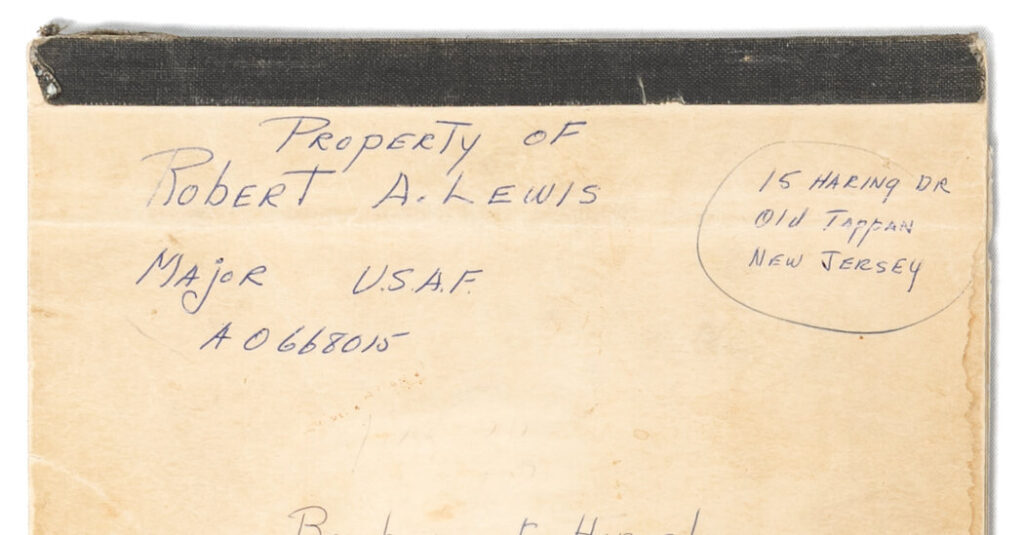
I was quizzing one bookseller for newsy tidbits when he broke off to steer me toward a colleague’s display at the booth of Whitmore Rare Books, from Pasadena, Calif. And there I saw it, in a glass case — an old War Department navigation pad with browned and scribbled pages headed “Property of Robert A. Lewis Major U.S.A.F.” Below the heading was written:
“Bombing of Hiroshima.”
“Aug. 6 – 1945.”
The consignor, Dan Whitmore, extracted the pad gingerly and leafed through the pages for me. It was a logbook kept by Lewis, co-captain of the Enola Gay, the U.S. Air Force plane that dropped the first atomic bomb in warfare. The bomb, “Little Boy,” killed an estimated 140,000 Japanese people, mostly civilians. Three days later, a second bomb, dropped on Nagasaki, killed another 60,000 to 80,000 people and brought the end of World War II. No official death toll was ever established.
The pages were filled with Captain Lewis’s handwritten account of the Hiroshima bombing.
And there was a New York Times connection — the log had handwritten edits made by William L. Laurence, one of the first science reporters at The Times and twice a winner of the Pulitzer Prize. Alone among the press, he had been handpicked by Lt. Gen. Leslie R. Groves of the Manhattan Project, and secretly approved by the managing editor and the publisher, to bear witness to the smashing of the atom and its ghastly debut in war.
Laurence (known as Atomic Bill to distinguish him from William H. Lawrence at The Times) had retired in 1964, the year I started, but his exploits were well known. Over the years, I had often paused at our paper’s Pulitzer Prize displays to gaze at his image and marvel at his scoops.
But there were things I didn’t know.
Laurence, an elfin figure often pictured in wrinkled fatigues and splashy ties, died at 89 in 1977. Since then, examinations of his life and career have yielded a more troubling legacy, exposing conflicts of interest and complicity in military disinformation. Laurence was paid for his work on the Manhattan Project and wrote false denials of the hazards of atomic radiation. After the war, he took pay from the urban planner Robert Moses to promote the 1964 World’s Fair.
The Enola Gay diary had been Laurence’s idea. After failing to get aboard the Hiroshima-bound B-29, he had prevailed on Captain Lewis, the mission co-captain under Brig. Gen. Paul Tibbets Jr., to keep a record from takeoff on the Pacific island of Tinian through the six hours to the target and the six hours back. For much of the mission, according to his log, Captain Lewis took notes in the dark and “half way through I ran out of ink.”
Captain Lewis originally wrote of Laurence: “He had expected to be aboard but this request was not permitted.” Laurence crossed out Captain Lewis’s words and wrote: “He had been ordered to be aboard but arrived in Tinian too late.”
Why the edit, which was hardly concealed? One published account suggests that General Groves may have vetoed Laurence’s presence. According to Whitmore’s research, Laurence expected the account to be made public.
As it turned out, Laurence didn’t need Captain Lewis’s diary. He got on the Bockscar, which bombed Nagasaki three days later. Laurence, who was detached from the newspaper to work on the Manhattan Project, an arrangement The Times later disclosed on its front page, won his second Pulitzer for his articles about the bombings. He also wrote an article aiding General Groves’s campaign to suppress the truth that atomic radiation was deadly.
In 1971, Captain Lewis, who was then managing a candy plant in New Jersey, auctioned the logbook to a rare-book dealer for $37,000 (around $300,000 today). From a back wall at Parke-Bernet Galleries, Captain Lewis himself followed the bidding. He died in 1983 at 65.
The log was acquired by Malcolm Forbes, the publisher of Forbes magazine, in 1978. Since then, according to the Whitmore catalog, it has been sold at auction twice more, most recently in 2022 for $543,000.
Whitmore now was offering it for $950,000.
This was a piece of history I did not expect to encounter as I sauntered through the Antiquarian Book Fair. And now that I think of it, one too fraught to celebrate as a lucky find.
In the logbook, as the Enola Gay approached its target, Captain Lewis wrote, “The bomb is now alive and it’s a funny feeling knowing it’s right in back of you.”
The diary continues: They released the bomb and the crew witnessed a “terrific” flash. The plane shuddered, “and there in front of our eyes” — Captain Lewis wrote, adding three exclamation points — “was without a doubt the greatest explosion man has ever witnessed.” Hidden from view was the deadly radiation that would kill many who survived the blast.
Shortly after the bombing, the gravity of the mission appeared to weigh on Captain Lewis. “My God,” he wrote, “what have we done.”
The post A Reporter’s Accidental Encounter With Atomic History appeared first on New York Times.