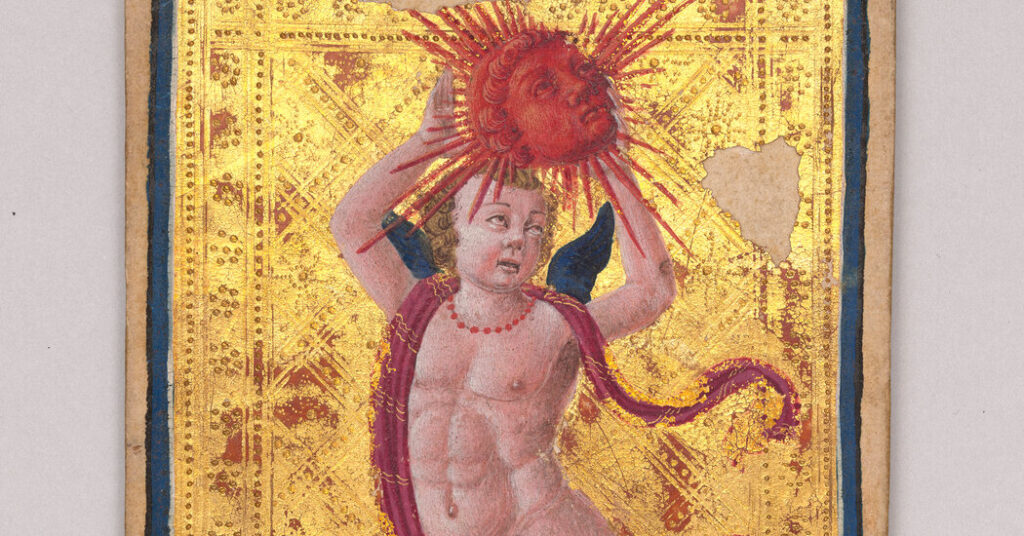
Around 1442, the Duke of Milan gave his daughter a deluxe set of handcrafted playing cards for the courtly game of tarot.
The cards, featuring meticulously illustrated figures like Death, the Chariot and the Emperor on gold- and silver-leaf backgrounds, were created by a renowned Renaissance workshop. They cost about 1,500 ducats, 10 times the annual salary of an average courtier.
Before its use in spiritual divination, tarot was a card game played by Italian nobility — mostly women — and each card was a hand-held work of art.
The Morgan Library & Museum in New York is presenting surviving cards from that tradition in “Tarot! Renaissance Symbols, Modern Visions.”
The show explores the 600-year evolution of tarot from a game to an occult practice and popular entertainment, from those early gilded exemplars through decks made by artists including Salvador Dalí, Leonora Carrington and the contemporary British painter Chris Ofili.
The show demonstrates that tarot cards are, perhaps above all else, an artistic and intellectual form of expression, created initially by leading artisans of 15th-century workshops, then later rediscovered and reinvented across the centuries.
“These are actually, front and center, really exquisite works of art,” said Joshua O’Driscoll, senior curator and department head of Medieval Renaissance manuscripts for the Morgan, who curated the show with Claire Gilman and Frank Trujillo.
The show also taps into a popular current tarot fascination, which has grown since the coronavirus pandemic, said Gilman, who mentioned new decks, like the Pulp Tarot, the Black Power Tarot and RuPaul’s Drag Race Tarot.
Gilman, the Morgan’s curator and department head of modern and contemporary drawings, added that today’s spike in interest is just one of tarot’s periodic resurgences, which occurred amid the late-19th-century British Occult Revival, the era of European Surrealism, and as part of the worldwide cultural upheaval of the 1960s.
“Each of these periods shares certain common conditions, namely a distrust of our societal institutions, and distrust in rational and masculinist ways of thinking,” Gilman said.
In their original form, tarot cards were used for a game played a bit like bridge, O’Driscoll said, but the concept of the game was partly inspired by Petrarch’s “Triumphs,” a 14th-century allegorical poem that set out moral hierarchies.
“Chastity defeats Love, Death defeats Chastity, Fame defeats Death, Time defeats Fame,” he explained. “The last one is Eternity, which defeats them all.” Along with teaching morality, “it was a game of the intellect,” he said. The word “trump,” which was used in the game, he noted, comes from the Italian word “trionfi,” or “triumph.”
Very few full sets from the early tarot years survived, but some cards from the most prized Renaissance decks — the Visconti de Modrone, Brambilla and the Visconti-Sforza — are the basis of the exhibition.
The game was probably used as a fun Humanist teaching tool for the Italian elite, O’Driscoll said, and it became a popular game for others as well.
After about 200 years, however, it went out of fashion. “By the time the occultists saw it, it had lost its tie to the game,” O’Driscoll said.
In 18th-century France, a few occultists fabricated an origin story for the cards, linking their symbols to Egyptian hieroglyphics, because they were both considered to be mystical and indecipherable image-based languages.
Although the story was invented out of whole cloth, this shift altered the course of tarot’s history, giving it its persistent esoteric aura.
The set that popularized tarot cards for divination in the English-speaking world was the Rider-Waite-Smith set, created in 1909 by the artist Pamela Colman Smith, under the direction of Arthur Waite. Waite, a poet and scholarly mystic, wrote an accompanying guidebook, “The Key to the Tarot.”
Waite was a leading figure in the Modernist occult movement known as the Golden Dawn, whose adherents included the poet William Butler Yeats and Bram Stoker, the author of “Dracula.” The key thinker behind the tarot occultist movement was Aleister Crowley, the English magician and author, who made his own deck, the Thoth Tarot.
Gilman said that it was probably Smith’s evocative illustrations, which seem to offer an enchanting range of narrative interpretations, that led to the continuing appeal of tarot in modern times.
“This deck has had a hold on people’s imaginations,” Gilman said.
Most sets today contain 78 cards, including what’s known as Major Arcana — character cards like the Magician, the Hanged Man and the Devil — and Minor Arcana cards including numbered suits, like cups, swords, pikes and pentacles (or coins).
Some people still play tarot as a card game, but others are drawn to the sets as a visual lexicon that invites imaginative narration, in part, Gilman said, because its symbols touch on universal themes.
“Maybe all of these cards apply to all of us, like the World card, or the Death card, and they’re open enough that you can find ways that you connect to them, and you find what you need to in them,” she said.
Tarot! Renaissance Symbols, Modern Visions
The Morgan Library & Museum. 225 Madison Avenue, Manhattan; 212-685-0008, themorgan.org.
The post Tarot Was a Courtly Card Game. How Did It Become a Tool for Divination? appeared first on New York Times.