Good morning. It’s Thursday. Today we’ll find out what a 31-foot Coast Guard vessel was doing in Times Square. We’ll also get details on a New School professor who thought tenure would protect him if he spoke his mind about the university’s efforts to navigate a financial crisis.
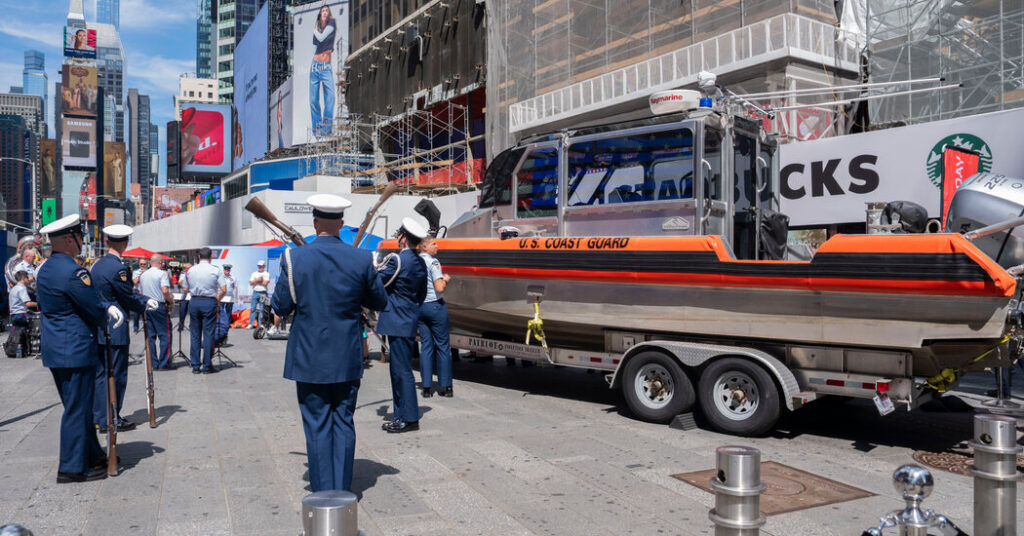
How did a 31-foot-long Coast Guard vessel with twin 225-horsepower outboard engines get to Times Square?
On a trailer, with help.
“They had an escort,” said Philip Walters, a security guard, not long before he lowered the velvety rope cordoning off the boat to allow members of the Coast Guard color guard to march in. Members of the Coast Guard band stood nearby.
They were only a few steps from a table with what looked like flintlock muskets and pistols from the revenue cutter Vigilant, which captured a British sloop that had preyed on American merchant vessels in the War of 1812. A sign noted that the guns were “nonfunctional replicas,” but they had the perfect dull patina of the old days.
The boat, the color guard and the band were there to celebrate the Coast Guard’s 236th anniversary, with an eye to next year and the opening of the National Coast Guard Museum in New London, Conn. It will be an 83,000-square-foot building with display space for more than 600 artifacts, including a Jayhawk helicopter that will hang in the atrium. The museum will also be home to the only active-duty tall ship in the U.S. fleet, the three-masted U.S.C.G.C. Eagle.
The Coast Guard traces its roots to a law that George Washington signed in 1790, and Susan Curtin, the chair of the museum, had told me earlier that the Coast Guard was the only branch of the military without its own museum. So why has it taken this long?
In “the other services, there’s a lot of groundswell and a lot of veterans,” said Wes Pulver, a retired Coast Guard captain who is the president of the National Coast Guard Museum Association. So the association functioned as “a nonprofit to a traditionally underfunded service,” he said, raising money — $58 million from private donations, complementing more than $100 million from the federal government and $28 million from Connecticut.
For Curtin, there is family history in the Coast Guard. Her father, J.D. Power, went on to start the consumer analytics company. First, though, he attended Officer Candidate School at the Coast Guard Academy and ended up on a polar icebreaker, the U.S.C.G.C. Eastwind.
She served in the Coast Guard Reserve while attending college in Massachusetts. Her time as a third-class petty officer began shortly after the Exxon Valdez oil spill in 1989, when roughly 11 million gallons of crude oil poured into waters off Alaska. She was based in Boston as the Coast Guard stepped up attention to environmental problems along the coast.
More recently, as the Pentagon used airstrikes to blow up boats it said were smuggling drugs, the Coast Guard intercepted vessels and captured suspected smugglers for prosecution. That continued the approach that began with Alexander Hamilton, the first secretary of the Treasury, who wanted armed ships to guard the new nation’s ports. The 1790 law authorized 10 of them and a branch of the military that was first known as the Revenue-Marine or Revenue Cutter Service and later the Coast Guard.
For the last 11 years, “Hamilton,” the musical that made Lin-Manuel Miranda famous, has been playing four blocks from where the Coast Guard band was playing in Times Square. But James Brundage, the museum’s director of exhibitions and programs, said as he stood listening to the Coast Guard band that he had never seen “Hamilton” live, only in a performance that was streamed on television.
The Coast Guard was something that Hamilton considered “a pretty significant achievement,” Brundage said. “It was something that he saw as being completely necessary.”
The Revolutionary War had been sparked by a revolt over taxes to Britain, he said, “and then as soon as you have a free country, people say, ‘Now I’ve got to pay taxes to you? I don’t want to do that, either.’ So then what do they do? They smuggle.” With the new federal government struggling to pay off debts from the war, “that’s where Hamilton said, look, we’ve got to find a way to ensure that we’re collecting the duties owed to us.”
Weather
Partly sunny skies, and rain is expected as temperatures near 89. Tonight will be partly cloudy with a low near 76. A heat advisory is in effect.
ALTERNATE-SIDE PARKING
In effect until Aug. 15 (Feast of the Assumption).
QUOTE OF THE DAY
“We may be hearing but not listening.” — Jacek Smolicki, on soundwalking, or taking in the sonic environment in places like Central Park. His microphones reveal a hidden aural universe.
The latest New York news
-
Free day care, big savings: The first 2,000 families selected for spots in the city’s new free child care program for 2-year-olds celebrated the news, dreaming of what the savings would mean. The city estimates that the families will save an average of $26,000 a year.
-
There’s still time for a New York City staycation: The five boroughs have many hidden gems that feel like an escape — and they are easily accessible, affordable and, most importantly, don’t require a hotel stay. Check out these 11 spots that can transport you, without going far.
-
Mom, police official, getaway driver: A high-ranking police official from Westchester County was arrested at her home in the Bronx and accused of driving the getaway car after her 20-year-old son fired a gun at a group of people outside Bronx Criminal Court in June. She and her son were charged with attempted murder and conspiracy.
-
Violations found: Officials inspected 180 construction sites involving firms connected to a Midtown high-rise that became dangerously unstable and found dozens of violations, none of which posed an immediate danger to the public.
-
New Jersey sues Amazon: The state’s attorney general sued Amazon under federal antitrust law, accusing the company of abusing its market power to suppress pay for delivery companies and their drivers who bring packages to customers’ doorsteps.
Tenure didn’t protect him
Sanjay Reddy is a tenured economics professor at the New School who has been openly critical of the way the institution handled a financial crisis brought on by declining enrollments and deficits. He was repeatedly quoted as blaming the problems on bureaucratic bloat and bad real estate deals.
That challenged the official line that the problem was a too-expensive faculty.
Reddy figured that tenure would protect him when the school began a restructuring with layoffs.
It didn’t. My colleague Sharon Otterman writes that Reddy was one of 19 professors who were laid off in June, 10 of whom had tenure. Buyouts and early retirements have reduced the full-time faculty to 387 professors, from 430 a year ago. Sixty-eight other staff members were also let go in June.
Reddy’s case was “particularly concerning,” according to a letter signed by more than 300 professors from across the country. The lead signatory is Joseph Stiglitz, the Nobel Prize-winning Columbia University economist.
Reddy stood out because he was the only economics professor who was terminated. His department is not among roughly two dozen programs that are being closed or redesigned. He said he was stunned when he was told to choose between stepping down by July 1 and signing a nondisclosure agreement in exchange for 11 months’ severance, or being terminated. He chose the second option, with his last day to come in December.
The provost, Richard Kessler, declined to comment on Reddy’s situation, citing privacy rules. But he said that the university had determined that the economics department “has more teaching capacity than we have need for.”
Reddy said he felt that allowing him to speak his mind was “what tenure is for.” And his criticism was “within my professional competence as an economist.”
METROPOLITAN diary
‘Let’s Go, Rangers!’
Dear Diary:
In spring 1974, my father and I were walking back to our car after attending a Rangers game at Madison Square Garden. We had a 90-minute drive home to Fishkill ahead of us, and I planned to skip school the next day.
In the distance, we heard a woman’s voice chanting: “Let’s go, Rangers!”
As we got closer, the voice began to sound familiar.
“Let’s go, Rangers!”
From behind, I saw a small, compact figure yelling at the top of her lungs: “Let’s go, Rangers!”
Then she turned around.
“Ms. Racheter!” I shouted.
It was my 11th-grade English teacher. I did not miss school the next day.
— Peter Charkalis
Illustrated by Agnes Lee. Tell us your New York story here and read more Metropolitan Diary here.
Good to be back. See you tomorrow. — J.B.
Davaughnia Wilson and Ed Shanahan contributed to New York Today. You can reach the team at [email protected].
Sign up here to get this newsletter in your inbox.
The post Why a Coast Guard Boat Came to Times Square appeared first on New York Times.