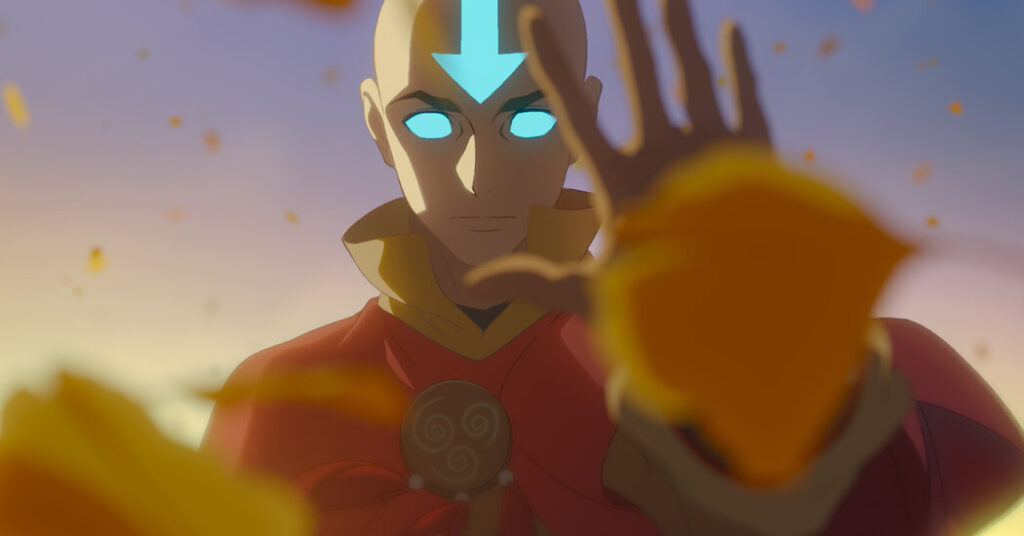
There’s something about the longevity of the “Avatar: The Last Airbender” (“ATLA”) franchise that is perfectly in step with the animated series’s hero figure, the Avatar. The acclaimed Nickelodeon show, created by Michael Dante DiMartino and Bryan Konietzko, takes place in a civilization in which select people can telekinetically manipulate one of the four elements: water, earth, fire and air. In this fantastical universe, the Avatar, a master of all four elements and meant to bring balance to the world, is reincarnated in a new form each lifetime. From 2005 to 2008, over the course of three beautifully written and illustrated seasons, the Avatar was Aang, a 12-year-old boy who spends 100 years frozen in ice and, after awakening, goes on to end the long-running war among nations.
The new animated film “Avatar Aang: The Last Airbender,” which has been the most watched movie on Paramount+ since its premiere in late July, arrives at a time when it feels like the Avatar universe is expanding in all directions, in various forms. As Netflix tries to replicate the magic of the original in a live-action series and DiMartino and Konietzko work on the next animated Avatar series, “Avatar Aang” snugly slots itself in the gap. At a time when many long-running franchises are fighting fatigue, the new film demonstrates a simple path to success: by serving its audience, by continuing the mythology with the original characters who fans have come to love and by doing so in the original format with the original creators.
When “ATLA” concluded in 2008, the franchise kept expanding with very mixed results. In 2010, M. Night Shyamalan directed a live action adaptation that was enthusiastically and soundly panned for both its lack of authenticity to the original and its erasure of the Asian and Indigenous heritage of its characters. Then in 2012, the original show’s creators returned with an animated sequel series. Though it took place in the same world, the series had a markedly different vibe with a brash, adolescent female Avatar navigating a more modern steampunk world. Though that show, “The Legend of Korra,” was more polarizing than the original, the sequel still had a loyal following of fans who admired the boldness of the series’s new chapter and its representation with an openly queer protagonist.
In 2024, Netflix tried its hand at another live-action adaptation, and though it cleared the low bar set by Shyamalan’s horrendous film, this entry couldn’t replicate the heart and humor of the original. The second season, which premiered last month, received a dismal drop in viewership compared with its first.
Like many other franchises, the broader Avatar universe also includes comics, novels and games; another animated sequel series, “Avatar: Seven Havens,” about an earth-bending Avatar and her twin sister, is scheduled to premiere in 2027. Oftentimes this kind of sprawl can be to a franchise’s detriment. Compare the heydays of great franchises like the Marvel Cinematic Universe, Harry Potter and Star Wars with where they are today: Too many sequels, spinoffs and reboots can create a case of diminishing returns, where early fans may feel alienated from the characters and stories that drew them to the fandom in the first place.
The new animated film “Avatar Aang” is full of fun, propulsive action punctuated with the same brand of levity that gave the original series its charm. The fight scenes have lift and movement with background animation that’s exquisite in detail, color and scope.
In the story, which takes place about a decade after the events of the original series, the peace among nations that Aang helped to achieve and the symbol of that success, the newly formed Republic City, are at risk of attack by a dissident group of non-benders looking for a sacred artifact that can shift the current balance of power. While Aang, with the help of his reliable teammates — Katara, Sokka, Toph and Zuko — races to find the artifact, he encounters another air-bender who’s been entrapped in ice for centuries and also dreams of reviving the long gone air-bender culture.
The original “Avatar” series expertly explored the repercussions of war: genocide, imperialism, class warfare, displacement. “Avatar Aang” follows along the same lines by exploring what happens when the so-called balance achieved postwar still leaves some groups of people disadvantaged. The non-benders resent living in a society in which bending abilities are synonymous with privilege and power. And in that sense the Avatar is the epitome of privilege.
“Avatar Aang” also continues to expand on the beautifully built character development within the series. The original series already believably showed the growth of its main character, a silly, sometimes immature 12-year-old boy unsure of his abilities, into a fighter and leader who still keeps true to his pacifist ideals. Now “Avatar Aang” presents a self-assured young man, more comfortable shouldering his responsibilities as Avatar, yet still holding on to lingering trauma and guilt from his childhood. For all of Aang’s success in ending a war and building peace, his feelings of isolation as the last of his kind are still a central part of his character. Even in a time of harmony among the nations, more than ever he worries about the legacy of his people and whether it will be forever lost after his death.
So “Avatar Aang” succeeds both as a stand-alone film and one that stays true to the “ATLA” identity, while allowing the franchise to continue to grow. The movie connects the brand back to its beginnings, while creating a steppingstone for viewers to revisit the characters and find a new entryway back into the world. There has been plenty of evidence lately that this is not the easiest thing to pull off. As long as the creators have the opportunity to expand the Avatar universe in line with their creative vision, it seems possible that the Avatar cycle can be truly eternal and stand as a lesson to franchise bloat.
The post ‘Avatar Aang: The Last Airbender’ Shows How to Beat Franchise Fatigue appeared first on New York Times.