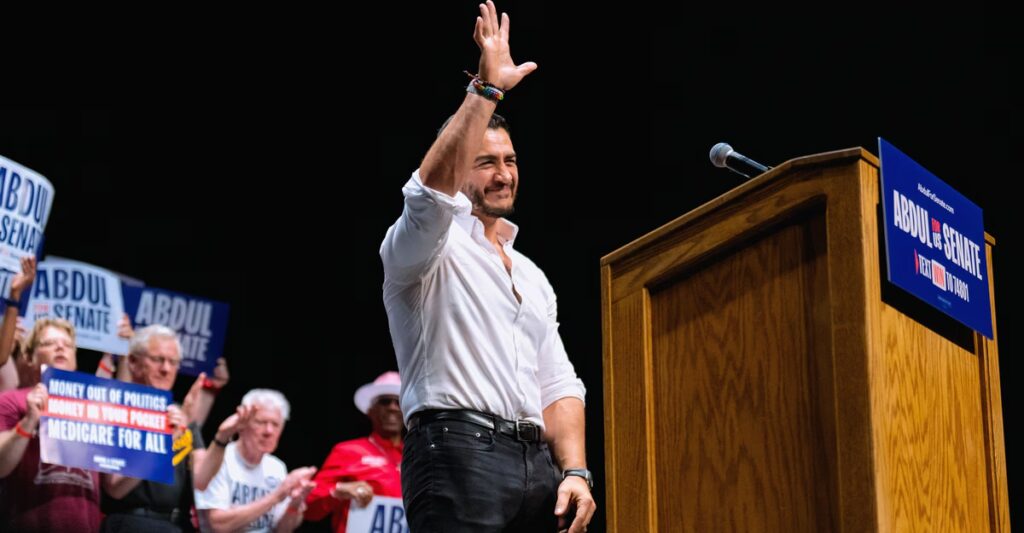
The Michigan Senate candidate Abdul El-Sayed made the customary call for unity after a hard-fought primary against a fellow Democrat. “Always magnanimity in victory,” he told a packed crowd of supporters, adding that “however much we might disagree with our Democratic opponent, there is so much more that unites us than divides us.”
But just minutes earlier, one of his most famous endorsers was pushing a much different message. “Everyone being like, Abdul has a fuck-ton of work to do mending bridges, here’s the fucking take-nuke for you, okay? You are all unbelievably Islamophobic pieces of shit,” Hasan Piker, the provocative left-wing Twitch streamer El-Sayed has embraced on the campaign trail, told some of his millions of followers. Piker went on to challenge would-be holdouts in the party to back El-Sayed: “Do you want to fucking win or not?”
Democrats in Michigan do, in fact, want to win in November, but they find themselves in a predicament over how to get everyone on board. El-Sayed, a progressive, eked out a victory over the more moderate Haley Stevens in a historically expensive and high-profile showdown between the party’s insurgent and centrist wings. The closeness of the race—El-Sayed led by about one point when the AP declared him the victor this morning—surprised many people, given that a number of polls showed the 41-year-old doctor with a double-digit lead over the four-term congresswoman.
The narrow margin of victory has, predictably, sparked a blizzard of thoughts about what lessons Democrats should garner from El-Sayed’s victory as the party barrels toward November. The candidate has suggested that he doesn’t plan to moderate his platform; he ended a news conference this morning by giving a version of his campaign slogan, asking Michiganders to join a “movement to get money out of politics, so we can put money back in pockets and finally guarantee the promise of health care through Medicare for all.” At the same time, he insisted that Democratic harmony would be crucial in the face of what he predicted would be an onslaught of negative attacks from his Republican opponents.
Senate Minority Leader Chuck Schumer and Senator Kirsten Gillibrand, chair of the Democratic Senatorial Campaign Committee, were happy to comply. They endorsed El-Sayed’s candidacy this morning, praising his “energetic campaign.” (Both had originally endorsed Stevens.) Michigan State Senator Mallory McMorrow, who ended her bid for the Democratic nomination last month, announced her support for El-Sayed last night before the race had even been called. Stevens also added her endorsement this morning. But much of the common ground ended there. The takes on what El-Sayed should do and the lessons the party should learn from his victory are so abundant in part because the stakes are so high. Democrats will struggle to recapture the Senate if they do not win the race in Michigan.
Adam Green, a co-founder of the Progressive Change Campaign Committee, told us that El-Sayed’s win “sends a signal to every other Democratic politician in America that you can cross very powerful interests and still win if the people are on your side.” Green suggested that El-Sayed didn’t need to perform some grand pivot to appeal to general-election voters who may be skeptical about his leftist views. “We believe that Abdul El-Sayed and candidates like him are more electable in a general election because we’re living in an outsider moment and people in all political parties and independents want someone who will shake up a broken system, not be a creature of it,” Green told us.
Asked about Green’s comment, another Democratic strategist, who requested anonymity to be frank, was, well, frank. “What the fuck is he talking about? Now you’re pushing an ideological agenda, and not trying to win,” the strategist said, before addressing El-Sayed himself. “You clearly need to pivot,” this person said. “A lot of the people in the party don’t like you!”
The returns highlighted clear vulnerabilities for the new nominee. El-Sayed performed well in highly educated, mostly white and affluent communities, including some of Michigan’s college towns, while trailing Stevens in some working-class areas and Black neighborhoods. Adam Jentleson, a former Democratic Senate leadership aide, posted on X that El-Sayed begins the general election as an underdog. He predicted that the Democrat would underperform his polls “because a lot of normie Dems are voting against him,” and added that El-Sayed should try to win over these folks by being “a little less rigidly left-wing, and a little more heterodox.”
El-Sayed said today that the primary would “pale in comparison to the cynicism” that would come from his Republican opponent, former Representative Mike Rogers, and President Trump during the general election. That prediction seemed to come true just hours later, as the National Republican Senatorial Committee released its first ad of the general election. “Abdulrahman Mohamed El-Sayed—the most radical Senate candidate in America,” the ad’s narrator begins, casting away any sense of subtlety before going on to link the Democrat to the Muslim Brotherhood and describe him as “too dangerous” for Michigan. (The ad uses the full name of the candidate attempting to become the nation’s first Muslim American senator at a time when some Republicans have been fomenting Islamophobia.)
[Read: The Republican who wants to banish his own constituents]
Michigan continues to swing between Republicans and Democrats—Trump won the state in 2016 and 2024. The president wasted no time weighing in on El-Sayed’s victory this morning, calling him a “Communist loser who hates Jews and Israel.” El-Sayed ran as an unabashed critic of Israel and AIPAC, which spent tens of millions of dollars backing Stevens. Trump predicted that, with El-Sayed, the “Dumocrats crazy policies will only get worse” and called his win “Great news for the Republican Party.”
Lis Smith, a Democratic operative who advised McMorrow in the primary, told us that El-Sayed should focus on broadening his coalition, adding that she felt “he has not tried to do that one iota during this primary.” Rogers, who ran unopposed, came just about 20,000 votes shy of winning a Senate seat in 2024. El-Sayed bashed Rogers last night and this morning, aiming to cast him as an avatar of the corporate elite that has raised prices and left everyday Michiganders struggling. He also tied Rogers closely to Trump, who polls show is unpopular in the state.
[Read: America’s most divided state loves its extremes]
The call for Democratic unity is a new one for El-Sayed. He’s shown no hesitation about blasting the party as he pursued its nomination, telling a group of young voters last month that “the Democratic Party brand right now is so bullshit.” El-Sayed also used his primary victory to attack politics as usual—clearly implying that Democrats have been engaged in it for far too long.
Although El-Sayed’s victory was the main event this week, several other races across the country complicated the idea that the Democratic Party has been seized by the progressive movement. In Missouri, former Representative Cori Bush lost handily to Representative Wesley Bell, the moderate who originally ousted her from her seat two years ago. In Washington State, centrist incumbent Marie Gluesenkamp Perez beat back a challenge from the left to win a primary for a district Trump carried in 2024. Moderate Democrats in Virginia prevailed in two key congressional primaries while left-leaning candidates claimed victories in two congressional primaries in Michigan.
The murkiness of the results show the party stuck in a state of tension. Joel Payne, a Democratic strategist whose organization, MoveOn, endorsed El-Sayed, told us that although the process appears chaotic, it is necessary for a party trying to redefine itself and recover from traumatic losses in 2024. “Democrats tried an era where we swept things under the rug and we tried to sort things out before it got in front of voters,” he said. “That doesn’t work. We’re in a different era.” Instead, he advised, the party needs to openly “have the fights, let it get messy, and then put it back together on the back side.”
Things in Michigan are certainly messy. Now El-Sayed and his fellow Democrats need to put it back together over the next 13 weeks if Democrats hope to win back the Senate in November.
The post Abdul El-Sayed’s Next Big Challenge appeared first on The Atlantic.