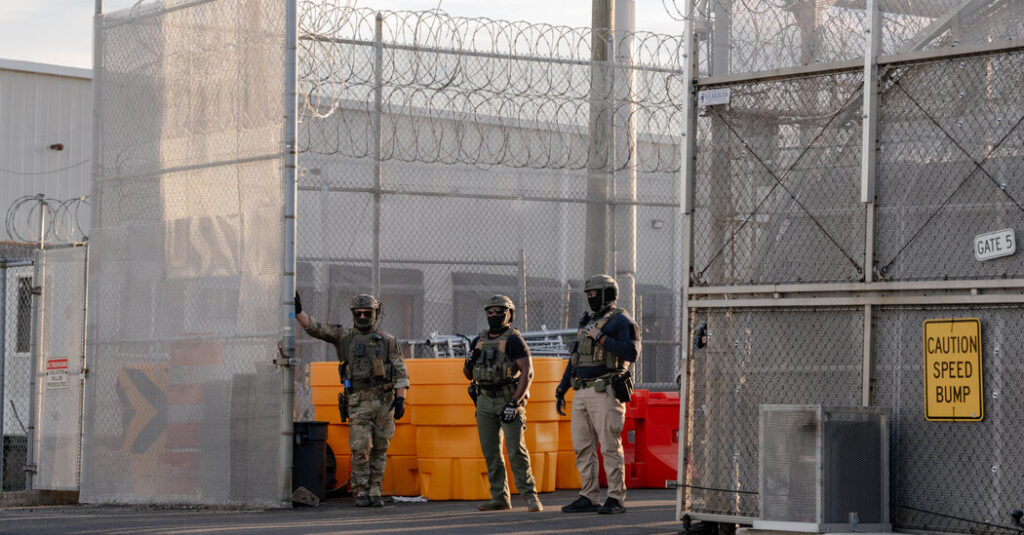
The death of a Salvadoran man who had been incarcerated at the Delaney Hall detention center in Newark has renewed scrutiny of the living conditions inside the federal government’s migrant holding cells.
Edwin Lopez-Cornejo, 41, was taken from Delaney Hall to University Hospital in Newark, where he was pronounced dead on Saturday. Government officials have not said how he died, and his family members have demanded answers about the circumstances that led to his death. On Wednesday afternoon, the Department of Homeland Security said that New Jersey hospital officials and the state medical examiner would provide medical records to his relatives.
Here is what to know about Delaney Hall:
What is Delaney Hall?
Delaney Hall opened in 2000 as a halfway house providing 250 beds for offenders serving jail terms of less than one year. From 2011 to 2017, the federal Immigration and Customs Enforcement agency used Delaney Hall to hold up to 450 immigrant detainees. It was then used as a drug rehabilitation center and halfway house until 2023, when it was closed. It reopened in 2025 as an ICE detention center as part of President Trump’s plan to deport more migrants. Today, the center has 1,000 beds.
How does Delaney Hall operate?
The detention center is run by Geo Group, one of the largest private prison operators in the United States, under a $1 billion, 15-year federal contract.
The center incarcerates immigrants who were arrested by ICE or its parent agency, the Department of Homeland Security.
Who is detained at Delaney Hall?
The people jailed inside Delaney have a broad and complex mix of immigration statuses. Some entered the United States illegally, while others overstayed their visas, which is a civil, not a criminal, offense. Many have legally applied to live in the United States and are awaiting the outcome of their cases as the Trump administration works to dissolve pathways to citizenship.
ICE officials have described the people inside Delaney Hall as killers, rapists and other criminals — “the worst of the worst.” But the federal government’s own data, including some from internal documents that The New York Times obtained in June, indicates that people with criminal convictions account for a relatively small fraction of the detainees at the center. The internal data obtained by The Times showed that of 591 people held at the time, 76 — about 13 percent — had criminal convictions, and 123 — about 21 percent — had pending criminal charges.
What do we know about the conditions inside?
Health inspection reports, court filings and other public records reviewed by The Times provided some of the first documented evidence of conditions inside Delaney. Migrants had complained for months about unsafe meals, dirty living quarters and bad medical care.
The documents reviewed by The Times validated some of those complaints. Inspectors found food-preparation surfaces that had been left unsanitized. In other instances, workers had touched open garbage containers as they made meals and had not kept food at temperatures necessary to kill harmful contaminants.
Dr. Novneet Sahu, the deputy commissioner of Public Health Services at the New Jersey Health Department, received a complaint in May from a physician about a detainee with an active case of tuberculosis. The physician said that an employee at University Hospital had told her that the inmate was brought to the hospital and taken back to Delaney with no follow-up plan to contain the infection.
Dr. Sahu said that the Health Department had tried to inspect Delaney Hall’s infection-control protocols and practices but was repeatedly rebuffed. The attorney general of New Jersey sued to force the center to allow state health inspectors inside. The suit is pending.
Why can’t members of Congress get full access?
Under federal law, members of Congress should have full access to Delaney Hall but they have sometimes been impeded by federal authorities. Democratic lawmakers have criticized ICE officials and pressed for more access.
A federal appeals court in May required the Trump administration to allow lawmakers to inspect immigration detention facilities without advance notice, ruling unanimously that the visits posed minimal problems for the government.
Representative Frank Pallone Jr., a Democrat from New Jersey, wrote a letter in July urging Markwayne Mullin, the homeland security secretary, to “take immediate action” to carry out a comprehensive review of conditions inside Delaney and to share a plan to fix the problems there.
The Department of Homeland Security has dismissed concerns about conditions at Delaney Hall and said that politicians were “inciting violent riots” by demonstrators who have gathered for weeks outside the detention center as complaints from detainees have mounted.
Why can’t family members access detainees’ medical records?
Days after the death of Mr. Lopez-Cornejo, his family members appeared before news cameras and said that Delaney Hall officials had refused to provide his medical records. The family demanded the documents and urged state officials to investigate Mr. Lopez-Cornejo’s death.
Mr. Lopez-Cornejo’s relatives have expressed concern that he might not have been getting the medication he needed to treat his diabetes and epilepsy, echoing longstanding complaints from detainees at Delaney and other detention centers about inadequate medical care.
A spokesman for Geo Group directed questions about Mr. Lopez-Cornejo’s medical records to ICE, which did not respond to inquiries. The Department of Homeland Security referred questions to hospital officials and the state medical examiner, who the agency said would “release the medical record to the next of kin.”
A law firm listed in a court filing as representing Mr. Lopez-Cornejo in a case that challenged the federal government’s right to detain him did not respond to a request for comment.
Why is Delaney Hall such a flashpoint?
The detention center has been the focus of protests for months and has renewed concerns about migrant holding cells across the United States.
Critics of Mr. Trump’s immigration crackdown say that the detention centers are being used to detain too many people too hastily, leading to overcrowding, maltreatment and abuse. The White House and its supporters say the centers are essential to the effort to deport undocumented immigrants.
In New Jersey, a robust and tightly knit collection of volunteer groups has shaped a media campaign using messages from detainees, publishing their handwritten letters.
The movement has garnered support from influential religious figures, including Cardinal Joseph W. Tobin, the Roman Catholic archbishop of Newark and friend of Pope Leo XIV.
The post Death Renews Scrutiny of Delaney Hall. Here’s What to Know. appeared first on New York Times.