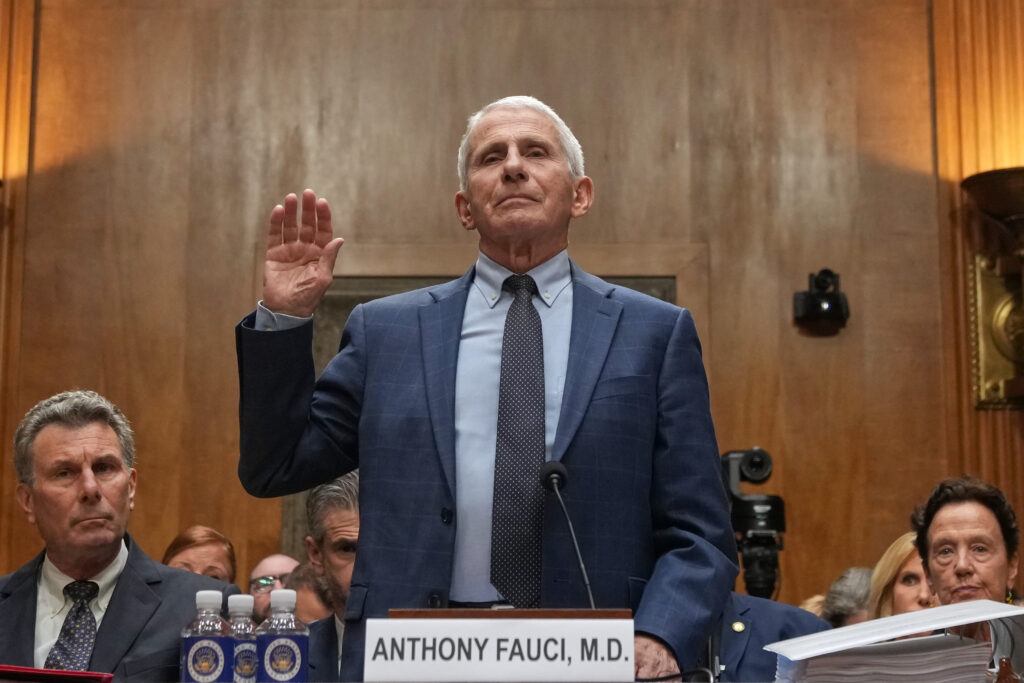
The top U.S. government scientist during the coronavirus pandemic could soon be facing criminal charges. A Republican-led Senate committee is scheduled to vote Thursday on whether to hold Anthony S. Fauci in contempt of Congress, which could lead to prosecution from the Justice Department.
“That is obstruction of a congressional investigation,” Sen. Rand Paul (R-Kentucky) said in a statement after Fauci invoked his Fifth Amendment right not to answer questions in a hearing last week. Paul is seeking to portray Fauci as maintaining a cover-up of the origins of the pandemic.
A wide array of health officials and scientists think Republicans in Congress are overstepping by focusing on Fauci in a way that damages readiness for the next pandemic.
“Scientific research and evidenced-based public health are under attack by the Trump Administration and its allies in Congress,” reads a letter signed by 155 scientists and doctors supporting Fauci. “They are waging a war on individual scientists, through public harassment, arrests, criminal indictment, and ongoing threats of prosecution.”
So why is there so much heat on one person, years after the pandemic ended? Here are a few theories.
Get The 5-Minute Fix in your inbox
Fauci was the voice of authority during an emerging threat
When the virus that causes covid-19 spread rapidly across the globe, it had never before been seen in humans.
For months, Fauci would appear alongside President Donald Trump and other government officials and share the latest of what officials knew and what they advised Americans to do to stay safe. Out of that came advice to social distance, to mask, to close schools and, eventually, to get vaccinated.
But because scientists were learning about the novel coronavirus alongside the rest of the world, they didn’t know with certainty what advice to give to stay safe, said Jennifer Kates, director of the global health policy program at KFF.
“People wanted certainty and safety, and public health officials were doing their best but not always getting it right,” she said. “In an emerging pandemic, you can’t have all the answers.”
Public health experts say Fauci deserves credit for trying to communicate in real time the latest on the virus.
“Fauci became the public face of science under extraordinarily difficult circumstances. In a rapidly evolving situation, with ever-changing data, he fought to maintain credibility for himself and for science,” Stefano Bertuzzi, head of the American Society for Microbiology, wrote in a letter to Congress. “Presenting evolving evidence honestly is not inconsistency, it is integrity.”
For some, Fauci had too much authority
Many on the right saw a widespread effort during that time to enforce what one man said. Some social media companies, in an attempt to stop the flow of misinformation, would delete posts that countered Fauci. The recommendations made by the federal government had lasting impacts: Schools across the country closed for months or years.
“Dr. Fauci was elevated to a role where whatever he said would go,” said Ryan Long, with the conservative-leaning Paragon Health Institute, “and that anyone who countered anything he said would be labeled as anti-science.”
Long and others say that raises legitimate questions about what Fauci knew about the virus and how he communicated it, questions that can help better inform what to do in the next pandemic.
Public health experts agree that studying how scientists communicated during the pandemic can provide lessons for how to better convey uncertainty in the next one. But many see an undue focus by Republicans on one person.
“I think he’s a convenient target,” said Jeanne Marrazzo, who led the National Institute of Allergy and Infectious Diseases after Fauci and now heads the Infectious Diseases Society of America. She said Fauci built an “empire” of public health funding during his 40-plus years of service and loved being in front of the camera communicating the science.
“He is larger than life,” Marrazzo said. “But there are consequences when you fly very high to the sun, and you are everywhere, and you become the public face of pretty much everything. You risk becoming a target when something bad happens because everybody is always looking for something to blame.”
There’s an election coming up
In 2020, Trump lost reelection, partly due to his handling of the pandemic. Now there’s an election in a few months where Republicans could lose control of one or both chambers of Congress.
Fauci’s supporters see Republicans trying to wield voters’ residual anger about the pandemic to create and punish a villain in time for the next election.
Fauci has been a target on the right for years. As The Washington Post’s Dan Diamond reports, Fauci has been blamed for myriad pandemic-related policies, including decisions that others made but he amplified, such as the Centers for Disease Control and Prevention’s recommendation to stay six feet apart to minimize virus risks.
A former Fauci aide was arrested in April after he privately bragged about concealing emails, stoking alarm among public health experts about the extent to which the Trump administration may be going to villainize Fauci.
“When I ran the Covid response for the White House, the buck stopped with me. And the President,” Ashish Jha, the covid adviser for President Joe Biden, posted on social media recently. “We didn’t blame government scientists (even when they gave advice I didn’t agree with) if things went wrong.”
“I think politics, not science, is the driving factor for why we’re rehashing this,” Kates said. “We should be preparing for the next pandemic rather than looking back for blame.”
Amber Phillips writes The 5-Minute Fix newsletter, a quick analysis of the day’s biggest political news. Send her an email here, or ask a question that could be featured in an upcoming newsletter.
The post Why there’s so much heat on Anthony Fauci right now appeared first on Washington Post.