Christine Liverpool considered sending her daughter, Cadence, to a private day care center in Queens this fall, but it was too expensive at $1,500 per month. She decided to keep her at home with relatives while she works as a New York City bus driver.
Then on Tuesday, Ms. Liverpool received an unexpected gift: one of the first seats in the city’s new free child care program for 2-year-olds.
“When they told me I got accepted, I kind of wanted to cry,” she said. “That was a burden lifted off of me.”
Next month, Cadence will be among 2,000 children to enter the program, known as 2-K, which is starting in four communities. The families selected for the coveted spots — based in part on a lottery with 5,700 applicants — celebrated the news, dreaming of what the savings could mean for their lives.
Child care is often a family’s largest expense after housing and can cost from $20,000 to $50,000 a year in New York. The city, which already offers free preschool for 3- and 4-year-olds, estimates that the 2-K program will save families an average of $26,000 a year. Mayor Zohran Mamdani, who campaigned on an affordability platform, has promised to eventually provide free care for all children from 6 weeks to 5 years old.
The city plans to add 10,000 more 2-K spots next fall. The program could eventually include more than 50,000 2-year-olds.
Ms. Liverpool learned about 2-K from a friend who sent her a video of Mr. Mamdani promoting it. The day care center where Cadence was placed is close to her home in South Jamaica and open until 6 p.m., and Ms. Liverpool hopes the financial relief will help her save for college.
“It’s literally down the block from me,” she said. “I was praying she’d get into that one.”
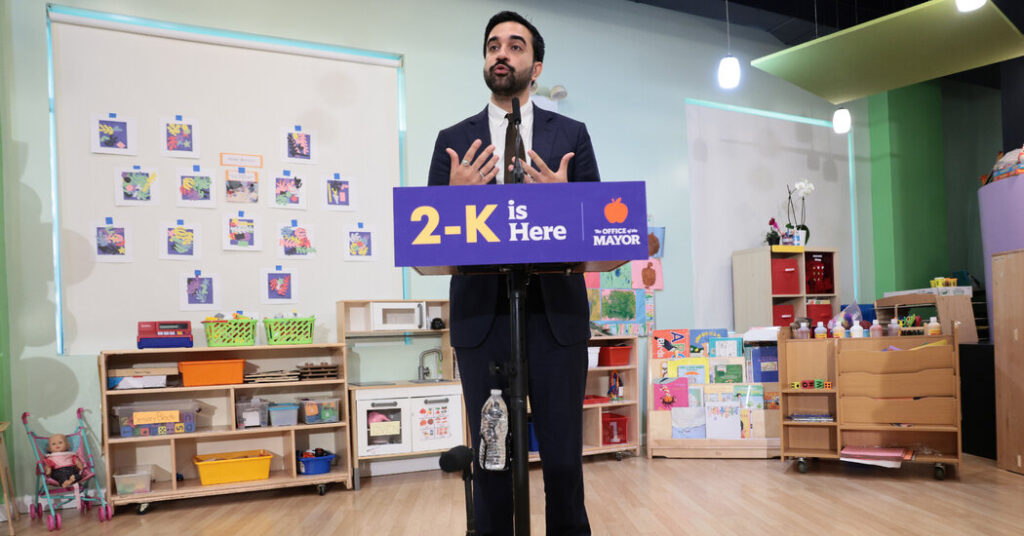
Mr. Mamdani announced the 2-K offers at a day care in the Bronx with Gov. Kathy Hochul, who helped start the program with $1.2 billion in state funding. But the mayor and the governor, both Democrats, are at odds over how to pay for the expensive expansion in the coming years.
Mr. Mamdani wants to raise taxes on New Yorkers who earn more than $1 million per year. Ms. Hochul has firmly resisted that idea.
They struck a tone of unity on Tuesday, and Mr. Mamdani sidestepped a question from a reporter about whether he still wants to tax the rich.
“I think the most important thing is that we fund programs like this,” he said. “What has truly been an incredible experience is having a partner at the state level in Governor Hochul, who is committed to that outcome.”
The application numbers show “serious demand” for the program, said Elliot Haspel, a senior fellow at the think tank Capita who wrote a book about child care policy.
Most of the new 2-K seats are full-day and full-year, a major difference from 3-K and pre-K, which typically end at 2:30 p.m. and are sometimes closed over the summer. City officials said they chose diverse neighborhoods that showed a need for affordable child care, but were not exclusively low-income areas.
Families who apply can list day care centers in order of preference. Children who live in the districts that offer 2-K or have a sibling in the day care where they are applying get priority, and then offers are decided by lottery.
Lauren Rosenberg was excited to get a free 2-K seat for her son in the Inwood neighborhood of Manhattan. But the day care center was not her first choice, and she posted a message in an online parent group asking if anyone knew anything about it.
“He’s my baby, and I want to feel comfortable with the place I’m sending him,” she said in an interview.
Ms. Rosenberg, a freelance art management consultant, hopes the program will allow her to work more.
“I feel a huge sense of weight off my shoulders that I have this option available to me,” she said. “It feels like a real financial gift for our family. The past few years have been challenging.”
Other families were not so lucky. Diana Christopher, a mother of 1-year-old twins who lives in Washington Heights, did not get a spot and was added to some wait lists.
“It is devastating,” she said. “We were really kind of banking on them. If nothing changes, we’re looking at $30,000 in child care just for part time.”
There is often movement on wait lists. Some families might not accept their offers if they choose to stay at their current day care or move away. Others have already paid deposits for private programs, which can complicate the decision to accept a free spot.
Ms. Christopher, an occupational therapist and a member of the group New Yorkers United for Child Care, which has pushed for the expansion, said she was happy for the families who did secure seats.
“Just because I didn’t win the lottery, it’s still absolutely necessary,” she said.
The post Free Day Care Spots Lift a $26,000 Burden for These N.Y.C. Families appeared first on New York Times.