Political candidates greedy for power are often parsimonious with information about what they would do with it. And voters currently being exhorted to participate in electing a new Congress might reasonably wonder: Why bother? Presidents govern, Congress spectates. Nevertheless, here are three commitments voters might seek from those currently seeking House or Senate seats.
First: When the Congressional Budget and Impoundment Control Act of 1974 was passed, the national debt was less than $500 billion. It is almost certain to reach 80 times that sum — $40 trillion — next month. It has become normal for the federal government to run nearly $2 trillion budget deficits even during full employment and steady economic growth.
So, ask candidates about Warren Buffett’s five-minute solution: “I could end the deficit in five minutes. You just pass a law that says that anytime there’s a deficit of more than 3 percent of GDP, all sitting members of Congress are ineligible for reelection.”
Buffett’s measure is Madisonian. He understands, as Saint James did, that it is not love, it is incentives that make the world go round. But a law might not suffice. Buffett’s plan would effect a change in qualifications for the House and Senate, so a constitutional amendment would be necessary. Fine. Ask the candidates if they would support one, and if not, why not.
Second: About 99.9 percent of Americans would be startled, or bemused, or both, to learn that they are living during 53 national “emergencies.” (The count is from the Brennan Center for Justice at New York University School of Law.) These have been declared by presidents whose powers are enhanced by invoking the National Emergencies Act of 1976.
Some of these declared emergencies have become long in the tooth: Six were declared in the previous century. In a recent hilarity, the current president said his tariffs respond to the “emergency” of a national trade deficit. This continuous 50-year fact — a.k.a. something normal — has coincided with soaring national prosperity, but is an “emergency.” Go figure.
Candidates should be asked to commit to making life more restful by making emergencies less numerous and persistent. Specifically, they should commit to legislation that says a declaration of emergency shall expire after 30 days unless there is a joint congressional resolution extending it.
Third: Congress was the arena for the great national debates of the 19th century — about manifest destiny (westward expansion), “internal improvements” (canals, railroads, etc.), and slavery (especially its status in territories not yet states). As Jay Cost of the American Enterprise Institute writes, the thunderous speeches of Congress’s “Great Triumvirate” (Daniel Webster, Henry Clay and John Calhoun) and others were national events, made so by being published in newspapers nationwide.
Late-19th-century Congresses were, however, as Cost says, corrupt and parochial. So, “reformers had good reason for moving power to the executive branch.” But, he says, this went too far.
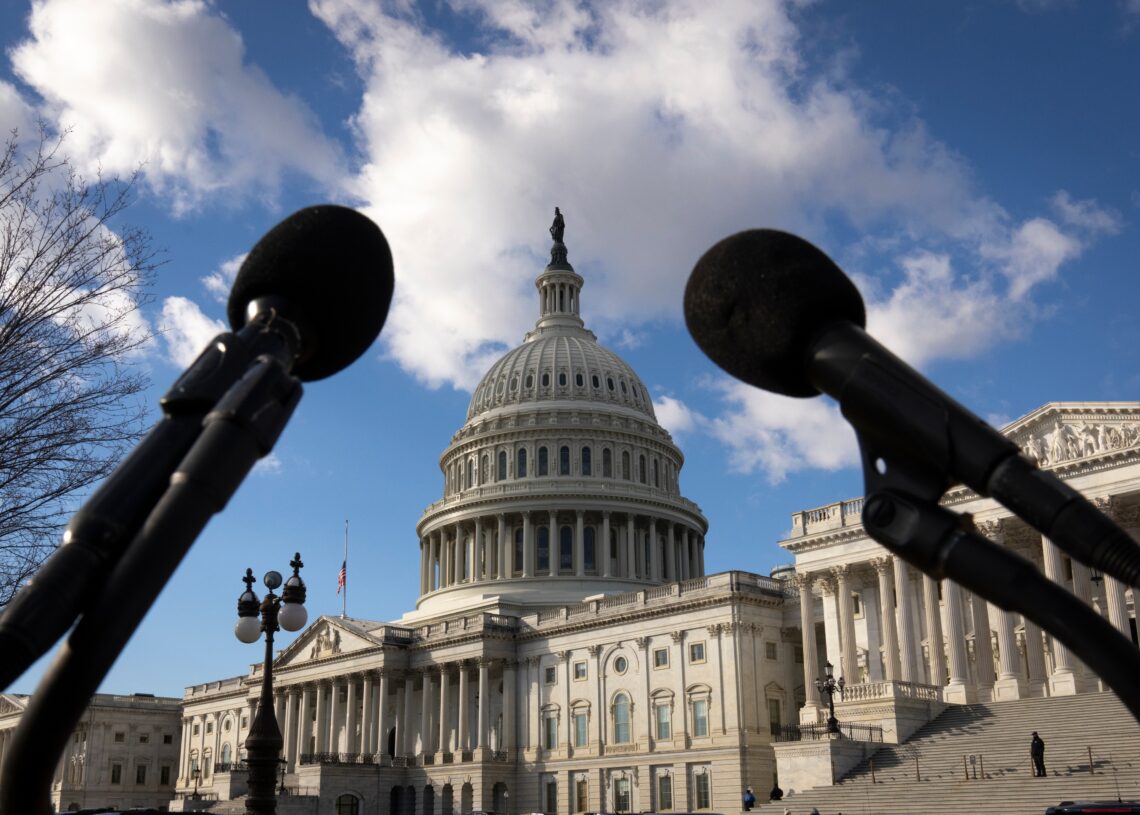
Cost, who cares more about Congress than many of its members seem to, writes: “If you have ever been to Washington, D.C., it is easy to appreciate just how much the city’s designers wanted you to notice Congress.” The Capitol sits on a hill, where the city’s four quadrants converge. In 1910, Congress passed height limits on the city’s buildings: the width of their street, plus 20 feet (about 12 stories). Congress’s prominence suits its constitutional preeminence — it creates all executive departments and all federal courts other than the Supreme Court.
Today’s national debates focus on the White House 16 blocks west of Congress, or across First Street from Congress, in the Supreme Court. Congress no longer even controls most federal spending: Beginning with Social Security (1935), then Medicare and Medicaid (1965), the federal budget has become primarily (approximately 60 percent) a distributor of entitlements — transfer payments.
It could begin to reverse its diminishment by involving itself with federal regulations that compel substantial private sector spending. Years pass, but the Regulations from the Executive in Need of Scrutiny Act does not. It would require Congress’s approval of “major” regulations, defined as those with an annual impact on private sector entities of at least $100 million.
If a candidate will not commit even to this small step toward resurrecting the legislative branch’s involvement in actual governance, it is fair to ask him or her this: Are you sure you want to be a legislator? There are other jobs involving less travel and more congenial colleagues. Starbucks is always hiring baristas.
The post Now the midterms begin in earnest. Ask candidates three questions. appeared first on Washington Post.