Finland is preparing for uncertain times ahead. To the east, it is boosting defenses along its 830-mile-long border with Russia, the longest in the NATO alliance. In the north, its soldiers are teaching other Western troops to fight in Arctic conditions.
And in its schools, young Finns are learning to defend another frontline: reality itself.
Educators around the world are scrambling to prepare students for life in the A.I. age, in which deepfake videos — those made or manipulated with artificial intelligence and often designed to deceive — are so good that even global experts struggle to tell what’s real.
Finland may have a big head start. Finns rank among the world’s most media-literate people, in part because educators in the Nordic country of close to six million already teach students how to spot fake news. It’s all part of an effort to teach Finns to think critically, in hopes of strengthening Finland’s democracy and protecting the country from misinformation.
But A.I. may test even the Finnish system.
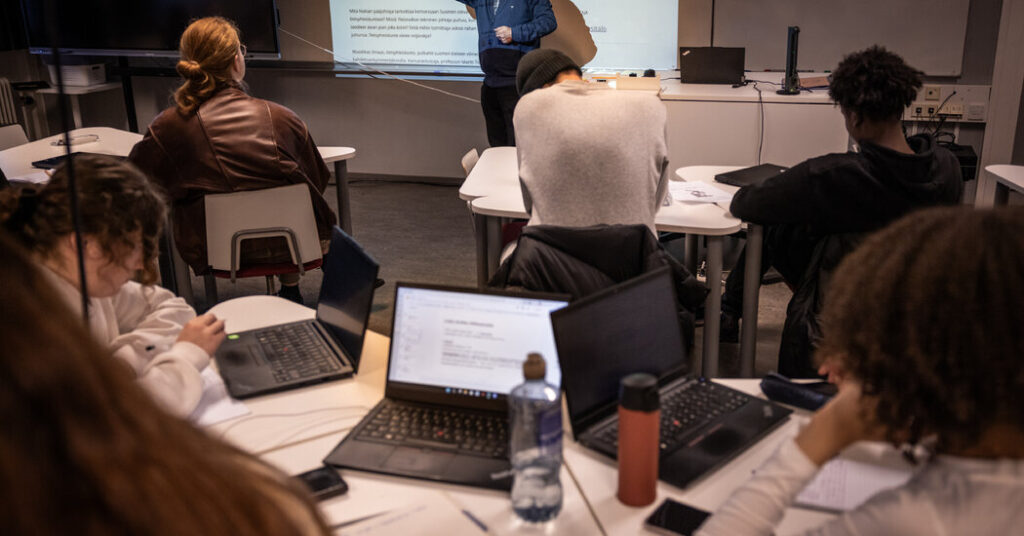
“We’ve been learning about deepfakes even before the A.I. boom,” said Olli Malankin, a 20-year-old graduating senior at the Helsinki Upper Secondary School of Media Arts, in the Finnish capital, who had just come from a social studies class focused on the dangers of trusting A.I. “That’s getting all the more harder since A.I. is getting better all the time.”
A giraffe playing soccer
Finnish teachers have long taught students to separate fiction from reality even before they have lost all their baby teeth. Efforts to promote media literacy started in the 1950s during the Cold War.
Generation by generation, Finnish teachers have adapted to changes in mass media, preparing students to think critically about information coming over radio waves and in print, and, decades later, through their computers, and now on their phones.
Russia remains one potential threat. As the Kremlin attempts to destabilize the West, it has increasingly turned to hybrid tactics, including cyberattacks, sabotage and disinformation campaigns.
In 2024, American spy agencies concluded that Russia was behind fabricated videos claiming voting fraud. Moscow tried to discredit Armenia’s prime minister online, including with video fakes, ahead of a recent election. In Moldova, it used A.I. to flood social media with fake posts, videos and even fake websites.
“The ideals have been more to empower students with useful critical thinking skills than to react to Russian nonsense,” said Mikko Salo, who leads Faktabaari, a Finnish digital information literacy service.
Teachers like Jaakko Maki try to find ways to make teaching such skills fun. What would be a weird thing for an animal to do, he recently asked his classroom of 11-year-olds in the northern outskirts of Helsinki. Where would you probably not see a big cat? Or an elephant?
The students fed their answers into an A.I. tool on their tablets. It produced surprisingly realistic pictures. And suddenly, their wildest ideas appeared before them.
There, a tiger, piloting a plane. Is that a giraffe kicking a soccer ball?
Mr. Maki wanted to show the kids how easy, and sometimes delightful, it is to “bend reality.”
“The idea was to imagine and create something that doesn’t exist or couldn’t happen,” he wrote in an email.
A national security tool
Officials see media education, and now A.I. literacy, as a key civic skill that is part of the country’s national security strategy and its broader approach to protecting its democracy.
It is still a work in progress. Last year, Finland released guidelines to help promote the safe use of A.I. They are broad, and there is not yet a national curriculum. Teachers handle lessons at their own discretion. Some, like Mr. Maki, use loose guidelines laid out by Faktabaari, the digital fact-checking organization.
A main goal, experts and officials said, is teaching young Finns to think for themselves. If Finns can trust that their neighbors understand the news, the theory goes, they will trust they are making decisions with the same set of facts. So, they’ll be harder to confuse and manipulate, and their society will be harder to rip apart with fake news.
“Media literacy is a basic civic skill, but it’s also a basic democratic skill,” Anders Adlercreutz, Finland’s education minister, said.
It fits into Finland’s whole-of-society readiness approach. The country’s defenses also include universal male conscription, crisis preparedness updates and bomb shelters beneath Helsinki that house playgrounds and even swimming pools, frequently with the country’s aggressive neighbor in mind.
Finland has become a bigger target for Russia since it joined NATO three years ago after decades of military nonalignment, the Finnish government warned in a report in March. But, analysts said, Finland has not faced the same level of Russian influence efforts, including disinformation, as other countries that have invested less in defending themselves.
“Finland is a very hard target,” said Martha Turnbull, the director of the hybrid influence team at the European Center of Excellence for Countering Hybrid Threats in Helsinki, citing in part Finland’s skepticism about fake news.
Swiping right on reality
As the focus has turned to A.I., Aki Saariaho, a teacher in the Helsinki area, is turning to a quiz in the style of the Tinder dating app, in which users swipe right or left on a photo, to teach about its risks. It gives students a few seconds to guess if a picture is real.
The photos from 2024 can be obvious: A fuzzy picture of a policeman holding a beer looks clearly wrong. But the 2025 round is harder. A.I. has improved so much in just a few years that the hints could be as subtle as a too-short shadow — or just a strange vibe.
A picture of a street at night that showed signs with what looked like Chinese characters appeared real.
It was wrong.
That’s the point of the swiping exercise, said Mr. Saariaho, who also advises Faktabaari. It’s not to teach students how to spot the deepfakes. Instead, it’s to show them that, increasingly, they can’t tell the difference.
“The base issue is learning critical thinking,” he said.
Being able to use A.I. as a tool instead of being taken in by it could be the most important skill young people need to thrive in today’s world.
“School is the last place where we reach the whole population,” Mr. Saariaho said. “We need to teach the core things that you need to learn for the rest of your life.”
After a recent media literacy lesson at the school where Mr. Saariaho teaches, a group of friends compared notes. One student, Annabelle Maijala, said she thought she had good radar for A.I., but she acknowledged that she had recently been duped.
The culprit: a video of bunnies on a trampoline. The backyard looked like a real backyard. The bunnies bounced like real bunnies. She at first thought it was real. Nope.
“I was really shocked,” said Ms. Maijala, 16, laughing. That, alone, was a useful learning opportunity, she said.
Her friend, Sonja Alanko, 17, was one of several students who said she could see the ties between their old classes and new challenges: “I apply the same lessons that I had on fake news and on media literacy to A.I.,” she said.
She’s already starting to look deeper into TikTok videos that seem really out there.
With just a few more clicks, either to check out the influencer’s social media page or just search for the source of the information, she can often get a better sense of the trustworthiness, she said.
“I learn from it,” she said. “Now, I think, I trust myself more.”
The post Finland Tries to Protect Children Against Deepfakes, With Russia in Mind appeared first on New York Times.