On the first day of my summer vacation, I stepped out of our Chicago hotel into a thick, orange-tinted haze that shrouded the city’s skyline. Almost instantly, my throat started burning.
In what was shaping up to be a summer of relentless travel disruptions, my family had managed to jump, almost literally, out of the frying pan and into the inferno. Like much of Western Europe, Geneva, where we live, had been hit by brutal heat waves, with temperatures soaring to nearly 104 degrees Fahrenheit. As I boarded my flight in mid-July with my husband and children, ages 1 and 4, wildfires were tearing through France, Spain, Portugal and Italy. Upon arriving in the United States, we discovered that large expanses of Canada were in flames, sending clouds of smoke into the United States, engulfing, among other places, Glenn, Mich., a small town on Lake Michigan, where we were headed.
As a travel reporter for The New York Times, I had spent the past year covering the travel meltdowns caused by numerous events: the war in Iran, airport chaos, sky-high prices, heat waves and fires. When it came to my family’s summer vacation, I was reluctant to go far. But the Michigan trip was important because our son had not yet met his grandmother, and the convergence of his first birthday and her 80th seemed like a milestone worth traveling for.
Smoky Skies and Fierce Storms
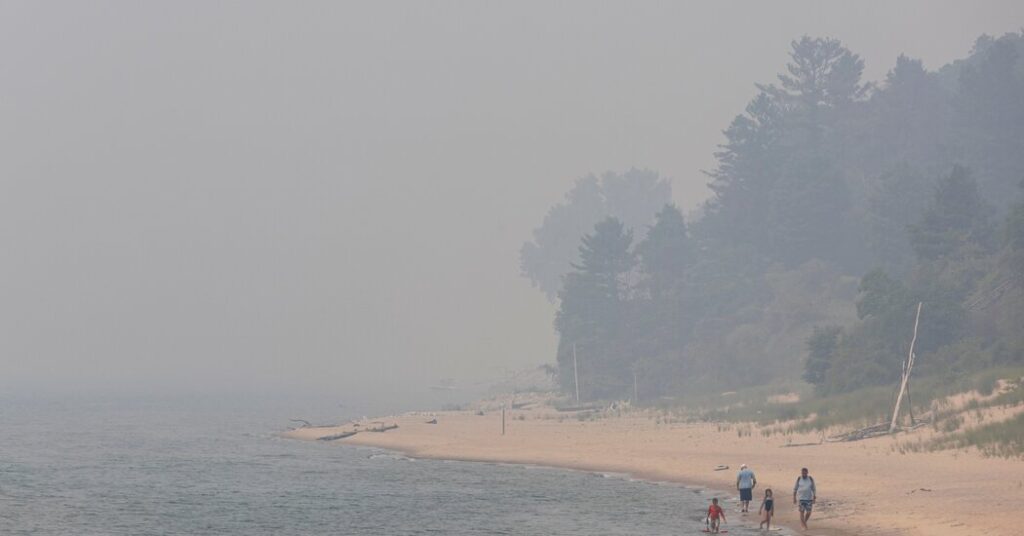
Smoke blanketed the freeway throughout our three-hour drive to Glenn. When we reached my mother-in-law’s cottage on Lake Michigan, a murky haze blocked the view. We hurried the children inside. Instead of the beach day I’d promised my daughter, air quality forecasts warned of “hazardous” conditions, forcing us to stay indoors.
Reality hit when my husband’s cousins arrived the next day bearing air purifiers. Trapped inside with the windows sealed tight, disappointment turned into agitation. My husband took our anxious daughter on a grocery run to break up the day, while I researched indoor activities.
Deep in rural Michigan with no shopping malls nearby, our best refuge was the Holland Aquatic Center, a half-hour drive away. We headed there that afternoon, finding it surprisingly uncrowded. Floating in a lazy indoor river in the middle of summer felt surreal, but the facility became our salvation over the next six days.
When visibility finally improved a few days later, it offered a false sense of security — the Air Quality Index remained above 100, which was still unsafe for young children.
Cooped up indoors, my husband and I confronted the harsh reality of climate change. Canadian wildfires have become more severe and widespread in recent years, affecting not just Canada, but much of the northern United States. In Europe, heat waves are getting longer, hotter and more frequent, with 24 out of 30 severe episodes recorded after the year 2000 until 2023, according to the Copernicus Climate Change Service, a branch of the European Commission. This year, the first of four severe heat waves started in May in Western Europe with temperatures reaching 113 degrees Fahrenheit in parts of Spain and Portugal.
Memories of our own childhood summers with carefree days spent on the beach contrasted sharply with our current struggle to protect our children. We wrestled with our own carbon footprint, questioning whether we should have flown my mother-in-law to Europe instead of the four of us flying to the United States. Or maybe we should have all stayed put.
When the air quality improved to moderate, we ventured to the beach for brief intervals. My husband even took my daughter out on his kayak and recreated a scene from Disney’s “Moana.” But during a walk, a tickle of smoke in my throat triggered a wave of panic.
That night, my husband and I decided to change our flights and leave early. Then we learned that severe storms would make it impossible to fly out the next day.
The storm came overnight with fierce winds and rain, but it cleared the smoke and we woke up on my son’s birthday to safe air. We threw my mother-in-law and son an outdoor party, and spent the next few days at the beach.
A $3,168 Fee and 7 Tornados
The night before our flight home, my son developed a 104-degree fever, forcing a 3 a.m. trip to the emergency room. After eight hours of tests and waiting, it became clear we’d miss our plane. I spent over an hour on the phone with Swiss airlines, expecting a routine rebooking of our “changeable-with-a-fee” tickets, only to be slapped with a $3,168 charge to push the flight back 24 hours. (Thankfully, we had purchased travel insurance.)
Once my son was discharged, we drove to Chicago for an overnight hotel stay before our flight. Every remaining step of the trip felt like an uphill battle, so it didn’t help matters to find that, at 5 p.m., we had to wait over 45 minutes for a crib. When I requested bed rails for my daughter, they simply handed them over, saying they had no idea how to install them. By 8 p.m. we were all in bed, exhausted.
We had planned to do some morning sightseeing, but then came the next setback: a violent thunderstorm, accompanied by a tornado warning. (Later, we would learn that seven tornadoes struck the city.)
But while many flights were delayed or canceled, ours was still scheduled, so we waded into the chaos at Chicago O’Hare, where endless lines of stranded passengers were scrambling to rebook. Thanks to my Star Alliance Gold status, we bypassed the initial mob, only for the agent to reveal our rebooked tickets hadn’t been issued.
And just like that, we were ushered back into a long line of passengers with “issues.”
Juggling luggage and children, we waited over an hour while an agent struggled to reissue our tickets, followed by another hour in the security line. We were finally called to board at 10 p.m., but at the gate I looked through a window and noticed something ominous: The lights of the plane were off. Our flight had, after all, been canceled.
As angry passengers targeted the agents, my husband and I went into battle mode, putting all our energy into finding a place for the children, delirious with exhaustion, to sleep. Nearby hotels were booked, but at the Loews Chicago O’Hare Hotel, my husband pleaded our case, offering to pay whatever it took for a reserve room. After a tense deliberation, we were offered a room for $700.
While the children slept, we huddled in the bathroom over our phones, searching for flights. Then, miraculously, I received an email from Swiss saying we had been rebooked through Copenhagen. The journey would be longer by six hours, but at that point it seemed like a minor hurdle.
At Home, at Last
In Copenhagen, we were met with a massive security line caused by the new entry-exit system, which has created significantly longer processing times across European airports. While inching forward in the zigzagging line, my daughter said, “Mommy, my tummy is hurting.” Then, suddenly, she vomited. When we got back from the bathroom, I begged the security agent to let us go to the front of the line. Other passengers shouted at us, saying they had 20 minutes to make their connection, but when I pointed to the pool of vomit my daughter left behind, their snarling ceased.
After a short, uneventful flight from Copenhagen, we were back in Geneva at last, only to be greeted with temperatures over 100 degrees: The fourth heat wave in Western Europe since May had just arrived.
Is the summer vacation as we once knew it dead? After my experience, the answer seems much clearer.
Follow New York Times Travel on Instagram and sign up for our Travel Dispatch newsletter to get expert tips on traveling smarter and inspiration for your next vacation. Dreaming up a future getaway or just armchair traveling? Check out our 52 Places to Go in 2026.
The post Heat, Fire and Airport Chaos: My Summer Vacation Nightmare appeared first on New York Times.